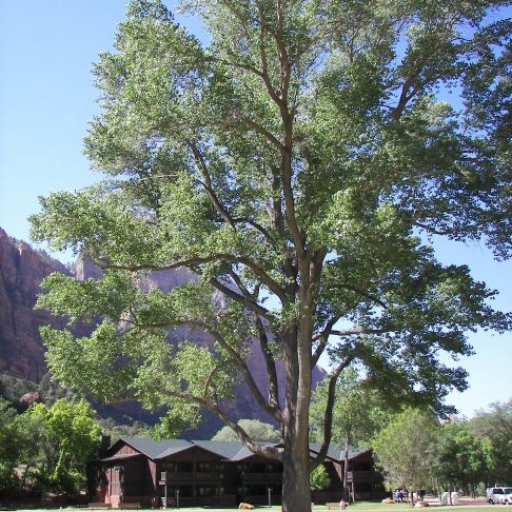
Plant Overview
Named after the 19th-century explorer John C. Frémont, this iconic tree is often called the "Emerald of the Desert." It is the majestic backbone of riparian corridors across the American Southwest, providing a lush, green sanctuary in arid landscapes. Its leaves are famous for their restless "shimmering" sound, which sounds remarkably like a distant mountain stream.
🔍 How to Identify
- 🍃 Leaf Shape: Look for broad, heart-shaped (deltoid) leaves with coarsely scalloped edges. They are a vibrant green in summer and transform into a brilliant, glowing gold during the autumn months.
- 🌳 Bark Texture: Younger trees have smooth, silvery-white bark. As the tree matures, the bark becomes deeply furrowed with thick, corky ridges and a dark gray hue.
- ☁️ The "Cotton": In late spring, female trees release thousands of tiny seeds attached to silky, white fluff. These drifts of "summer snow" can carpet the ground near the base of the tree.
🏡 In Your Garden
- 💧 Water Obsession: This is an "obligate riparian" plant, meaning it naturally grows where its roots can reach the water table. If you plant one, it requires deep, regular watering—it will not thrive in a xeriscape or dry backyard without assistance.
- 🏗️ Space and Roots: This tree grows incredibly fast, sometimes several feet a year, but its roots are opportunistic. Never plant a Fremont Cottonwood near a septic tank, pool, or sidewalk, as the roots will aggressively seek out moisture and can lift concrete or clog pipes.
- 💨 Wind Management: Because the wood is relatively soft and fast-growing, it can be brittle. It’s best to plant it in a spot where falling limbs won't damage structures during heavy windstorms.
⚠️ Safety & Toxicity
- 🐾 Pet Safety: The Fremont Cottonwood is considered non-toxic to horses, dogs, and cats. It is a safe choice for properties with curious animals.
- 🤧 Allergen Alert: While the "cotton" is often blamed for allergies, it is actually the invisible pollen from the male trees in early spring that causes hay fever. The cotton itself is just the transport for seeds!
✨ Fun Fact
🏜️ The Desert Compass: For indigenous peoples and early pioneers, a line of Fremont Cottonwoods on the horizon was a literal lifesaver; because these trees require constant water, their presence always signaled a hidden spring or an underground creek in the middle of the desert.

Detailed Care Instructions
Here are some steps to help you grow Populus Fremontii, also known as the Fremont Cottonwood:
- Climate and location: Fremont Cottonwood trees thrive in moist, riparian habitats with full sun exposure. Make sure you have the appropriate space and conditions for the tree to grow.
- Seed collection: If you have access to mature Fremont Cottonwood trees, you can collect fresh seeds from the female catkin-like structures that contain cotton-like fluff. Collect enough seeds for your desired number of trees.
- Seed preparation: Soak the collected seeds in water for 24 hours to help soften the hard outer shell and promote germination. This step is important as the hard shell might prevent water and air from reaching the embryo.
- Germination: After soaking, plant the seeds in a pot or seed tray filled with a well-draining soil mixture. The seeds should be covered with approximately half an inch of soil. Keep the soil moist and place the container in a warm and sunny location. Germination can take anywhere from a few days to a few weeks.
- Transplanting: Once the seedlings have grown to a few inches in height and have developed strong roots, they can be transplanted into larger pots or directly into the ground. Choose a well-draining soil location for planting. Ensure that the tree has enough space to grow because they can reach heights of up to 80 feet (24 meters).
- Watering: Fremont Cottonwoods are drought-tolerant once established, but when young, they require regular watering to help them establish a strong root system. Keep the soil consistently moist but not waterlogged.
- Maintenance: Mulching around the base of the tree will help retain moisture and suppress weed growth. Prune the tree to remove any dead or diseased branches, and shape it as desired. Avoid pruning heavily during the dormant season as it may increase the susceptibility to diseases.
- Protection: Young Fremont Cottonwood trees are susceptible to browsing by rabbits and deer. Protect the trunks with tree guards to prevent damage.
Remember that growing trees from seeds requires patience, as they may take several years to reach maturity and become established. Regular care, water, and attention will help your Populus Fremontii plant thrive.

Place in a bright room that is sun drenched almost all day. Or directly in a south-facing window.

To water this plant, first check the soil moisture level by sticking your finger into the soil up to your second knuckle. If the soil feels dry, it's time to water the plant. Use a watering can or garden hose with a gentle nozzle to water the plant thoroughly, ensuring that the water reaches the root zone. Avoid getting water on the leaves as this can promote fungal growth. Allow the soil to drain completely after watering and avoid letting the plant sit in standing water as this can cause root rot. Water this plant regularly but avoid overwatering which can also cause root rot.
To fertilize this plant, apply a balanced fertilizer with equal parts nitrogen, phosphorus, and potassium. Use a handheld spreader to distribute the fertilizer evenly around the base of the plant. Water in the fertilizer thoroughly after application. Repeat fertilization once every two months during the growing season, which typically runs from early spring to late summer. Avoid over-fertilization, as it can lead to issues like stunted growth, leaf burn, and increased susceptibility to pests and diseases.
The ideal type of soil to use for the Populus Fremontii plant is a well-draining soil that is rich in nutrients. The soil should have a slightly acidic to neutral pH level, between 5.5 to 7.5. The soil should also be able to hold enough moisture to keep the plant healthy but should not be waterlogged or too moist. It is recommended to use soil that is a mix of sandy loam, compost, and perlite or vermiculite for added drainage. Avoid using heavy or compacted soils that are low in organic matter content. Additionally, it is recommended to mulch the soil around the plant to retain moisture and regulate the soil temperature.
One way to propagate this plant is through hardwood cuttings. Collect mature, woody stems from the parent tree and cut them into 8-12 inch lengths. Remove all leaves from the bottom 2-4 inches of each cutting and make a clean, angled cut at the bottom. Dip the bottom of each cutting in rooting hormone and plant them in a well-draining soil mixture, burying the bottom few inches. Place the cuttings in a shaded area and keep them moist, but not waterlogged. After 6-8 weeks, roots should begin to form. Once the roots are well established, the new plants can be transplanted to a permanent location.








