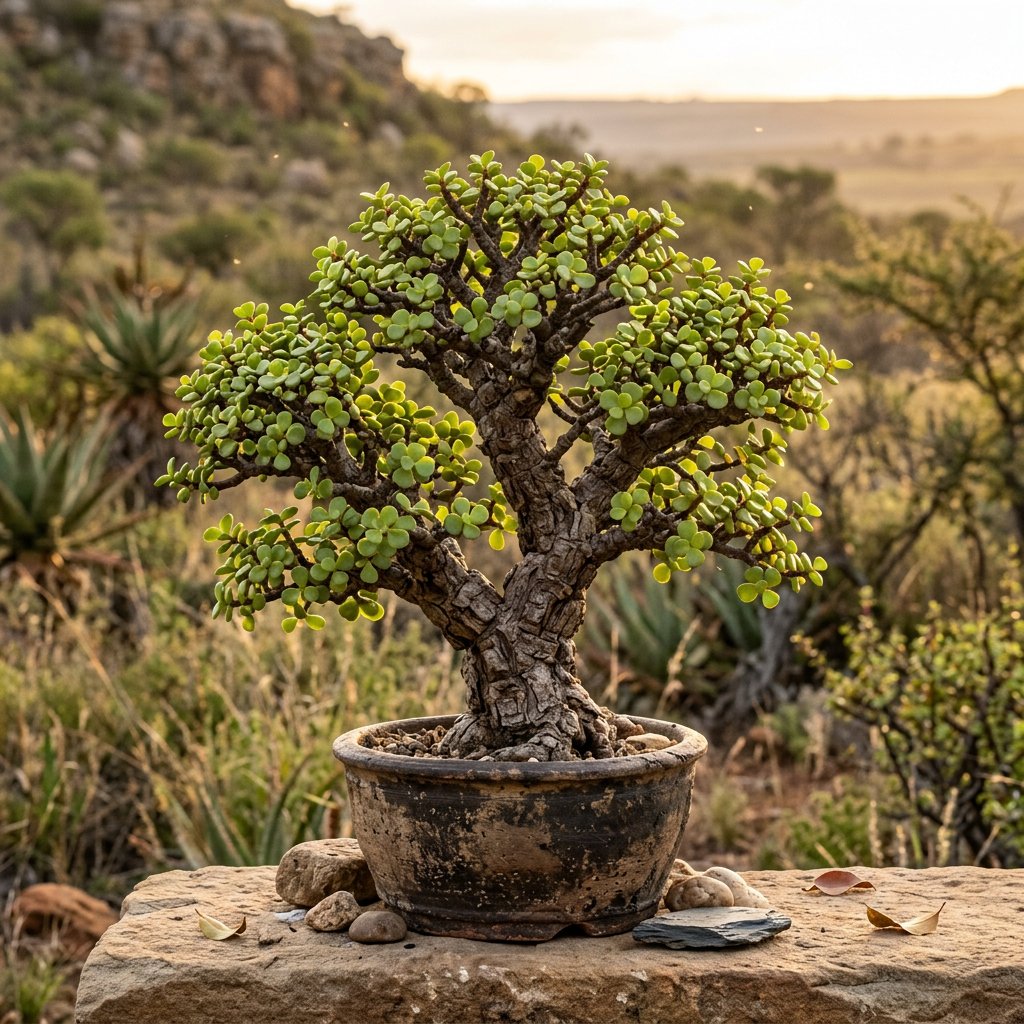
Plant Overview
Known affectionately as the "Elephant Bush" or "Dwarf Jade," this South African native is a darling of the bonsai world. While it resembles the common Jade plant, it is far more resilient and faster-growing, making it the perfect "training tree" for beginners. In its homeland, this succulent grows into massive thickets that serve as a favorite snack for wild elephants, who can consume hundreds of pounds of its sour, juicy leaves in a single day.
🔍 How to Identify
- 🌿 The Trunk: Young branches start as a vibrant reddish-pink, eventually maturing into a thick, corky, greyish-brown bark that mimics the appearance of a centuries-old tree.
- 🍃 The Foliage: Tiny, emerald-green leaves that are round and fleshy. These leaves store water, allowing the plant to survive in harsh, arid conditions.
- 🌸 The Growth Habit: It features a naturally branching structure that responds beautifully to pruning, allowing it to be shaped into classic bonsai styles like "slanting" or "cascade."
🏡 In Your Garden
- 🌞 Light Seekers: To maintain its compact bonsai shape, this plant needs as much light as possible. If kept in the dark, the stems will "stretch" (etiolate), ruining the miniature tree aesthetic.
- ✂️ Pruning & Wiring: The Elephant Bush is incredibly forgiving. You can prune it back hard to encourage new growth, and its branches are flexible enough to be wired into artistic shapes, though they become brittle as they age.
- 🪴 Soil Nuance: It thrives in a gritty, fast-draining bonsai mix. Because it is a succulent, the biggest threat to its health is overwatering, which can lead to sudden leaf drop or root rot.
⚠️ Safety & Toxicity
- ✅ Pet & Human Safe: Unlike the standard Jade (Crassula ovata), which is toxic to pets, the Portulacaria afra is completely non-toxic to cats, dogs, and humans.
- 🥗 Edible Interest: The leaves are actually edible! They have a tart, citrus-like flavor and are often used in salads in South Africa to add a refreshing crunch.
✨ Fun Fact
🌍 The Carbon Sponge: This plant is an environmental superhero. It is exceptionally efficient at carbon sequestration, capable of capturing more carbon from the atmosphere than many species of trees in a similar climate—literally breathing in the world's "trash" to grow its beautiful leaves.

Detailed Care Instructions

Place in a bright room that is sun drenched almost all day. Or directly in a south-facing window.

1. Determine the watering needs of your specific Portulacaria Afra Bonsai plant: The first step to watering your bonsai is to assess how much water your specific plant needs. Some Portulacaria Afra Bonsai plants may require more water than others based on factors such as the climate, the pot size, and the soil type.
2. Water only when the top inch of soil is dry: It is important to avoid over-watering your Portulacaria Afra Bonsai plant to prevent root rot. The best way to water your plant is to check the soil regularly, and only water when the top inch of the soil feels dry to the touch.
3. Water slowly and thoroughly: When it is time to water your plant, water it slowly and thoroughly. This will allow the water to penetrate deep into the soil and reach the roots of the plant. It is important not to rush the watering process, as a quick and shallow watering can lead to dry or unhealthy roots.
4. Use room temperature water: Always use room temperature water when watering your Portulacaria Afra Bonsai plant. Cold water can shock the roots, while hot water can damage the plant. Let the water sit at room temperature for a few hours before watering the plant.
5. Water in the morning: It is best to water your bonsai in the morning, as this gives the plant ample time to absorb the water before the sun's heat becomes too intense. Avoid watering your plant in the evening or at night, as this can lead to fungal growth and other plant diseases.
6. Use a well-draining soil: A well-draining soil is essential for the health of your Portulacaria Afra Bonsai plant. If the soil holds too much water, it can lead to root rot and other problems. Use a soil mix that allows for good drainage, and make sure the pot has drainage holes.
7. Adjust watering frequency based on the season: The frequency of watering your Portulacaria Afra Bonsai plant will depend on the season. In the summer, when the weather is hot and dry, your plant may need to be watered more frequently. In the winter, when the weather is cooler and humid, your plant may require less water.
These plants can thrive without taking help from any fertilizer. However, if the medium of growth is something other than soil for instance sand then you may need to add little fertilizer. The best way to know if your plants need fertilizer or not is to check for yellowing of leaves. If the leaves start to turn yellow it’s fertilizing time.
You may use All Purpose Plant Food or Cactus Fertilizer for your Portulacaria Afra Bonsai
The ideal soil for the Portulacaria Afra Bonsai plant should be well-draining and allow for good airflow. It should also be able to retain some moisture to avoid the plant from drying out. The soil should be porous, and permeable to water and air, with good water-holding capacity. A mix of peat moss, sand, and perlite is ideal for this plant. The pH level of the soil should be between 5.5 and 7.5. Using organic fertilizers and avoiding synthetic fertilizers is recommended to maintain the health of the plant. The soil should also be free from harmful pathogens and diseases that can cause damage to the plant. It is essential to repot the Portulacaria Afra Bonsai plant every two to three years to ensure the soil remains healthy and conducive to healthy growth.
Common pests of the portulacaria afra bonsai include Mealybugs. Make a habit of checking your portulacaria afra bonsai frequently for pests so that any infestations can be caught and managed early.







