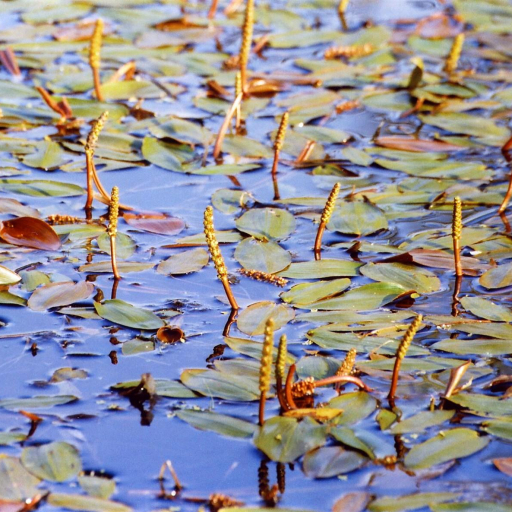
Plant Overview
Often called the Broad-leaved Pondweed, this aquatic perennial is the sturdy architect of the pond world. It is famous for its distinctive oval leaves that carpet the surface of still waters, creating a natural mosaic that provides essential shade and shelter for aquatic life. In folklore, these floating mats were sometimes called "fish blankets," as they offer the perfect hiding spot for young fry escaping predators.
🔍 How to Identify
- 🍃 Floating Leaves: Look for opaque, leathery, brownish-green leaves that are oval or elliptical. They have a characteristic "waxy" sheen that repels water.
- 🦴 The Flexible Joint: A key identification feature is a small, flexible, discolored (often brownish) section at the top of the leaf stalk, just below where it joins the blade. This acts as a hinge to prevent the leaf from snapping in moving water.
- 🌾 Submerged Leaves: Unlike the floating leaves, the underwater leaves are narrow, translucent, and often disappear as the plant matures.
- 🍦 Flower Spikes: In summer, it sends up dense, cylindrical spikes of tiny, greenish flowers that stand vertically above the water line like miniature towers.
🏡 In Your Water Garden
- 💧 Water Management: This plant thrives in still or very slow-moving water. It is a fantastic oxygenator and helps suppress algae by blocking sunlight with its broad leaves.
- 🌱 Rooting Habits: It anchors itself deeply into the mud using creeping rhizomes. Because it is a vigorous grower, it’s best planted in aquatic baskets to prevent it from taking over a small garden pond entirely.
- 🐟 Habitat Hero: If you keep fish, this plant is a must-have; its dense underwater stems provide a safe haven for spawning and protect tadpoles from hungry birds.
⚠️ Safety & Toxicity
- ✅ Safe Status: Potamogeton natans is generally considered non-toxic to humans, dogs, and cats.
- 🏊 Physical Hazard: While not poisonous, it grows very densely. In large wild ponds or lakes, it can create a "tangling" hazard for swimmers or get caught in boat propellers.
- 🐾 Pet Safety: It is safe for pond-dwelling goldish and koi, who may occasionally nibble on the softer submerged parts.
✨ Fun Fact
The Broad-leaved Pondweed is a master of adaptation; that "brown hinge" on its leaf stalk isn't a sign of disease—it’s a biological shock absorber! It allows the leaf to stay flat on the surface even when the water level rises or waves try to flip it over.

Detailed Care Instructions
To grow Potamogeton natans (also known as floating-leaf pondweed), here are some steps you can follow:
- Choose the right location: Potamogeton natans thrives in full sun to partial shade conditions. Make sure you have a suitable location in your garden or pond that receives at least 6 hours of direct sunlight per day.
- Prepare the planting area: If you're growing Potamogeton natans in a pond, make sure the water is a suitable depth for this plant, typically around 24-48 inches. Clear any debris or unwanted plants from the area before planting.
- Acquire the plants: Potamogeton natans is typically grown from seeds or purchased as established plants from a nursery that specializes in aquatic plants. You can also try gathering seeds from established plants in your local pond.
- Planting: If using seeds, sow them at a shallow depth in the soil or substrate of your pond, ensuring they are evenly distributed. If using nursery-bought plants, gently place them into the water and position the roots into the substrate.
- Maintenance: Potamogeton natans requires constant moisture, so keep the water level consistent. Regularly remove any dead or decaying leaves to promote healthy growth. In a pond, you may need to control the growth of the plant to prevent it from taking over the entire water surface.
- Fertilization: Potamogeton natans benefits from occasional fertilization. Use a slow-release aquatic plant fertilizer or a fertilizer specifically designed for submerged plants. Follow the instructions on the packaging to avoid over-fertilizing.
- Winter care: In colder climates, Potamogeton natans may go dormant during winter. Ensure the water doesn't freeze completely, as this could harm the plant. If necessary, consider using a pond heater or de-icer to keep the water temperature above freezing.
- Reproduction: Potamogeton natans can spread through seeds, runners, or rhizomes. Depending on the specific variation, it may reproduce differently. Be mindful of its potential invasiveness and maintain control over its growth.
Keep in mind that specific care instructions may vary depending on your location and climate. It's always recommended to consult with a local nursery or horticulture expert for personalized advice.

Place in a bright room that is sun drenched almost all day. Or directly in a south-facing window.

The plant should be watered regularly, ensuring that the soil remains moist but not waterlogged. It is important to avoid getting the foliage wet while watering, as this can lead to fungal diseases. Watering should be reduced in the winter months when the plant is dormant. Planting in a container with drainage holes can help regulate moisture levels, and placing a layer of mulch around the base of the plant can help retain moisture in the soil.
To properly fertilize this plant, apply a slow-release granular fertilizer that is specifically formulated for aquatic plants according to the manufacturer's instructions. It is important to avoid over-fertilization as it can harm the plant and contribute to algae growth in the water. Consider using an aquarium test kit to monitor nutrient levels in the water and adjust fertilizer application accordingly. It is also beneficial to provide the plant with adequate light and carbon dioxide to encourage healthy growth.
The optimal soil for growing this plant species is a loamy sand or sandy loam soil. It should be relatively nutrient-poor, with a pH level between 6-8. The soil should be well-drained, yet able to retain some moisture to ensure proper growth. Additionally, an important aspect of the soil composition is a low concentration of organic matter. This helps to mimic the natural growing conditions of this plant in aquatic habitats with low nutrient levels.
There are a few different ways to propagate this aquatic plant. One method is to take cuttings from the stems of the plant and then place them in water or damp soil until they root. Another method is to propagate the plant through its seeds, which can be collected from the mature plant and planted in soil or water. It is important to keep the soil or water that the plant is growing in consistently moist and to make sure it receives enough sunlight. Additionally, controlling the temperature of the environment can help to encourage successful propagation.








