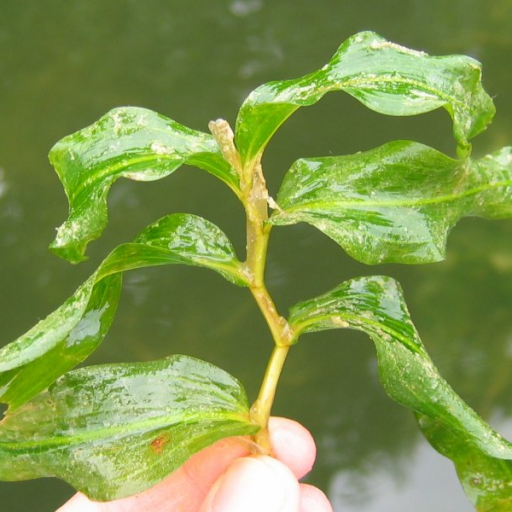
Plant Overview
Known as the White-stemmed Pondweed, Potamogeton praelongus is often called the "Ghost of the Deep" by lake enthusiasts. Unlike many pondweeds that clutter the surface, this elegant aquatic perennial prefers the cool, quiet depths of clear glacial lakes. Its striking, zig-zagging white stems look almost like underwater lightning, providing a majestic backdrop for freshwater life.
🔍 How to Identify
- ⚪ The Stem: Features a distinctive creamy-white or pale olive color that zig-zags between nodes, making it easy to spot even in murky water.
- 🍃 The Leaves: Large, translucent, and wavy-edged. They are "perfoliate," meaning the base of the leaf partially wraps around the stem like a cozy green shawl.
- 🛶 The Leaf Tip: If you look closely at the end of a leaf, it is "cucullate"—shaped like the bow of a boat or a tiny hood, rather than coming to a sharp flat point.
🌊 In the Aquatic Landscape
- 🐟 A Natural Nursery: Because it grows in deeper water (often up to 20 feet deep), it provides a critical sanctuary for large predatory fish like Muskie and Northern Pike to hide while waiting for prey.
- 💧 Water Quality Indicator: This plant is a bit of a "diva" when it comes to environment; it thrives only in high-quality, clear water and quickly disappears if a lake becomes too polluted or cloudy with algae.
- ❄️ Winter Survival: It doesn't fear the cold. In late autumn, it produces specialized winter buds called "turions" that sink to the lake floor, waiting for the spring thaw to begin the cycle again.
⚠️ Safety & Toxicity
- ✅ Status: Generally non-toxic and safe for the environment.
- 🐢 Wildlife Friendly: It is a vital food source for waterfowl and provides a safe grazing ground for aquatic snails and turtles.
- 🚤 Boater Note: While not as aggressive as invasive milfoil, its long stems can occasionally tangle in boat propellers in shallower bays, though it rarely forms the dense "mats" associated with nuisance weeds.
✨ Fun Fact
In the fishing world, this plant is famously known as "Muskie Weed." Expert anglers look specifically for patches of White-stemmed Pondweed, knowing that where these white zig-zag stems grow, the legendary "fish of ten thousand casts" is likely lurking.

Detailed Care Instructions
To grow Potamogeton praelongus (also known as White-stem Pondweed or Long-stalked Pondweed), follow these steps:
- Water requirements: Potamogeton praelongus thrives in freshwater environments like ponds, lakes, and slow-moving streams. Ensure the water is clean, non-polluted, and free from chemicals.
- Light requirements: Provide adequate sunlight for the plants to grow. Place the container or aquarium in a location that receives direct or indirect sunlight for a few hours each day.
- Container: If you are growing the plants indoors, use a container or aquarium that is large enough to hold the plants and the required water volume. Ensure the container has drainage holes and is suitable for aquatic plants.
- Substrate: Use a substrate that is rich in nutrients for the plants to root properly. Options include clay soil, potting soil, or a pre-packaged aquatic plant substrate. Spread the substrate at the bottom of the container, ensuring it covers the entire area.
- Planting: Gently lower the Potamogeton praelongus plants into the container, gently pressing their roots into the substrate. Space them out to allow them room to grow.
- Temperature: Maintain the water temperature between 10-25°C (50-77°F). This temperature range promotes healthy growth of Potamogeton praelongus.
- Water quality: Ensure the water quality remains high. Regularly test and monitor the pH, ammonia, nitrite, and nitrate levels in the water, maintaining them within suitable ranges for aquatic plants.
- Fertilization: To promote healthy growth, you can use a liquid or substrate fertilizer specifically designed for aquatic plants. Follow the product instructions for dosage and frequency.
- Pruning: As the Potamogeton praelongus plants grow, you may need to prune them occasionally to prevent overcrowding and encourage new growth. Trim off any dead or decaying parts to maintain water quality.
- Water circulation: If growing the plants indoors, consider using a water pump or aerator to ensure proper water circulation and oxygenation.
Remember to regularly observe and maintain the plants, monitoring water quality, and making necessary adjustments. With proper care, Potamogeton praelongus should thrive and grow successfully.

Place in a bright room that is sun drenched almost all day. Or directly in a south-facing window.

Potamogeton praelongus is an aquatic plant that requires water as a medium for its growth. To water this plant, it is important to provide it with appropriate aquatic conditions such as clean, clear, and oxygenated water. Here are some tips on how to water Potamogeton praelongus:
1. Choose an appropriate water source: Potamogeton praelongus grows naturally in freshwater ecosystems such as lakes, ponds, and streams. Therefore, it is important to choose a water source that is appropriate for its growth. The water should be clean and free from pollutants, chemicals, and heavy metals.
2. Provide adequate water depth: Potamogeton praelongus grows best in shallow water with a depth of up to 3 meters. Therefore, it is important to ensure that the water level is suitable for its growth.
3. Ensure proper water circulation: Potamogeton praelongus requires oxygenated water for its growth. Therefore, it is important to ensure that there is proper water circulation to provide a steady supply of oxygen to the plant.
4. Water regularly: Potamogeton praelongus requires regular watering to maintain sufficient moisture levels. However, it is important not to overwater the plant as it can lead to root rot.
5. Avoid cold water: Potamogeton praelongus is sensitive to cold water. Therefore, it is important to ensure that the water temperature is suitable for its growth.
Overall, providing adequate water conditions is crucial for the growth and survival of Potamogeton praelongus.
To fertilize this aquatic plant, use a slow-release fertilizer that is specifically formulated for submerged plants. Apply the fertilizer pellets directly to the soil or substrate around the base of the plant, taking care not to disturb the roots. Alternatively, use a liquid fertilizer that is suitable for aquatic plants and apply as directed. Avoid over-fertilizing, as this can lead to excessive growth and may harm fish and other aquatic organisms. Regular water changes can also help to keep nutrient levels in check and promote healthy plant growth.
Potamogeton Praelongus is a species of aquatic plant that has specific soil requirements. It is typically grown in well-draining and nutrient-rich soil that is designed for aquatic plants. The soil should be sandy and loamy with a pH range of 6.5 to 7.5. Specific soil mixes that are designed for aquatic plants are available in stores and can be used for Potamogeton Praelongus. This plant does not grow well in soil that is clay-like or has a high concentration of organic matter. It is important to avoid using soil that contains contaminants or pollutants, as these can harm the plant’s growth and development. Additionally, the plant should be watered regularly to ensure that the soil remains moist, but not waterlogged. With proper soil and care, Potamogeton Praelongus can thrive and become a beautiful addition to any aquatic garden or habitat.
To propagate this plant, you will need to collect a mature healthy plant from a natural environment. Cut the healthy stem of the plant and remove all the leaves except the apical meristem leaves. The stem should be about 10-15cm long.
Prepare a 5-10 cm pot with a mixture of sand and mud, which should be 1:1. Plant the cutting into the soil and make sure that the apical meristem leaves are above the soil. Water the plant only when the soil is dry.
Place the potted cutting in a location with plenty of sunlight but not under direct sunlight, as this can harm the plant. The cutting will start to root after about two to three weeks.
After the roots have established, transplant the plant to a bigger pot or an aquatic environment. The new pot or environment should be filled with water to allow the plant to grow.
Make sure to keep the water clean, and provide sufficient nutrients to the plant. This will promote growth and improve the lifespan of the plant.








