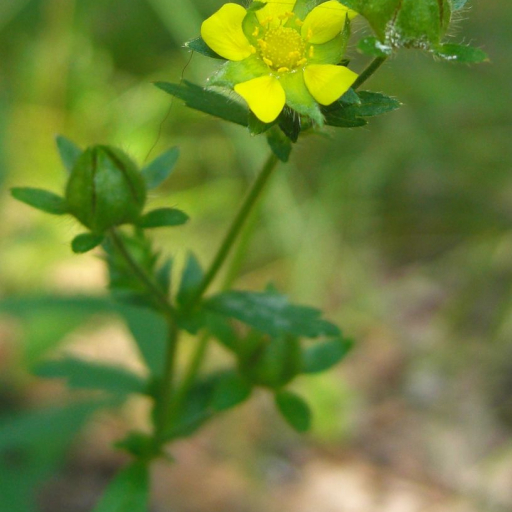
Plant Overview
Often called the Rough Cinquefoil, this hardy traveler is a rugged relative of the strawberry. While its leaves might trick you into thinking you’ve found a patch of wild fruit, its small, sunny yellow blooms tell a different story. A resilient "pioneer" species, it is one of the first plants to reclaim disturbed soil, acting as a natural bandage for the earth in meadows and roadsides across the Northern Hemisphere.
🔍 How to Identify
- 🍓 The Leaves: Look for "trifoliate" leaves—meaning they grow in clusters of three. They are deeply toothed (serrated) and look remarkably like strawberry leaves, though they lack the runners.
- 🧔 The Stem: True to its "Rough" nickname, the stems are covered in stiff, spreading hairs that give the plant a coarse, bristly texture when touched.
- ⭐ The Bloom: Small, pale yellow flowers with five petals. A key ID feature is that the green sepals (the leafy bits behind the petals) are often longer than the yellow petals themselves, creating a star-like frame around the flower.
🏡 In Your Garden
- 🌱 The Survivor: This plant thrives in "tired" or disturbed soil where other plants might struggle. It is an excellent choice for a low-maintenance native meadow but can be opportunistic in a manicured garden.
- 🥕 The Taproot: It develops a sturdy, woody taproot fairly quickly. If you decide to move it, do so while it’s young; once established, it anchors itself firmly and resists transplanting.
- 🐝 Pollinator Buffet: While humans might overlook the tiny flowers, they are a vital nectar source for small native bees, hoverflies, and butterflies during the mid-summer months.
⚠️ Safety & Toxicity
- ✅ Status: Non-toxic and generally safe.
- 🐾 Details: There are no known toxicity reports for dogs, cats, or horses. While not typically used as a food source due to its hairy, tough texture, it poses no danger to curious children or pets who might wander through a patch of it.
✨ Fun Fact
The genus name Potentilla is derived from the Latin word potens, meaning "powerful." This refers to the potent medicinal reputation the Cinquefoil family held in ancient herbalism, where it was used to treat everything from fevers to sore throats.

Detailed Care Instructions
To successfully grow Potentilla Norvegica, also known as Norwegian Cinquefoil, follow these steps:
- Climate: Potentilla Norvegica is a hardy perennial that grows in USDA hardiness zones 3-8. Make sure your climate is suitable for this plant.
- Sunlight: Choose a location with full sun exposure for at least six hours a day. Potentilla Norvegica thrives in bright sunlight.
- Soil: The plant prefers well-drained soil with a neutral to slightly acidic pH level. Amend heavy clay soil with organic matter to improve drainage.
- Planting: Dig a hole in the prepared soil that is slightly wider and deeper than the root ball. Place the plant in the hole, ensuring that the top of the root ball is level with the soil surface. Backfill the hole with soil, gently firming it around the roots.
- Watering: Water the plant thoroughly after planting. Potentilla Norvegica prefers slightly moist soil, so you may need to water it regularly during dry periods. Avoid overwatering, as it can lead to root rot.
- Mulching: Apply a layer of organic mulch around the base of the plant. This will help retain moisture, moderate soil temperature, and suppress weed growth.
- Pruning: Prune Potentilla Norvegica in late winter or early spring to remove dead or damaged branches. This will promote new growth and maintain a compact shape.
- Fertilization: Apply a balanced, slow-release fertilizer in early spring to provide essential nutrients. Follow the product's instructions for application rates and frequency.
- Pest and disease control: Potentilla Norvegica is generally resistant to pests and diseases. However, keep an eye out for common garden pests like aphids or spider mites and treat them accordingly with organic or chemical methods.
- Propagation: Propagate Potentilla Norvegica through division or by collecting and planting seeds. Division is best done in early spring or fall when the plant is dormant. Sow seeds in a seed tray in early spring and transplant the seedlings outdoors when they are strong enough.
By following these tips, you can successfully grow Potentilla Norvegica and enjoy its beautiful yellow flowers.

Place in a bright room that is sun drenched almost all day. Or directly in a south-facing window.

To properly water this plant, you should first check the soil moisture level by sticking your finger into the soil up to your first knuckle. If the soil feels dry at this depth, it's time to water. Use a watering can or hose to apply water directly to the soil around the base of the plant, rather than watering from above. Ideally, you want to moisten the soil to a depth of about 6 inches. Avoid overwatering, as Potentilla Norvegica prefers well-draining soil and can suffer from root rot if the soil becomes too waterlogged. It's also important to avoid getting water on the leaves, as this can increase the chances of fungal diseases developing. Water the plant regularly during the growing season, but reduce watering during the winter months when the plant is dormant.
To properly fertilize this plant, you should apply a balanced fertilizer in the spring and summer months. You can use a general-purpose fertilizer that is formulated for flowering plants, or you can use a slow-release fertilizer. Make sure to follow the instructions on the fertilizer label and provide the plant with enough water after fertilizing to help the plant absorb the nutrients. Additionally, you may want to fertilize the plant once more in the fall to help it prepare for the winter months.
Potentilla Norvegica plant prefers a well-draining soil with moderate fertility to grow properly. The soil should not be too heavy or too light, as it may lead to drainage problems or insufficient nutrients respectively. It is best to use a loamy soil mix that has sand, silt, and clay in equal portions. A pH range of 6.0 to 7.5 is ideal, and acidic soils need to be amended with lime to raise the pH level. Organic matter such as compost or rotted manure can be added to the soil to improve its structure and nutrient content. The plant also requires regular watering, especially during the growing season, but the soil should not remain waterlogged. Therefore, a soil mix that has good water retention properties and drains well is suitable for Potentilla Norvegica plant.
Propagating Potentilla Norvegica plant can be done through various methods, including seeding, cuttings, and division.
Seeding:
To propagate the plant through seeding, collect mature seeds from the plant and sow them in a well-draining soil mix. Keep the soil moist and maintain a warm temperature around 70-75°F. Once the seeds germinate and seedlings have grown, transplant them to individual pots and care for them until they are mature enough to be planted in their final location.
Cuttings:
Another way to propagate this plant is through stem cuttings. Take a healthy stem from the plant and make a clean cut just below a node. Remove the lower leaves from the stem and dip it in rooting hormone. Plant the cutting in a well-draining soil mix and cover it with a plastic bag to maintain humidity. Keep the soil moist and maintain a warm temperature around 70-75°F. After a few weeks, the cutting should develop roots and can be transplanted to individual pots.
Division:
Propagation through division involves separating the mature plant into smaller sections and replanting each section. To do this, dig up the entire plant and carefully separate it into sections, making sure that each section has its own roots and leaves. Replant each section into its own pot or location with well-draining soil and water regularly until established.
Regardless of the method you choose, it is important to propagate the plant during the growing season when it is actively growing to increase the chance of success.
Common pests of the rough cinquefoil include Spider mites, larvae. Make a habit of checking your rough cinquefoil frequently for pests so that any infestations can be caught and managed early.








