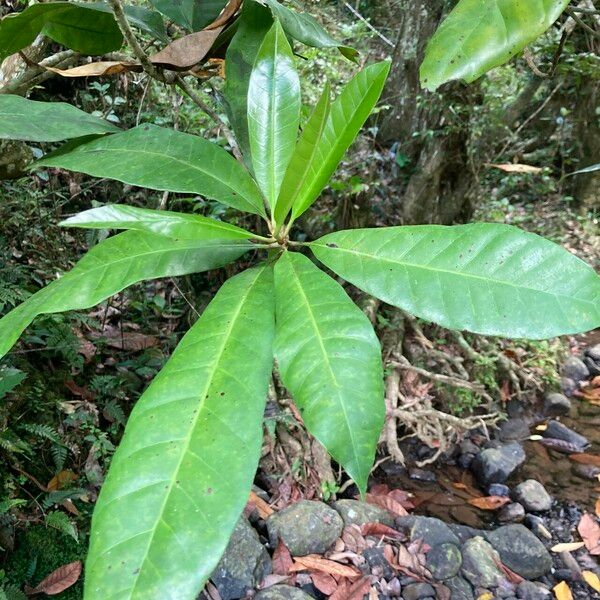
Plant Overview
Known affectionately as the Jacana or the Bully Tree in the Caribbean, Pouteria multiflora is a lush, tropical evergreen that commands attention with its dense canopy and sturdy stature. This tree is a member of the Sapotaceae family, making it a cousin to the famous Sapodilla and Mamey Sapote. In its native islands, it is prized not just for its sweet, starchy fruit, but also for its incredibly hard, durable timber that can withstand the test of time.
🔍 How to Identify
- 🍃 Glossy Foliage: The leaves are large, leathery, and a deep, vibrant green, often arranged in clusters at the ends of branches to create a thick, umbrella-like shade.
- 🌼 Clustered Blooms: Living up to its name "multiflora," the tree produces many small, fragrant, greenish-white flowers that sprout directly from the leaf axils or along the older branches.
- 🥭 Rounded Fruit: The fruit is globe-shaped and turns a yellowish-brown or dull orange when ripe, containing a bright yellow, floury pulp that surrounds one or two large, shiny brown seeds.
🏡 In Your Garden
- ☀️ Tropical Requirements: This is a true child of the tropics; it thrives in high humidity and deep, well-draining soil. It is very sensitive to frost, so it’s best suited for coastal or tropical landscapes where temperatures remain consistently warm.
- 🌳 The "Forever" Tree: Because it develops a deep, strong taproot, the Jacana hates being moved once it is established. When planting, choose a permanent spot with plenty of room to grow, as it can reach impressive heights over several decades.
⚠️ Safety & Toxicity
- ✅ Generally Safe: The ripe fruit pulp is edible and enjoyed by humans and local wildlife alike, though the texture is more "mealy" or "starchy" than juicy.
- 🧪 Milky Latex: Like many in its family, the bark and unripe fruit contain a sticky, milky white latex. While not typically poisonous, this sap can be quite messy and may cause mild skin irritation for people with sensitive skin or latex allergies. Keep an eye on pets to ensure they don't chew on the hard seeds.
✨ Fun Fact
The nickname "Bully Tree" isn't because the plant is mean! It’s a corruption of the Dutch word bolletrie, referring to the exceptional strength and "bullet-proof" density of its wood, which was historically used to build heavy-duty mill rollers and ship components.

Detailed Care Instructions
Pouteria multiflora, commonly known as "Burdekin Plum" or "Black Plum," is a tropical fruit tree native to parts of Southeast Asia and Australia. It is valued for its sweet edible fruit and can be an interesting addition to your garden. Here are some steps to grow Pouteria multiflora successfully:
1. Climate and Location
- Climate: Pouteria multiflora thrives in tropical to subtropical climates. It prefers warm temperatures and can be sensitive to frost.
- Sunlight: Choose a location that receives full sun to partial shade. A spot with at least 6 hours of direct sunlight each day is ideal.
2. Soil Requirements
- Soil Type: The plant prefers well-draining soil with a good amount of organic matter. Sandy or loamy soils are suitable.
- pH Level: Aim for slightly acidic to neutral soil pH (around 6.0 to 7.0).
3. Planting
- Propagation: You can start Pouteria multiflora from seeds or by grafting. If using seeds, ensure they are fresh and plant them in a pot with the proper soil mix.
- Spacing: If planting multiple trees, maintain a distance of at least 10-15 feet between them to ensure adequate air circulation.
4. Watering
- Keep the soil consistently moist but not waterlogged, especially during dry spells. Watering should be reduced during the rainy season.
- Mulching around the base can help retain moisture and suppress weeds.
5. Fertilization
- Use a balanced fertilizer or organic compost to provide necessary nutrients. Fertilize during the growing season (spring and summer).
- Regular applications of compost can boost soil fertility.
6. Pruning
- Prune the tree to maintain its shape and encourage airflow. Remove any dead, damaged, or crossing branches.
- Pruning can also help improve yield by allowing more light and air into the canopy.
7. Pest and Disease Management
- Check for pests like aphids and scale insects. Use organic insecticides or horticultural oils if necessary.
- Monitor for signs of fungal diseases and ensure the tree is not overwatered to prevent root rot.
8. Harvesting
- Pouteria multiflora typically begins to bear fruit when it reaches 3-5 years of age, although this can vary.
- The fruit is usually ripe when it changes color and can be easily removed from the tree.
9. Companion Planting
- Consider planting with other tropical plants that have similar care requirements for biodiversity and improved pollination.
By following these steps and providing the right care, you should be able to grow a healthy Pouteria multiflora plant that yields delicious fruit. Good luck with your gardening!
Watering the Pouteria multiflora requires careful attention to its specific needs, as it is adapted to tropical climates. Here’s a detailed guide on how to properly water this plant:
- Soil Moisture Level: Before watering, check the moisture level of the soil. The top inch or two of soil should feel dry to the touch. You can use your finger or a moisture meter to gauge the moisture level.
- Watering Frequency: The frequency of watering will depend on several factors, including the climate, season, and growth stage of the plant. Generally, water the plant consistently during the growing season (spring and summer) and reduce watering during the dormant period (fall and winter).
- Water Quality: Use clean, potable water that is free from chlorine and other chemicals. Rainwater is an excellent option if available, as it is naturally soft and free of additives.
- Watering Technique: Water the plant deeply to encourage deep root growth. Apply water evenly around the base of the plant but avoid waterlogging the soil. You can do this by using a watering can with a spout or a hose with a gentle spray setting.
- Drainage: Ensure that the pot or planting area has adequate drainage. Excess water should be able to escape freely to prevent root rot. If the plant is in a pot, there should be holes in the bottom.
- Mulching: Applying a layer of organic mulch around the base of the plant can help retain soil moisture and regulate temperature. This practice reduces evaporation and can help keep the root zone consistently moist.
- Observing the Plant: Monitor the plant for signs of underwatering (wilting, dry leaf edges) or overwatering (yellowing leaves, root rot symptoms). Adjust your watering schedule accordingly based on the plant's response.
- Environmental Considerations: Consider the surrounding environmental conditions, such as humidity and temperature. High temperatures may increase water needs, while cooler, more humid conditions may reduce them.
By following these guidelines, you can ensure that your Pouteria multiflora receives the appropriate amount of water for healthy growth.
To effectively fertilize Pouteria multiflora, follow these guidelines:
- Timing: Fertilize during the growing season, which is typically in spring and early summer. Avoid fertilizing during the dormant period in late fall and winter.
- Type of Fertilizer: Use a balanced, slow-release fertilizer with an N-P-K ratio suitable for fruiting plants, such as 10-10-10 or 14-14-14. Organic options like well-rotted compost or manure can also be beneficial.
- Application Rate: Apply the fertilizer according to the manufacturer's instructions based on the age and size of the plant. Generally, for a young plant, start with about 1 tablespoon of granular fertilizer, increasing the amount for larger, mature plants.
- Method of Application:
- For granular fertilizers, evenly distribute the granules around the base of the plant, leaving a small gap from the stem to prevent burn. Rake lightly into the soil surface and water thoroughly afterward.
- For liquid fertilizers, dilute according to the instructions and apply directly to the soil around the plant, ensuring adequate coverage of the root zone.
- For granular fertilizers, evenly distribute the granules around the base of the plant, leaving a small gap from the stem to prevent burn. Rake lightly into the soil surface and water thoroughly afterward.
- Frequency: Re-apply every 6-8 weeks during the growing season. If using organic fertilizers, you may need to apply more frequently, as they release nutrients more slowly.
- Soil and Watering: Ensure the plant is in well-draining soil. Water the plant well before and after applying the fertilizer to help prevent root burn and to assist with nutrient uptake.
- Observation: Monitor the plant for signs of nutrient deficiency or excess, such as yellowing leaves or poor growth. Adjust your fertilization routine accordingly.
By following these guidelines, you can help Pouteria multiflora thrive and produce healthy fruit.
Pouteria multiflora thrives best in well-draining soil that is rich in organic matter. A suitable soil mix should be slightly acidic to neutral, with a pH range between 5.5 to 7.0. Utilizing a combination of loamy soil, peat moss or coconut coir, and well-decomposed compost can provide the necessary nutrients and enhance drainage.
Incorporating perlite or coarse sand can further improve drainage and aeration, which is crucial for preventing root rot. It's also beneficial to ensure the soil retains some moisture without becoming waterlogged. Creating a raised bed or using pots with adequate drainage holes can help maintain optimal moisture levels.
Overall, the ideal soil will maintain a balance of moisture retention and drainage while providing a nutrient-rich environment for optimal growth.
Pouteria multiflora can be propagated through several methods, including seed propagation and vegetative means such as grafting or air layering. Here’s a detailed guide for each method:
Seed Propagation
- Seed Collection: Harvest ripe fruit when it is fully matured. Extract the seeds from the fruit and clean them thoroughly to remove any pulp.
- Seed Preparation: To maximize germination, you may soak the seeds in water for 24 hours. This can help soften the seed coat.
- Germination Environment: Use a well-draining potting mix, such as a combination of peat moss, perlite, and sand. Fill seed trays or pots with this mix.
- Planting Seeds: Sow the seeds about 1 to 2 centimeters deep in the soil. Space them adequately to allow for growth.
- Moisture and Temperature: Keep the soil consistently moist but not waterlogged. Maintain the ambient temperature around 20-30°C (68-86°F) to encourage germination.
- Light Conditions: Place the trays in a bright location with indirect sunlight. Strong direct sunlight may harm the delicate seedlings.
- Germination Time: Be patient, as seeds may take several weeks to months to germinate. Monitor the moisture level regularly.
- Transplanting: Once seedlings have developed a few true leaves and are sturdy enough to handle, they can be transplanted into larger pots or outdoors if conditions are suitable.
Vegetative Propagation
- Grafting:
- Selecting Scion and Rootstock: Choose healthy scions from a desired cultivar and compatible rootstock.
- Technique: Utilize techniques such as cleft grafting or whip-and-tongue grafting, ensuring proper cambium contact between scion and rootstock.
- Sealing: Use grafting tape or parafilm to secure the graft and prevent moisture loss.
- Selecting Scion and Rootstock: Choose healthy scions from a desired cultivar and compatible rootstock.
- Air Layering:
- Choosing a Branch: Select a healthy, semi-mature branch and make a series of shallow cuts around the circumference to expose the cambium.
- Preparing the Site: Apply rooting hormone to the exposed area if available.
- Wrapping: Surround the area with moist sphagnum moss and cover it with plastic to maintain humidity.
- Monitoring: Check regularly to ensure the moss remains moist, and roots will typically develop within a few weeks to a few months.
- Severing: Once roots are established, sever the branch below the new root system and plant it in a suitable potting medium.
Care After Propagation
- Choosing a Branch: Select a healthy, semi-mature branch and make a series of shallow cuts around the circumference to expose the cambium.
- Watering: Newly transplanted seedlings or cuttings should be kept well-watered, but avoid overwatering to prevent root rot.
- Fertilization: Once established, you can start applying a diluted balanced fertilizer during the growing season to support healthy growth.
- Sunlight: Gradually acclimate seedlings or cuttings to full sunlight if started in shaded conditions.
By following these steps, you can successfully propagate Pouteria multiflora and grow healthy plants.







