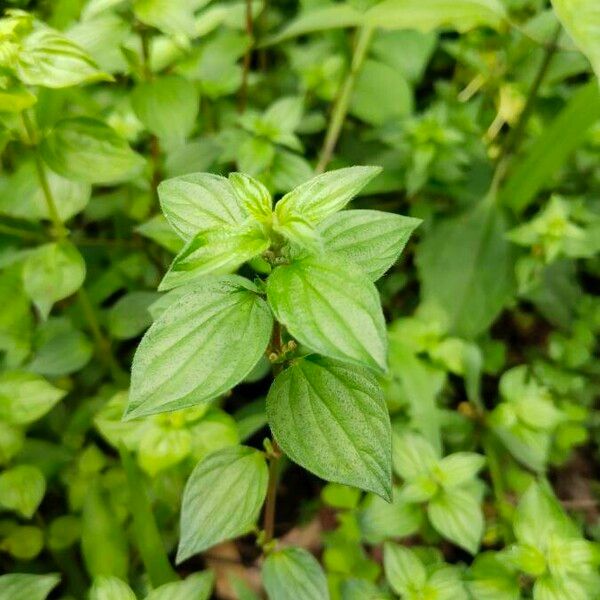
Plant Overview
Often referred to as the Graceful Pouzolzia or "Zeylan's Bush," this unassuming member of the Nettle family is a humble wanderer found across tropical Asia and Africa. While many modern gardeners might mistake it for a common weed, it has been cherished for centuries in traditional herbalism for its cooling properties. It thrives in the "in-between" spaces—damp cracks in walls, the edges of rice paddies, and the shaded corners of moist gardens.
🔍 How to Identify
- 🌿 The Foliage: The leaves are usually oval or lance-shaped with three distinct veins running from the base to the tip. They have a soft, almost translucent quality when held up to the light.
- 🖋️ The Stems: The stems are slender, often tinged with a reddish or purple hue, and can grow upright or trail along the ground depending on how much light they receive.
- 🌸 Hidden Blooms: Look closely at the "axils" (where the leaf meets the stem). You’ll find tiny, greenish-white flower clusters that are so small they are often overlooked by the naked eye.
🏡 In Your Garden
- 💧 The Moisture Lover: This plant is an indicator of wet soil. If you see it popping up, it usually means that spot stays consistently damp. It’s a great companion for ferns and other moisture-loving tropicals.
- 🌱 A Resilient Resident: It is incredibly hardy and can bounce back from heavy pruning. While it isn't a showstopper in terms of bright flowers, its lush green texture provides a "wild" and naturalistic look to shade gardens.
⚠️ Safety & Toxicity
- 🟢 Status: Generally considered non-toxic and safe for handling.
- ✋ Skin Sensitivity: Although it belongs to the Nettle family (Urticaceae), Pouzolzia zeylanica lacks the painful stinging hairs found on its cousins. However, individuals with very sensitive skin should handle it with care, as the fine hairs on the leaves can occasionally cause mild itching.
- 🐾 Pets: There is no documented toxicity for cats or dogs, but it is always best to discourage pets from grazing on garden plants.
✨ Fun Fact
In various parts of Southeast Asia, this plant is nicknamed the "Crush Herb" because the leaves are traditionally pounded into a paste and used as a poultice to soothe skin inflammations and minor sores!

Detailed Care Instructions
To grow a Pouzolzia Zeylanica plant, also known as the creeping nettle or false nettle, follow these steps:
- Plant selection: Obtain a healthy Pouzolzia Zeylanica plant either as seeds or as a small potted plant from a nursery or garden center. Look for plants that have lush green leaves and no signs of disease or damage.
- Soil preparation: Choose a well-draining potting mix or prepare your garden soil. Pouzolzia Zeylanica prefers moist, fertile soil with a slightly acidic to neutral pH (around 6.0-7.0).
- Planting in pots: If planting in pots, select a container with drainage holes and fill it with the potting mix. Place the plant in the center of the pot and cover the roots with soil, ensuring the crown of the plant is at the soil level.
- Planting in the garden: If planting in the garden, choose a location with partial shade to full shade. Dig a hole slightly larger than the plant's root ball. Place the plant in the hole, backfill with soil, and gently compact the soil around the roots.
- Watering: Pouzolzia Zeylanica prefers consistently moist soil, so water the plant regularly. However, avoid overwatering, as it may cause root rot. Ensure that the soil remains moist but not waterlogged.
- Fertilization: Apply a balanced, slow-release fertilizer or compost in spring to encourage healthy growth. Follow the manufacturer's recommended dosage for application.
- Pruning: Regular pruning can promote better branching and denser growth in Pouzolzia Zeylanica. Trim back any overgrown or leggy stems, making clean cuts above a leaf node or branch junction.
- Pests and diseases: Monitor the plant for common pests like aphids and spider mites, as well as diseases like powdery mildew. Treat any infestations or diseases promptly using appropriate organic or chemical methods.
- Propagation: Pouzolzia Zeylanica can be propagated through stem cuttings or division. Take 3-4 inch long stem cuttings, remove the lower leaves, dip the cut end in rooting hormone, and plant it in a well-draining soil mix. Keep the cutting moist until roots develop. To divide an established plant, carefully separate the root ball into smaller sections and replant them.
- Winter care: If growing in colder regions, protect Pouzolzia Zeylanica from freezing temperatures. Consider bringing potted plants indoors or providing a layer of mulch around garden plants to insulate the roots.
Remember, each plant may have unique care requirements, so researching and adapting to its specific needs is crucial for successful growth.

Place in a window with dappled sun or a spot in the middle of a room. Or directly in a window facing west or east.

Pouzolzia Zeylanica is a plant that requires regular watering to survive and thrive. To water this plant, you should first check the soil to see if it is dry to the touch. If the soil is dry, you should water the plant thoroughly, making sure to saturate the soil evenly.
It is important to avoid over-watering Pouzolzia Zeylanica, as this can lead to root rot and other issues. To prevent over-watering, you should only water the plant when the soil has dried out completely, and you should ensure that the soil is well-drained and does not become waterlogged.
You can water Pouzolzia Zeylanica by using a watering can or hose, making sure to direct the water at the soil and not the leaves. You should also avoid getting water on the plant's stem, as this can lead to rot and disease.
Overall, the key to successfully watering Pouzolzia Zeylanica is to maintain consistent moisture levels in the soil, without allowing the soil to become too wet or too dry. With proper care and attention, this plant can thrive and add beauty to any indoor or outdoor space.
To fertilize your plant, use a balanced, all-purpose fertilizer and apply it every 2-3 months during the growing season. Dilute the fertilizer according to the package instructions and water the plant well before and after application. Avoid over-fertilizing as it can damage the plant.
Pouzolzia Zeylanica plant requires soil that is well-draining and rich in nutrients. The soil should have a pH level of between 5.5 and 7.5. It is recommended to use a mixture of soil, compost, and sand in equal parts to create a well-balanced soil mixture. The plant prefers moist soil, so it is important to ensure that the mixture is able to retain moisture without becoming waterlogged. Additionally, it is beneficial to provide the plant with organic fertilizers, such as bone meal or fish emulsion, to promote healthy growth. Overall, Pouzolzia Zeylanica plant thrives in nutrient-rich, well-drained soil that is kept consistently moist and supplied with organic fertilizers.
To propagate this plant, you can take stem cuttings of about 6 inches in length. Make sure each cutting has at least 2-3 nodes on it. Remove the lower leaves and dip the cut end of the stem in rooting hormone. Plant the cutting in a well-draining soil mix and keep it moist but not waterlogged. Place the pot in a bright but indirect light location. You can cover the cutting with a plastic bag or clear plastic container to create a mini greenhouse environment to maintain humidity. After a month or so, you should see signs of roots developing. Once the plant has established a good root system, you can transplant it to a larger pot or garden bed.








