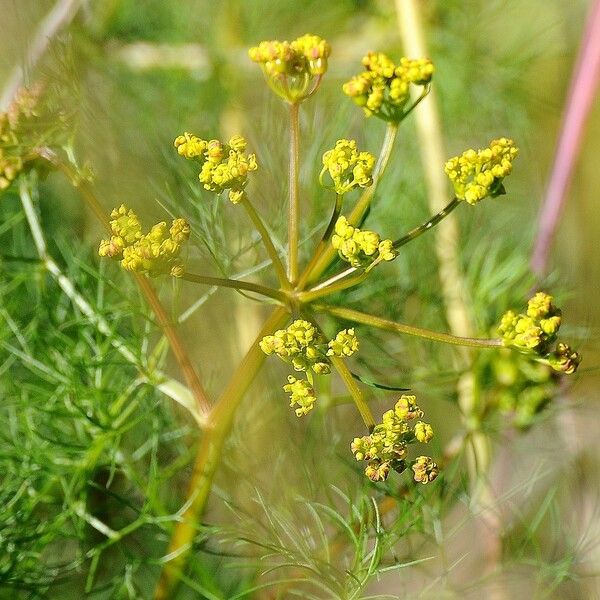
Plant Overview
Often found clinging to dry, rocky hillsides across the Mediterranean and Middle East, Prangos trifida is a rugged, architectural member of the carrot family (Apiaceae). Its name "trifida" refers to its intricately divided, three-parted leaves that create a soft, cloud-like texture against harsh landscapes. Historically, it has been a staple of mountain ecology, valued by local communities for its aromatic properties and its role in traditional folk medicine.
🔍 How to Identify
- 🍃 Finely Cut Foliage: The leaves are deeply divided into three-parted, linear segments, giving the plant a lacy, feathery appearance that softens its sturdy stems.
- 🟡 Golden Umbel Blooms: It produces striking, flat-topped clusters (umbels) of tiny, vibrant yellow flowers that act as bustling landing pads for local pollinators.
- 📦 Winged Fruits: After flowering, the plant develops large, distinctive fruits that are often corky or winged, designed to be dispersed by the wind across the rocky terrain.
🏡 In Your Garden
- 🏔️ The Deep Taproot: Because it grows a long, powerful taproot to find water in arid climates, Prangos trifida hates being moved once established. Choose its permanent home carefully.
- ☀️ Drought Warrior: This plant is an excellent choice for "xeriscaping" or rock gardens. It thrives in poor, well-draining soil and demands full, unfiltered sun to prevent its stems from becoming floppy.
⚠️ Safety & Toxicity
- ☀️ Phototoxic Warning: Like many members of the Apiaceae family, the sap contains compounds that can cause "phytophotodermatitis." If the sap gets on your skin and is then exposed to sunlight, it can cause painful blisters or rashes.
- 🐾 Pet Caution: While some wild livestock graze on Prangos, it is generally considered unsafe for household pets. Ingestion can lead to severe digestive upset, and skin contact should be avoided.
✨ Fun Fact
In some regions of the Middle East, species of Prangos are harvested from the wild and dried to be used as a "mountain hay" that is said to give the milk of grazing animals a particularly sweet and aromatic flavor!

Detailed Care Instructions
To grow Prangos Trifida (also known as Turkish hollyhock or Turkish carrot), you can follow these steps:
- Climate and soil: Prangos Trifida prefers a Mediterranean climate with dry summers. It can tolerate temperatures as low as -15°C (5°F). The plant thrives in well-draining sandy or loamy soil with a pH between 6 and 7.5.
- Seed collection: You can collect seeds from existing plants or purchase them from a reputable seed supplier.
- Seed preparation: Soaking the seeds in warm water for 24 hours before planting can help with germination. You can also scarify the seeds by gently nicking the seed coat with a sharp knife.
- Planting: Sow the seeds directly in the garden bed in the early spring or early fall. The depth should be around 1 cm (0.4 inches). Space the seeds 30-45 cm (12-18 inches) apart to ensure adequate growth room.
- Watering: Water the seeds regularly after planting to keep the soil moist but not waterlogged. Once established, Turkish hollyhock is a drought-tolerant plant and requires little watering.
- Sunlight: Prangos Trifida prefers full sun exposure, so ensure that the planting location receives at least 6-8 hours of sunlight per day.
- Maintenance: Regular weeding is necessary to prevent competition for nutrients and water. Mulching around the plants can help suppress weeds and retain soil moisture.
- Pruning: Pruning is not necessary for Prangos Trifida unless you want to maintain a particular shape or remove dead or damaged branches.
- Fertilizer: Prangos Trifida does not require heavy fertilization. You can add a balanced slow-release fertilizer during the growing season if necessary.
- Pests and diseases: Prangos Trifida is generally resistant to pests and diseases. However, occasional aphids or slugs may be encountered. Use appropriate organic pest control methods if needed.
- Harvesting: The leaves, roots, and seeds of Prangos Trifida are edible. Leaves can be harvested throughout the growing season, while roots are typically harvested in fall or early spring. Seeds can be collected as they mature and turn brown.
Remember, some Prangos Trifida varieties may have specific requirements, so it's always helpful to research the specific cultivar you have and adjust the growing conditions accordingly.

Place in a bright room that is sun drenched almost all day. Or directly in a south-facing window.

Prangos Trifida is a type of plant that needs to be watered adequately to thrive. You can water it in several ways. One way is to check the soil moisture level regularly to determine when to water the plant. You can do this by sticking your finger in the soil to feel the moisture level. If the soil feels dry up to an inch, this means it is time to water the plant.
Another way to water Prangos Trifida is to water it deeply and make sure the water reaches the root zone. You can achieve this by watering the plant thoroughly until the water drains out at the bottom of the pot or container. You can also use a watering can or hose to water the plant slowly and evenly.
Aside from checking the soil moisture level and watering the plant deeply, you should also avoid overwatering Prangos Trifida. Overwatering can lead to root rot, which can kill the plant. Make sure the soil has adequate drainage and avoid letting the plant sit in water for extended periods.
In summary, the best way to water Prangos Trifida is to check the soil moisture regularly, water it deeply, and avoid overwatering. By following these tips, you can ensure that your Prangos Trifida plant gets enough water to thrive.
To fertilize this plant, use a balanced fertilizer with equal amounts of nitrogen, potassium, and phosphorus. Apply the fertilizer once a month during the growing season, from spring to late summer. Mix the fertilizer with water and apply it evenly around the base of the plant. Avoid fertilizing during winter or during a drought to prevent root burn or stress.
The Prangos Trifida plant requires a well-draining soil that is composed of a mix of organic matter and inorganic materials. The soil should have a slightly acidic to neutral pH level and should be rich in nutrients such as nitrogen, phosphorus, and potassium. It is recommended to mix the soil with sand or perlite to improve drainage and aeration. Additionally, the plant prefers a soil that is not too moist as it may lead to root rot. Therefore, it is important to ensure the soil is not excessively wet.
Prangos Trifida plant can be propagated through both seed and vegetative methods.
Seed Propagation:
- Collect mature seeds from the parent plant.
- Soak the seeds in water for 24 hours to soften the hard outer seed coat.
- Sow the seeds in well-draining soil mix in small pots or trays.
- Cover the seeds with a thin layer of soil and water lightly.
- Place the pots or trays in a warm and bright location, avoiding direct sunlight.
- Keep the soil moist but not waterlogged.
- The seeds will germinate in 10-14 days and can be transplanted to larger containers or the garden once they have developed a few true leaves.
Vegetative Propagation: - Choose a healthy and mature parent plant to obtain cuttings from.
- Cut a stem from the parent plant that is at least 4-6 inches long and has at least one node.
- Remove the leaves from the bottom two-thirds of the stem.
- Dip the cut end of the stem in rooting hormone powder.
- Plant the cutting in a well-draining soil mix in a small pot or container.
- Water the cutting lightly and cover it with a plastic bag to create a humid environment.
- Keep the pot in a warm and bright location, avoiding direct sunlight.
- Check the cutting regularly and keep the soil moist but not waterlogged.
- Once the cutting has rooted and started to grow, it can be transplanted to a larger container or garden.








