Plant Overview
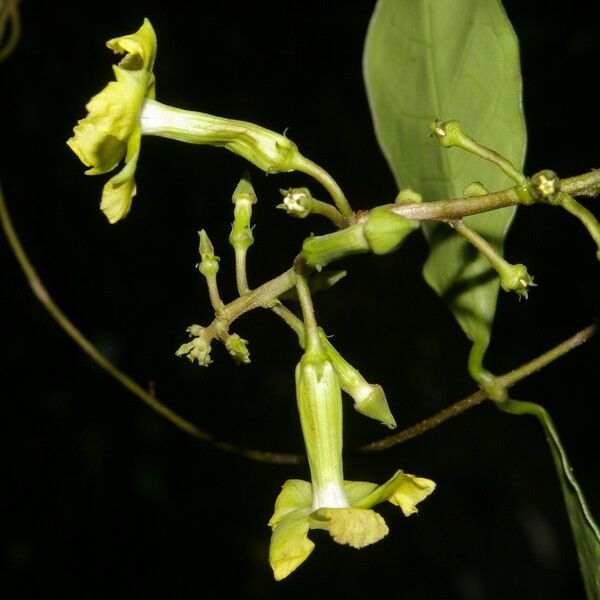
Often called the Yellow Prestonia or the Gold-and-White Prestonia, this stunning tropical climber is a hidden gem from the rainforests of Central and South America. It is a vigorous woody vine that belongs to the Apocynaceae family—the same family as the fragrant Frangipani. In its native habitat, it weaves through the canopy, showing off unique "star-centered" flowers that look like they were painted by hand.
🔍 How to Identify
- 🌟 The Starry Bloom: The flowers are trumpet-shaped and buttery yellow, featuring a striking five-sided red or burgundy ring in the center that creates a perfect pentagon.
- 🍃 Veined Foliage: Its leaves are large, oval, and glossy green, often displaying prominent, pale-colored veins that give the plant a textured, "quilted" appearance.
- 🌀 Twining Stems: As a natural climber, it doesn't have tendrils; instead, the entire stem spirals tightly around trellises, fences, or neighboring trees to move upward.
🏡 In Your Garden
- 💧 Humidity is Key: Coming from the tropics, this vine craves moisture in the air. If you are growing it indoors or in a dry climate, frequent misting or a pebble tray is essential to keep the leaves from browning at the edges.
- 🪴 Root Stability: The Yellow Prestonia has a sensitive root system and "hates" being moved once it has settled. Choose its permanent home carefully, ensuring the soil is rich in organic matter and drains quickly to prevent root rot.
⚠️ Safety & Toxicity
- 🧪 Status: Toxic / Skin Irritant.
- 🐾 Details: Like many of its cousins in the Dogbane family, this plant contains a milky white latex sap. This sap can cause localized skin irritation or rashes upon contact. It should be kept away from pets and children, as ingestion can lead to stomach upset or more serious cardiac reactions.
✨ Fun Fact
The species name quinquangularis is Latin for "five-angled." This refers to the precise geometric shape formed by the raised tissues in the center of the flower, which looks like a tiny, crimson fortress protecting the nectar.

Detailed Care Instructions








