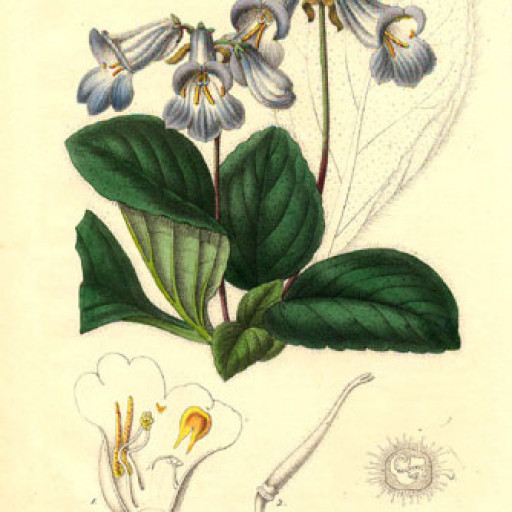
Plant Overview
Often called the "Silver Primulina," this gem from the misty limestone cliffs of Southern China and Vietnam is a prized possession for indoor collectors. With its quilted leaves that look as though they’ve been meticulously painted with metallic frost, it feels more like a piece of living art than a standard houseplant. While it is related to the African Violet, it carries a prehistoric, rugged elegance that sets it apart.
🔍 How to Identify
- 🌿 Foliage Texture: The leaves are thick, oval, and covered in fine hairs, giving them a soft, velvety feel.
- 🥈 Silver Marbling: Most varieties feature a striking "lace" or "tiger stripe" pattern of silvery-white over a deep forest-green base.
- 🌸 Trumpet Blooms: It produces delicate, tubular flowers on tall, leafless stalks. These are typically a soft lavender or pale orchid color with subtle yellow markings inside the throat.
🏡 In Your Garden
- ⛰️ The Limestone Lover: In nature, this plant clings to rocky crevices. It thrives in a "gritty" potting mix (like orchid bark or perlite mixed with soil) and prefers slightly alkaline conditions over acidic ones.
- 💧 Bottom-Watering is Best: Like its cousin the African Violet, its hairy leaves are prone to rot or spotting if they stay wet. Water from the bottom or use a narrow-neck watering can to keep the crown bone-dry.
- ☀️ Light Sensitivity: It loves bright, indirect light. If the silver pattern starts to fade, it’s likely too dark; if the leaves turn yellow or crisp, it’s getting too much direct sun.
⚠️ Safety & Toxicity
- ✅ Safe for All: Primulina dryas is generally considered non-toxic to cats, dogs, and humans. It is an excellent choice for a pet-friendly household.
- 👐 Handle with Care: Though it isn't poisonous, the leaves are quite brittle. They can snap off with the slightest bump, so it is best placed in a low-traffic area where it won't be brushed against.
✨ Fun Fact
For decades, this plant was known by the name Chirita sinensis. It wasn't until 2011 that botanists used DNA sequencing to realize it belonged to a completely different group, leading to its "new" official name, Primulina. This massive reclassification changed the names of over 150 species overnight!

Detailed Care Instructions
To grow Primulina Dryas, follow these steps:
- Choose a location: Primulina Dryas prefers bright, indirect light. Place the plant near a window that receives filtered sunlight or artificial grow lights that mimic natural light conditions.
- Select the right soil: Primulina Dryas thrives in well-draining soil that retains some moisture. Use a mixture of peat moss, perlite, and vermiculite or a high-quality potting mix formulated for African violets.
- Provide proper watering: Keep the soil consistently moist but avoid overwatering, as it can lead to root rot. Consider watering from the bottom by placing the pot in a shallow dish of water and allowing the plant to soak up moisture through the drainage holes. Empty any excess water after a few minutes to prevent waterlogging.
- Maintain humidity: Primulina Dryas prefers high humidity levels. You can increase humidity by placing the pot on a tray filled with water and pebbles. Avoid placing the pot directly in the tray to prevent excess moisture from contacting the bottom of the pot.
- Fertilize regularly: Feed your Primulina Dryas with a diluted, balanced, water-soluble fertilizer every 2 to 4 weeks during the growing season (spring and summer). Follow the package instructions for the correct dosage.
- Prune as needed: Remove any yellowing or dead leaves to maintain the plant's appearance and overall health.
- Keep temperatures stable: Primulina Dryas prefers temperatures between 65°F and 75°F (18°C to 24°C). Avoid sudden temperature fluctuations and keep the plant away from cold drafts.
- Propagate if desired: Primulina Dryas can be propagated by leaf cuttings. Select a healthy leaf and remove it cleanly from the plant. Dip the cut end in rooting hormone powder and place it in a small pot filled with a mix of peat moss and perlite. Keep it moist and provide indirect light until new growth appears.
By following these steps, you can successfully grow Primulina Dryas and enjoy its beautiful foliage and occasional flowers.

Place in a window with dappled sun or a spot in the middle of a room. Or directly in a window facing west or east.

To water this plant, wait until the top inch of soil feels dry to the touch. Then, slowly pour water into the soil until it runs out the drainage holes at the bottom of the pot. Be careful not to overwater, as this plant is sensitive to root rot. Keep the soil consistently moist but not waterlogged. Avoid getting water on the leaves, as this can cause damage.
To properly fertilize the Primulina Dryas plant, it is important to provide it with balanced nutrition. Follow these guidelines for proper fertilizing:
- Use a balanced, water-soluble fertilizer specifically formulated for houseplants. Ensure that the nutrient ratio is balanced, such as a 10-10-10 or 20-20-20 NPK ratio. This will provide essential macronutrients like nitrogen (N), phosphorus (P), and potassium (K).
- Dilute the fertilizer according to the label instructions. Aim for a weaker concentration than recommended, as over-fertilizing can harm the plant. Typically, a general guideline is to use a 1/4 or 1/2 strength solution.
- Apply the diluted fertilizer to moist soil. Avoid applying fertilizer to dry soil to prevent burning the roots. It is advisable to water the plant a day before fertilizing.
- Pour the diluted fertilizer solution directly into the soil around the base of the plant. Ensure that the solution is evenly distributed in the soil.
- Be cautious not to let the fertilizer come in contact with the foliage or petals of the plant. If any fertilizer gets on the leaves or flowers, gently wipe or rinse it off to avoid damage.
- Fertilize the Primulina Dryas plant once a month during the growing season, which typically includes spring and summer. During the dormant season, usually fall and winter, reduce or completely halt fertilization.
Remember to regularly monitor the plant's overall health and adjust the fertilization schedule if necessary. Providing the correct nutrients will help maintain a robust and thriving Primulina Dryas plant.
Primulina Dryas is a plant that requires a specific type of soil to grow properly. The soil should be well-draining, but also retain moisture. A mixture of peat moss and vermiculite or perlite works well. It is important to avoid using heavy, dense soils that do not allow water to run through easily. The pH level of the soil should be slightly acidic, between 5.5 and 6.5. Additionally, the soil should be rich in organic matter and nutrients to support the plant's growth and development. It is recommended to fertilize the soil with a balanced, slow-release fertilizer every 3 to 4 months to provide the plant with essential nutrients. Proper soil preparation and maintenance are essential for healthy growth and beautiful blooms from Primulina Dryas.
Primulina Dryas is a plant that can be propagated through various techniques. Here are the steps to propagate this plant:
- Select a healthy mother plant: Choose a mature Primulina Dryas specimen that is in good health and free from any diseases or pests. This will ensure that the propagated plant starts off on the right foot.
- Prepare the tools and materials: Gather all the necessary tools and materials such as clean pruning shears, clean pots or containers, a well-draining potting mix, and a rooting hormone (optional).
- Choose the propagation method: Primulina Dryas can be propagated through various methods, including leaf cuttings, stem cuttings, or division. Choose the method that suits you best or that you feel most comfortable with.
- Leaf cutting propagation: If you choose to propagate through leaf cuttings, select a healthy, mature leaf from the mother plant. Make a clean cut near the base of the leaf, ensuring you have enough stem attached.
- Stem cutting propagation: For stem cuttings, choose a healthy stem that is not yet woody. Cut the stem just below a node, ensuring you have a piece that is approximately 4-6 inches long.
- Division propagation: For division, carefully remove the mother plant from its pot or container, and gently separate the root system into smaller sections, ensuring each section has its own set of leaves and roots.
- Prepare the propagation medium: Fill the containers or pots with a well-draining potting mix. This can be a mixture of peat moss, perlite, and vermiculite to provide adequate drainage for the young plants.
- Planting: Insert the leaf cuttings or stem cuttings into the prepared potting mix, ensuring that at least half of the cutting is buried in the medium. If propagating through division, simply plant each divided section in a separate container.
- Watering: Water the newly planted cuttings or divisions thoroughly, allowing the excess water to drain out. Ensure the potting mix is moist but not waterlogged. Overwatering can lead to root rot and other issues.
- Provide optimal conditions: Place the containers or pots in a warm, bright location with indirect sunlight. Maintain a temperature of around 70-75°F (21-24°C). Keep the humidity high by covering the containers with a clear plastic bag or using a humidity dome.
- Monitor and care: Regularly check the cuttings or divisions for signs of growth and root development. Mist the plants occasionally to maintain humidity levels. Avoid direct sunlight, as it can scorch the tender young leaves.
- Transplanting: Once the new plants have established a healthy root system and are showing signs of new growth, they can be transplanted into larger pots or containers with regular potting mix. Follow general care instructions for Primulina Dryas to ensure their ongoing health and growth.
By following these steps, you can successfully propagate Primulina Dryas plant and expand your collection or share it with other gardening enthusiasts.
Common pests of the chinese chirita include Mealybugs, spider mites, aphids. Make a habit of checking your chinese chirita frequently for pests so that any infestations can be caught and managed early.








