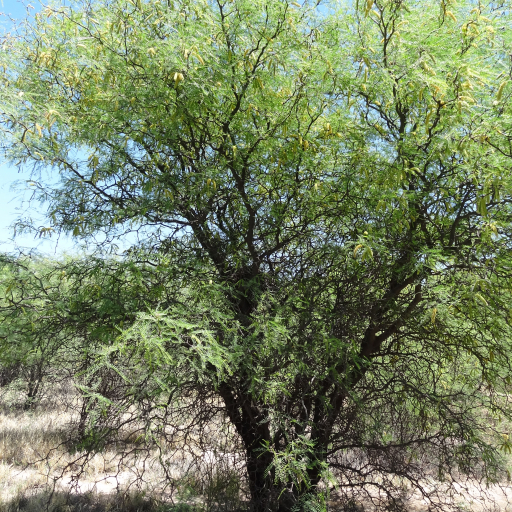
Plant Overview
Known as the "Algarrobo Dulce" or Sweet Carob, Prosopis flexuosa is a legendary survivor of the South American arid plains. In the harsh landscapes of Argentina and Chile, this tree is often called the "Tree of Life" because it provides shade, timber, and highly nutritious food where little else grows. Its twisted, artistic trunk tells a story of endurance against wind and heat.
🔍 How to Identify
- 🌿 Feathery Foliage: The leaves are bipinnate and delicate, giving the tree a light, airy appearance that allows filtered sunlight to reach the ground.
- 🦴 Tortuous Trunk: It rarely grows straight; instead, the trunk is often dark, deeply fissured, and "flexuose" (zigzagging or wavy), creating a sculptural silhouette.
- 🟡 Golden Spikes: In spring, it produces cylindrical, pale-yellow flower clusters that look like soft bottle brushes and attract a frenzy of pollinators.
- 🥜 Sweet Pods: The fruit is a long, flattened legume that turns yellow with violet streaks when ripe. These pods are famously sweet and pulpy.
🏡 In Your Garden
- 💧 The Deep Drinker: This plant possesses an incredibly deep taproot system designed to find groundwater meters below the surface. Because of this, it hates being moved once established; transplanting an older specimen is almost always fatal.
- 🏜️ Salt & Sand Specialist: It is one of the few trees that thrives in saline or sandy soils. It actually improves the ground around it by "fixing" nitrogen, essentially fertilizing the soil for neighboring plants.
- ☀️ Architectural Shade: While it grows slowly, it creates a "cool microclimate" under its canopy, making it a perfect center-piece for xeriscaped (water-wise) gardens.
⚠️ Safety & Toxicity
- ✅ Safe & Nutritious: The pods of the Prosopis flexuosa are non-toxic and have been a staple food for indigenous cultures for centuries. They are often ground into a sweet flour called patay.
- 🌵 Physical Hazards: Watch out for the thorns! Like many desert dwellers, it protects itself with stout, paired spines at the base of its leaves that can easily puncture skin or bicycle tires.
- 🐾 Pet Friendly: It is generally safe for livestock and pets, who often enjoy snacking on the fallen, sugary pods.
✨ Fun Fact
The pods of this tree are used to create a traditional fermented beverage called Aloja. For many indigenous groups in the Gran Chaco region, the "Algarrobeada" (the harvest season) is still a time of major cultural celebration and community gathering.

Detailed Care Instructions
To grow a Prosopis Flexuosa plant, also known as the Argentine mesquite or algarrobo tree, follow these steps:
- Choose the right location: Prosopis Flexuosa plants thrive in well-draining soil and full sun. Select a spot in your garden or outdoor space that receives at least 6-8 hours of direct sunlight per day.
- Prepare the soil: Ensure the soil is loose, well-draining, and deep. If the soil is clay-heavy, add organic matter such as compost to improve its drainage and fertility.
- Germinate the seeds: Prosopis Flexuosa plants primarily propagate through seeds. Soak the seeds in warm water for a few hours or overnight to soften the hard outer layer. Plant the seeds in small pots filled with moist well-draining soil. Place the pots in a warm location or use a heating mat to maintain a temperature of around 80°F (27°C). Keep the soil consistently moist but not waterlogged.
- Provide optimal conditions: Once the seedlings emerge, place them in a sunny location. Maintain a warm temperature and ensure they receive adequate water. Water the plants deeply but allow the soil to dry partially between waterings. Avoid overwatering as it may lead to root rot.
- Transplanting: Once the seedlings are a few inches tall and have a sturdy root system, they can be transplanted outdoors. Choose a location with the right soil conditions and plenty of sunlight. Dig a hole slightly larger than the root ball of each seedling and gently place it in the hole. Backfill the hole with soil while lightly firming it around the roots. Water thoroughly after transplanting to help the plant establish in its new environment.
- Care and maintenance: Prosopis Flexuosa plants are drought-tolerant but require regular watering during the first few years until they establish a strong root system. After that, they will be more resilient to dry conditions. Mulching around the base of the plant can help retain moisture and suppress weed growth. Fertilizer may not be necessary as these plants can fix nitrogen from the air, but if desired, a balanced slow-release fertilizer can be applied in spring.
- Pruning and shaping: As the Prosopis Flexuosa plant grows, it may require minimal pruning to remove dead or damaged branches. Pruning should be done in late winter or early spring before new growth emerges. Young plants can be shaped by pruning to encourage a desired growth pattern.
By following these steps and providing the appropriate care, your Prosopis Flexuosa plant should grow and thrive in your garden.
Prosopis Flexuosa is a plant species that requires regular watering to maintain its health and growth. The frequency and amount of water required depends on various factors like soil moisture level, weather conditions, and plant size.
When watering the plant, it is essential to avoid wetting the foliage and saturating the soil, as it can lead to root rot or fungal diseases. Instead, water should be applied directly at the base of the plant, and the soil should be allowed to dry out partially before the next watering.
To water the plant, fill a watering can or bucket with water and slowly pour it around the base of the plant, ensuring that the water seeps into the soil and reaches the roots. It is better to water the plant early in the morning or late in the day when the heat is minimal, as it will reduce evaporation and improve water absorption.
During periods of drought or hot weather, the plant may require more frequent watering to prevent stress and preserve its vitality. However, excessive watering or waterlogging should also be avoided, as it can deprive the roots of oxygen and cause damage.
Overall, watering Prosopis Flexuosa is a straightforward process that requires careful attention to the plant's needs and environmental factors. With proper watering and care, the plant can thrive and enhance the beauty of its surroundings.
To properly fertilize this plant, use a balanced fertilizer with a ratio of 10-10-10 or 20-20-20. Apply the fertilizer in early spring, before new growth starts, and again in midsummer. Spread the fertilizer evenly around the base of the plant, avoiding direct contact with the stem or foliage. Water the plant thoroughly after fertilizing to help the nutrients penetrate the soil. Be careful not to over-fertilize, as this can lead to leaf burn or other damage.
Prosopis Flexuosa plant should be cultivated in soil that has good drainage capabilities and is moderately fertile. The ideal pH for the soil should be between 6.0-8.0, slightly acidic to slightly alkaline. Soil containing sandy loam or loamy sand with low amounts of clay often works the best. Clay soils should be avoided as they retain too much moisture and do not provide good drainage, which can cause root rot. It is also important to add organic matter, such as compost, to the soil before planting, as this can help improve soil structure and water retention. Additionally, soil should be kept moist but not waterlogged, as excessive water can cause root rot and other fungal diseases.
To propagate this plant, you need to collect seeds from mature pods. Once the seeds are collected, they should be scarified or treated with acid to help them germinate. The seeds should be sown in well-draining soil, and kept moist until they germinate. Once they have sprouted, they should be gradually acclimated to the outdoor environment before transplanting into the ground. Alternatively, cuttings can be taken from mature plants during the growing season and rooted in a sandy soil mixture. Rooting hormones may help to increase the success rate of this method. The cuttings should be kept in a humid environment until they have rooted and can be gradually acclimated to the outdoor environment before transplanting.








