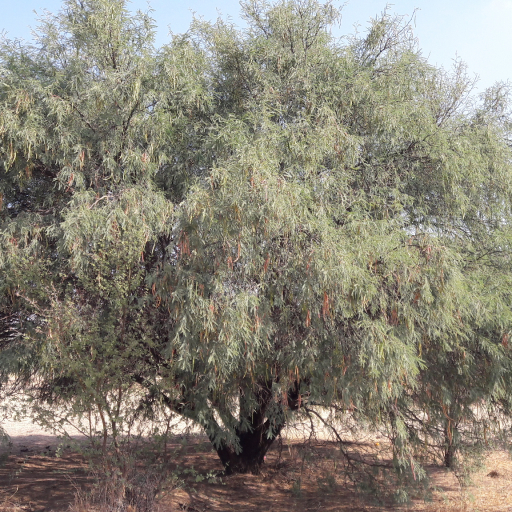
Plant Overview
Often called the "Tree of Life" in its native Mexican landscapes, the Smooth Mesquite is far more than a simple desert shrub. This architectural beauty is a master of survival, known for its ability to thrive in the harshest sun while providing a delicate, lace-like canopy that filters light like stained glass. Historically, it has been a cornerstone species, providing shade, food, and fuel to desert dwellers for millennia.
🔍 How to Identify
- 🌿 Feathery Foliage: The leaves are bipinnate and finely divided into tiny leaflets, giving the tree a soft, fern-like appearance that dances in the slightest breeze.
- 🦴 Zig-Zag Stems: Look closely at the branches; they often grow in a distinct, angular "zig-zag" pattern, typically sporting pairs of sharp, straight thorns at the joints.
- 🌾 Golden Catkins: In the spring and summer, it produces long, cylindrical clusters of pale yellow or cream-colored flowers that resemble fuzzy caterpillars.
- 🫛 Pendant Pods: Following the flowers, long, tan-colored seed pods hang from the branches; unlike many garden peas, these pods do not "pop" open easily on their own.
🏡 In Your Garden
- 🏜️ Drought Champion: This tree is built for extreme heat. It develops an incredibly deep taproot—sometimes reaching dozens of feet underground—to find water where other plants would wither.
- 🌱 Soil Builder: As a member of the legume family, it "fixes" nitrogen into the earth. It actually leaves the soil healthier than it found it, acting as a natural fertilizer for nearby grasses.
- 🌳 Stability Over Speed: While it grows relatively quickly when young, it hates being moved. Because of its sensitive taproot, transplanting a mature Mesquite is rarely successful; pick its "forever home" with care.
⚠️ Safety & Toxicity
- 🌵 Physical Hazard: The primary danger of Prosopis laevigata is mechanical. The thorns are sturdy and very sharp, capable of piercing thin shoes or causing painful punctures to curious pets and children.
- 🐾 Non-Toxic: The plant itself is not known to be poisonous to cats, dogs, or horses. In fact, many livestock species enjoy grazing on the fallen seed pods.
- 🧤 Handling Note: Always wear heavy-duty leather gloves when pruning to avoid "Mesquite thumb," a common injury among desert gardeners.
✨ Fun Fact
The seed pods of the Smooth Mesquite are surprisingly sweet! For centuries, indigenous groups have ground these pods into a nutrient-dense, gluten-free flour used to make cakes and a traditional fermented drink called tesgüino.

Detailed Care Instructions
To grow a Prosopis laevigata plant, also known as the smooth mesquite, you can follow these steps:
- Climate and Location: Ensure that you live in a region with a suitable climate for the plant. Prosopis laevigata thrives in warm and dry climates, such as parts of the southwestern United States and northern Mexico.
- Soil: The plant prefers well-draining soil, so make sure the soil is sandy or loamy. It should not retain excessive moisture.
- Seeds: Obtain Prosopis laevigata seeds from a reputable source. You can also collect them from mature pods that have fallen from the tree. Soak the seeds in warm water for 24 hours before planting to enhance germination.
- Planting: Choose a sunny location with enough space for the tree to grow. Dig a hole that is twice as wide and deep as the root ball. Place the seeds or seedlings into the hole, ensuring they are at the same depth as they were in the container.
- Watering: Water the seedlings or newly planted seeds gently but deeply. Keep the soil consistently moist but not waterlogged. Once the plant is established, it can tolerate drought conditions.
- Mulching: Add a layer of organic mulch (e.g., wood chips or straw) around the base of the plant to retain moisture and suppress weed growth. However, ensure the mulch doesn't touch the stem directly.
- Pruning: As the plant grows, occasionally prune it to remove dead or damaged branches and maintain a desired shape. Pruning will also help promote healthy growth.
- Maintenance: Monitor the plant for pests and diseases. Treat any issues promptly to prevent damage. Control the growth of weeds around the tree.
Remember that Prosopis laevigata plantings may require permits or permissions in certain areas, so be sure to check local regulations before planting.

Place in a bright room that is sun drenched almost all day. Or directly in a south-facing window.

The best way to water this plant is to slowly and deeply saturate the soil around its base, making sure the water reaches the roots. Watering too often and with shallow amounts of water can lead to shallow roots and poor growth. It is preferable to water this plant in the morning or late afternoon to avoid water loss through evaporation during the heat of the day. Additionally, it is important to observe the plant and the soil and adjust watering frequency and amount depending on the plant's needs and the weather conditions. Proper watering will help this plant thrive and maintain its health and beauty.
To fertilize this plant, you should first identify the specific nutrient deficiencies it may have by conducting a soil test. Based on the results, choose a balanced fertilizer with the appropriate ratio of nitrogen, phosphorus, and potassium. Apply the fertilizer evenly around the plant's drip line, avoiding direct contact with the trunk or foliage. Water the plant thoroughly after fertilizing to promote nutrient uptake. Repeat fertilization every 3-4 months during the growing season.
The ideal soil for the Prosopis Laevigata plant should have good drainage and be able to retain moisture. It should also be well-aerated and have a balanced pH, preferably between 6.0-8.0. The soil should be rich in organic matter, such as compost oraged manure, to promote healthy growth and nutrient uptake. Additionally, the soil should have a good mixture of sand, silt, and clay to enhance soil structure and prevent compaction. It is also recommended to add a slow-release fertilizer to the soil before planting to support initial growth.
Propagation of this plant can be done through various methods such as seeds, cuttings, and grafting. For seed propagation, collect mature pods from the plant when they are mature and dry. Break open the pods to obtain the seeds, which should be soaked in warm water for a few hours to encourage germination. Plant the seeds in a pot filled with well-draining soil and keep it moist until the seedlings emerge.
For cuttings, select a stem with a diameter of at least 1 cm and cut it at a sharp angle. Dip the cut end in a rooting hormone powder and plant it in a pot with moist soil. Keep the soil moist and place the pot in an area of indirect sunlight until roots have formed.
Grafting is another method of propagating this plant. Choose a healthy stem from a mature plant to use as the rootstock. Cut off the top part of the stem and make a horizontal cut on the stem, about one-third of the way down. Take a healthy stem from the desired cultivar and make a slanted cut on one end. Insert the slanted end of the stem into the horizontal cut of the rootstock and secure it with twine or grafting tape. Cover the graft with grafting wax to protect it until it begins to grow.








