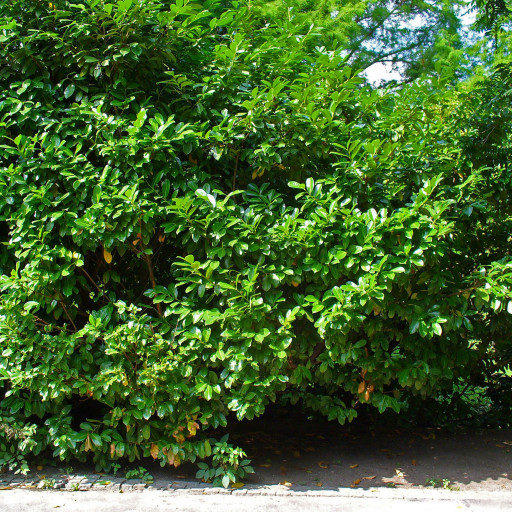
Plant Overview
Often called the Cherry Laurel or English Laurel, this robust evergreen is the king of privacy. Though its name suggests a relation to the bay laurel used in cooking, it is actually a member of the plum and cherry family (Prunus). Prized for its glossy, "polished" foliage and its ability to grow rapidly into a dense, living wall, it has been a staple of European and American estate gardens for centuries.
🔍 How to Identify
- 🍃 Leathery Leaves: The foliage is thick, oblong, and exceptionally shiny. The tops are a deep, forest green, while the undersides are a paler, matte lime.
- 🕯️ Candle-like Blooms: In mid-spring, it produces upright spikes (racemes) of tiny, creamy-white flowers that look like fuzzy white candles sticking out from the branches.
- 🍒 Dark Drupes: Small, cherry-like fruits appear after flowering. They start green, turn red, and eventually ripen into a deep, glossy black.
🏡 In Your Garden
- 🧱 The Ultimate Screen: Because it grows so densely and quickly, it is perfect for blocking out noisy neighbors or unsightly views. It handles heavy "hard pruning" remarkably well, allowing you to shape it into formal geometric hedges.
- 🌑 Shade Warrior: Unlike many flowering shrubs that demand full sun, the Cherry Laurel is incredibly versatile. It will happily thrive in deep shade, making it a "problem solver" for those dark corners of the yard where nothing else grows.
- 🌱 Soil Flexibility: It isn't picky about soil types but prefers well-drained ground. Its only real "complaint" is "wet feet"—it may develop root rot if left in standing water for too long.
⚠️ Safety & Toxicity
- 🚫 High Toxicity: WARNING. All parts of the plant, especially the leaves and the seeds inside the berries, contain cyanogenic glycosides.
- 🐾 Pet & Child Risk: If ingested, the plant can release hydrogen cyanide. Keep it away from curious pets and children. Even wilting leaves are dangerous as they can smell faintly of bitter almonds, signaling the presence of toxins.
✨ Fun Fact
Despite its name and look, the Cherry Laurel is more closely related to a Peach than it is to a true Laurel. If you crush a leaf, you might catch a distinct scent of marzipan or almonds—this is actually the chemical signature of the cyanide compounds within the plant!

Detailed Care Instructions
Cherry laurels can live to more than 100 years old.
How fast do cherry laurels grow?
This fast-growing shrub can grow over 25 inches per year.
What’s an alternative to cherry laurel?
Inkberry holly is another shrub that works well as an evergreen hedge. It has smooth leaves, unlike other holly bushes, and dark berries that are also toxic.
| Color | Green Foliage And Cream-White Blossoms |
| Soil Ph | 4.5-7.8 |
| Humidity | Dry |
| Invasive | Weed |
| Lighting | Full Sun |
| Toxicity | Poisonous |
| Soil Type | Well-Draining, Peaty Soil |
| Bloom Time | Spring |
| Difficulty | Easy |
| Plant Type | Perennial |
| Hibernation | Cold Period |
| Mature Size | 10-18-Inches Tall And 20-25-Inches Wide |
| Native Area | Southwestern Asia And Southwestern Europe |
| Temperature | 18°C - 25°C |
| Sun Exposure | Full Sun To Partial Sun, But Will Also Grow In The Shade |
| Hardiness Zones | 6-8 |
To grow a Prunus Laurocerasus plant, also known as cherry laurel or English laurel, you can follow these steps:
- Choose the right location: Prunus Laurocerasus prefers full sun to partial shade. Ensure the planting area has well-draining soil.
- Soil preparation: Amend the soil with organic matter, such as compost, to improve its fertility and drainage. This will create a favorable growing environment for the plant.
- Planting: Dig a hole slightly larger than the plant's root ball. Place the plant into the hole, making sure it is at the same depth as it was in its original container. Backfill the hole with soil and firm it gently around the roots.
- Watering: Water the newly planted Prunus Laurocerasus thoroughly and keep the soil consistently moist during its establishment period.
- Mulching: Apply a layer of organic mulch around the base of the plant, leaving a small gap around the trunk. Mulching helps to conserve soil moisture, suppress weed growth, and regulate soil temperature.
- Pruning: Prunus Laurocerasus responds well to pruning. If you want a shrub shape, you can trim it lightly after planting. For hedges, trim them to the desired shape and size during the appropriate season.
- Fertilizing: Apply a slow-release balanced fertilizer in early spring to promote healthy growth. Follow the instructions on the fertilizer package for the appropriate dosage.
- Pests and diseases: Monitor the plant regularly for any signs of pests or diseases, such as aphids, scale insects, or root rot. If an issue is detected, take appropriate measures to control the problem, such as using insecticidal soaps or consulting a professional.
Remember to research and understand the specific needs of the Prunus Laurocerasus cultivar you have to provide optimum care for the plant.

Place in a window with dappled sun or a spot in the middle of a room. Or directly in a window facing west or east.

To water this plant, you should first check the soil to ensure it is dry before watering. Using a watering can or hose, slowly and evenly water the soil around the plant, being careful not to splash water onto the leaves or stems. Wait until the soil is slightly dry to the touch before watering again, as overwatering can cause root rot. It is also important to ensure that the plant receives adequate drainage to prevent waterlogging. Regular watering during the growing season is important, but be sure to reduce watering during the winter dormant period.
- Choose a balanced, slow-release fertilizer with equal proportions of nitrogen, phosphorus, and potassium.
- Apply the fertilizer in early spring before new growth appears.
- Use a granular fertilizer and sprinkle it around the base of the plant.
- Be careful not to let the fertilizer touch the foliage or stems as this can cause burning.
- Water the plant thoroughly after fertilizing to help the nutrients soak into the soil.
- Repeat fertilization once every year for optimal growth and health of the plant.
The ideal soil for a certain plant, which is typically grown as an ornamental shrub, should be well-draining and slightly acidic with a pH range of 5.5-6.5. The soil must be rich in organic matter and should have a loamy texture to promote healthy root growth. It is recommended to mix the planting hole’s native soil with organic compost and bark to improve aeration and drainage, also the addition of sulfur can help to acidify the soil. This plant is adaptable and can grow in various types of soils, but avoiding heavy clay soils that retain water is essential, as it can lead to root rot and stunted growth. Lastly, frequent mulching around the plant can help conserve moisture, reduce weed growth and break down nutrients more effectively.
To propagate this plant, take cuttings from the stem in the summer when the plant is actively growing. The cuttings should be around 6 inches long and should be taken from the tip of the stem. Remove the lower leaves from the cutting and dip the end of the cutting in rooting hormone. Plant the cutting in potting soil and place it in a warm, bright location. Keep the soil moist and wait for roots to develop. Once roots have formed, transfer the plant to a larger pot or plant it in the ground.
Common pests of the cherry laurel include Scale insect, aphids, larvae. Make a habit of checking your cherry laurel frequently for pests so that any infestations can be caught and managed early.








