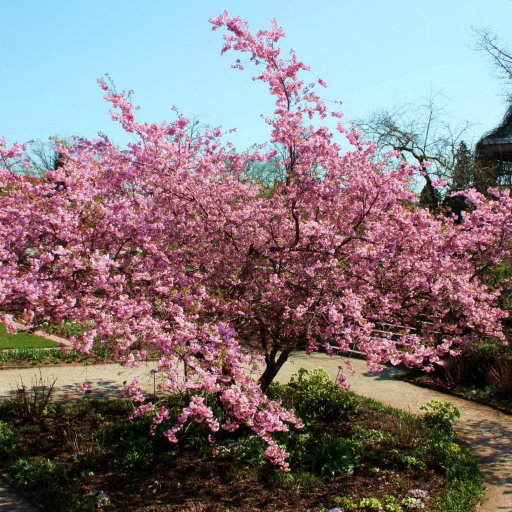
Plant Overview
Known as the "Sargent’s Cherry" or the "North Japanese Hill Cherry," this tree is a true four-season showstopper. While many ornamental cherries fade into the background after their spring bloom, the Sargentii keeps the drama going with its glossy mahogany bark and a fall foliage display that rivals the most vibrant maples. It is widely considered one of the hardiest and most elegant of all the flowering cherries.
🔍 How to Identify
- 🌸 The Blossoms: Large, single, deep-pink flowers that appear in early spring, often arriving in clusters of two to four just before the leaves fully unfurl.
- 🍃 Transforming Foliage: The leaves emerge with a distinct bronze or purple tint, mature into a deep, glossy green, and then ignite into fiery shades of orange and scarlet in autumn.
- 🪵 Polished Bark: The trunk features a stunning, smooth bark that looks almost metallic, colored in shades of reddish-brown to polished mahogany with prominent horizontal "breathing pores" called lenticels.
🏡 In Your Garden
- ☀️ Sun Seeker: This tree thrives best in wide-open spaces with full sun exposure. Maximum sunlight is the secret to getting the highest bloom count and the most intense fall colors.
- 💧 Drainage is Key: While it is more resilient than many of its delicate cherry cousins, it cannot tolerate "wet feet." It requires well-drained soil and will struggle in heavy clay or areas where water tends to pool.
- 🌳 Growth Habit: It naturally develops a graceful, upright-vase shape. Because it is a relatively fast grower for a cherry, it provides excellent "quick shade" for medium-sized lawns.
⚠️ Safety & Toxicity
- 🐾 Toxic to Pets: Like many members of the Prunus genus, the leaves, stems, and especially the pits of the small fruits contain cyanogenic glycosides.
- 🚫 Risk Level: These compounds can be toxic to dogs, cats, and horses if ingested. It is best to rake up fallen fruit or wilted leaves if you have curious pets that like to snack on garden debris.
✨ Fun Fact
🎓 A Living Legacy: The tree was named after Charles Sprague Sargent, the founding director of Harvard University’s Arnold Arboretum. He first introduced this species to North America in 1890 after discovering it growing wild in the mountains of Northern Japan.

Detailed Care Instructions
To help your Prunus Sargentii plant grow, you can follow these steps:
- Planting: Choose a location with well-draining soil and full sun to partial shade. Prunus Sargentii prefers slightly acidic soil.
- Soil preparation: Before planting, amend the soil with organic matter to improve its fertility and drainage. Mix in compost or well-rotted manure.
- Watering: Provide consistent moisture, especially during the growing season. Water deeply but avoid waterlogging the soil. It is better to water deeply and less often rather than light, frequent waterings.
- Mulching: Apply a layer of organic mulch around the base of the plant to help conserve moisture, control weeds, and regulate soil temperature.
- Fertilizing: Prunus Sargentii doesn't require heavy fertilization, but you can apply a balanced slow-release fertilizer during the spring to promote healthy growth. Follow the package instructions for the recommended dosage.
- Pruning: Prune the plant during the dormant season to remove any dead, damaged, or diseased branches. This will help maintain a healthy and attractive shape for the plant.
- Pest and disease control: Monitor your plant regularly for any signs of pests or diseases. Common issues include aphids, caterpillars, and fungal diseases like leaf curl. Apply appropriate pesticides or seek professional advice if necessary.
- Winter protection: Prunus Sargentii is hardy, but it's a good idea to protect young plants with a layer of mulch or burlap during harsh winters, especially in colder regions.
- Propagation: If you want to propagate more Prunus Sargentii plants, you can do so by collecting seeds from the fruits in the autumn or by taking softwood cuttings in early summer and rooting them in moist soil or a rooting hormone.
Remember to research and understand specific care requirements for your plant species as it may differ slightly from general guidelines.

Place in a bright room that is sun drenched almost all day. Or directly in a south-facing window.

To properly water this plant, you should first consider the soil conditions. The soil should be moist but not waterlogged. You can test this by sticking your finger about an inch deep into the soil and feeling for moisture. If it feels dry, it's time to water.
When watering, use a watering can or hose with a soft spray nozzle to avoid damaging the plant. Water around the base of the plant, making sure to cover the root zone. Avoid getting water on the leaves, as this can lead to fungal diseases.
The frequency of watering will vary depending on the climate and season. In general, this plant prefers moist soil and may require more frequent watering during hot, dry weather.
It's important to avoid overwatering, as this can lead to root rot and other problems. If the soil feels consistently soggy, cut back on watering and ensure proper drainage.
Overall, the key to watering this plant is to monitor soil moisture levels and adjust watering frequency as needed to keep the soil consistently moist but not waterlogged.
- Choose a high-quality, well-balanced fertilizer suitable for flowering trees.
- Before applying the fertilizer, make sure the soil around the plant is moist.
- Follow the recommended dosage on the fertilizer package.
- In early spring or late fall, apply the fertilizer around the base of the plant, but avoid directly applying it to the trunk or leaves.
- Use a rake or hoe to lightly work the fertilizer into the topsoil.
- Water the plant thoroughly after fertilizing.
- Repeat the fertilization process once a year in the spring or fall, depending on the preferred schedule for the specific fertilizer and plant.
Prunus Sargentii plant requires well-draining soil that is rich in organic matter. The soil should have a slightly acidic pH level, ideally between 5.5 and 6.5. It is recommended to use a soil mixture that is comprised of equal parts of peat moss, sand, and loam soil. The plant prefers a slightly moist, but not waterlogged soil. Avoid using heavy clay soils or soils that do not drain well, as this can lead to root rot and other soil-borne diseases. Regular fertilization with a balanced fertilizer can help to ensure that the plant receives the nutrients it needs to thrive in the soil.
Prunus Sargentii can be propagated through a variety of methods, including seeds, cuttings, and grafting. To propagate through seeds, collect mature fruit in the fall and extract the seeds. The seeds should be stratified in moist soil or sand for several months before planting in the spring.
To propagate through cuttings, select healthy, semi-hardwood stems in the summer or early fall and prepare them by removing the leaves and making a 45-degree angle cut at the base of the stem. Dip the cut end in rooting hormone and plant in a container filled with a moistened mixture of peat moss and perlite. Place the container in a warm, humid location and mist the cuttings regularly.
Grafting is another method of propagation, which involves joining a piece of Prunus Sargentii stem (scion) with a compatible rootstock. This method is most successful when performed in the winter or early spring while the plants are dormant. The scion is attached to the rootstock using a grafting knife and secured with grafting tape and wax.
Regardless of the method used, it is important to keep the soil moist and maintain a consistent, warm temperature to ensure successful propagation.








