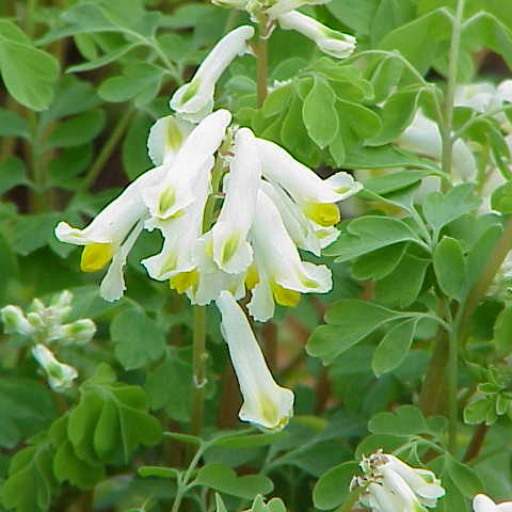
Plant Overview
Often called the White Corydalis or Pale Rock Fumitory, this dainty perennial acts as a living lace for the shadier corners of your garden. Native to the rocky crevices of Southern Europe, it is a marathon bloomer, often pushing out flowers from early spring until the first hard frost. It is a favorite for those looking to achieve a "romantic ruins" or "cottage core" aesthetic, as it effortlessly softens the hard edges of stone walls and gravel paths.
🔍 How to Identify
- 🌿 Lacy Foliage: The leaves are deeply divided and fern-like, displaying a soft blue-green or "glaucous" tint that remains attractive even when the plant isn't in bloom.
- ☁️ Tubular Flowers: The blossoms are small, spurred tubes that hang in delicate clusters; they are creamy white with a distinct yellow "throat" or tip.
- 🏗️ Mound Habit: It grows in a low, cushion-like mound that rarely exceeds 10 to 12 inches in height, giving it a soft, misty appearance from a distance.
🏡 In Your Garden
- 🧱 The Wall Dweller: This plant has a specialized "lithophytic" nature, meaning it loves to grow in the cracks of stone walls or between paving stones where the roots stay cool and the drainage is perfect.
- 🌱 Natural Wanderer: Because it has a sensitive taproot, it hates being moved once established. Instead, it spreads by "exploding" seed pods that fling seeds into nearby crevices, allowing the plant to "find" the best spots in your garden on its own.
⚠️ Safety & Toxicity
- 🚫 Status: Mildly toxic if ingested.
- 🐾 Details: Like many members of the Poppy family, it contains isoquinoline alkaloids. While it is generally avoided by deer and rabbits due to its bitter taste, it should be kept away from curious pets or toddlers, as ingestion can cause stomach upset or lethargy.
✨ Fun Fact
📜 The genus name Pseudofumaria translates to "False Fumitory." The original "Fumitory" plants were named from the Latin fumos terrae (smoke of the earth), because their fine, grayish-green leaves were said to look like smoke rising from the ground in the morning mist.

Detailed Care Instructions
| Humidity | Normal |
| Lighting | Part Sun |
| Difficulty | Medium |
| Hibernation | Cold Period |
| Hardiness Zones | 4A - 8B |
To grow Pseudofumaria Alba (also known as bleeding heart or white bleeding heart), follow these steps:
- Planting conditions: Choose a suitable location that receives partial shade to full shade. The soil should be well-draining, rich in organic matter, and slightly acidic to neutral (pH 5.5-7.0).
- Planting time: Spring is the best time to plant Pseudofumaria Alba, once the soil has thawed and temperatures have started to rise.
- Preparation: Prepare the planting area by removing any weeds or grass. Dig a hole that is twice the size of the rootball and loosen the soil at the bottom. Amend the soil with compost or well-rotted manure to improve its fertility.
- Planting: Gently remove the plant from its container and place it in the center of the hole. Make sure to position it at the same depth it was previously growing. Backfill the hole with the amended soil, firming it gently around the roots. Water thoroughly after planting.
- Watering: Keep the soil consistently moist but not waterlogged. Water deeply when the top inch of soil feels dry. During hot and dry periods, increase the frequency of watering to prevent the plant from drying out.
- Mulching: Apply a layer of organic mulch around the base of the plant to help conserve moisture, suppress weed growth, and regulate soil temperature. It also adds nutrients as it breaks down.
- Pruning: Pseudofumaria Alba doesn't require a lot of pruning. Removing dead or damaged foliage can be done in early spring. After blooming, you can cut back the flower stalks to encourage fresh growth.
- Fertilizing: Apply a balanced, slow-release granular fertilizer in early spring or use a liquid fertilizer every 4-6 weeks during the growing season. Follow the manufacturer's instructions for application rates.
- Dividing: Pseudofumaria Alba can be divided every 3-4 years in early spring. Dig up the plant and carefully separate the clumps into individual sections, ensuring each section has roots attached. Replant the divisions at the same depth and water well.
By following these steps, you can successfully grow Pseudofumaria Alba and enjoy its delicate white flowers in your garden.

Place in a window with dappled sun or a spot in the middle of a room. Or directly in a window facing west or east.

Pseudofumaria Alba plant belongs to the family Papaveraceae and requires regular watering to thrive. To water this plant, you should first check the moisture level of the soil by inserting your finger about 1-2 inches deep into the soil. If the soil feels dry, it's time to water the plant.
When watering, you should aim to moisten the soil evenly around the plant's roots. Avoid splashing water onto the leaves or stem as this can lead to fungal diseases. You can water from above with a watering can or use a drip irrigation system.
Typically, indoor Pseudofumaria Alba plant needs to be watered once a week while outdoor plants may require more frequent watering during hot or dry weather. However, the frequency of watering may vary depending on various factors such as humidity, temperature, and soil type. It's important to monitor the plant regularly and adjust the watering schedule to ensure it doesn't become too dry or waterlogged.
To fertilize this plant, apply a balanced fertilizer with equal amounts of nitrogen, phosphorus, and potassium every two weeks during the growing season. Be sure to dilute the fertilizer to half the recommended strength and apply it to the soil around the plant, avoiding direct contact with the foliage. Water the plant thoroughly after fertilizing and avoid fertilization during periods of drought or extreme temperatures.
Pseudofumaria Alba plant requires a well-draining soil that is rich in organic matter. The ideal soil pH for this plant is slightly acidic to neutral, ranging from 6.0 to 7.0. To ensure proper drainage, the soil should be loose and friable, with good aeration and water-holding capacity. Adding peat moss, compost, or well-aged manure will help improve soil fertility and texture. It is important to avoid using heavy soils or those with high clay content, as this can lead to poor drainage, root rot, and other issues. Additionally, regular fertilization and watering are essential to maintain healthy growth and appearance of the plant.
To propagate this plant, take stem cuttings from healthy and mature plants in the early spring or early summer. Cut a 6-inch long stem with several leaves attached using a clean and sharp pair of scissors. Remove the bottom leaves and dip the cut end of the stem in rooting hormone powder. Place the stem cutting in a pot filled with moist potting soil and cover it with a plastic bag to create a humid environment. Keep the soil moist and place the pot in a shaded area with indirect sunlight. After a few weeks, check for roots by gently tugging on the stem. Once there are roots, remove the plastic bag and move the plant to a bright location with partial shade. Allow the plant to grow for a few weeks before transplanting it to a larger pot or directly into the garden.








