Plant Overview
Known as the Chinese Douglas-fir, this majestic evergreen is the Asian cousin of the famous North American timber giant. Though its name Pseudotsuga translates to "false hemlock," this tree is a powerhouse in its own right, often found clinging to the rocky slopes and misty mountains of China and Vietnam. In its native habitat, it is a symbol of endurance, surviving in high-altitude environments where few other large trees can thrive.
🔍 How to Identify
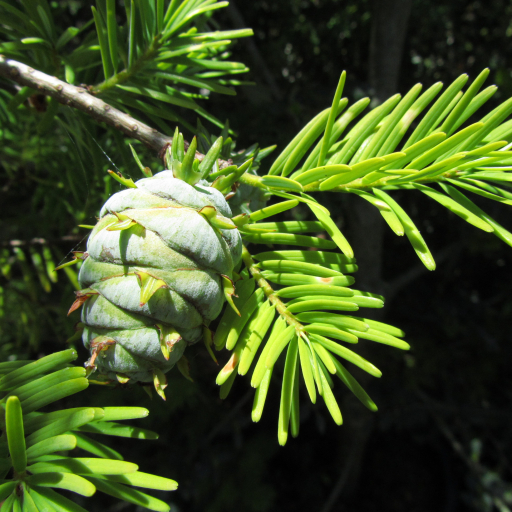
- 🌲 The Cones: The most unmistakable feature is the woody cone, which features "three-pointed" bracts that stick out past the scales. These look like the back half of a tiny mouse diving into the cone!
- 🌿 The Needles: Unlike the prickly needles of a spruce, these are flat, soft to the touch, and usually have two pale white stripes (stomatal bands) on the underside.
- 🪵 The Bark: Young trees have smooth, grayish bark, but as the tree reaches its massive potential, the bark becomes thick, corky, and deeply scarred with vertical furrows.
🏡 In Your Garden
- ⛰️ Mountain Heritage: Because this tree evolved in high-altitude regions, it prefers cool, humid air and well-draining, slightly acidic soil. It struggles in stagnant, clay-heavy ground where water pools around the roots.
- ⏳ Patience is Key: The Chinese Douglas-fir is a slow-grower compared to its American relatives. It invests its energy into a deep root system first, making it quite wind-resistant once established, but it won't provide instant shade in a single season.
⚠️ Safety & Toxicity
- ✅ Safe Status: This tree is considered non-toxic to humans, cats, and dogs. It is not known to contain any of the volatile alkaloids found in true "Hemlock" (which is a flowering plant, not a conifer).
- 💧 Resin Warning: Like most firs and pines, the tree produces a sticky resin. While not poisonous, the sap can be difficult to remove from fur or clothing and may cause mild skin irritation for people with specific sap allergies.
✨ Fun Fact
The "mousetail" bracts on the cones are part of a charming piece of folklore: it is said that during ancient forest fires, tiny mice would hide inside the scales of the Douglas-fir cones to stay safe, leaving only their tails and hind legs sticking out!

Detailed Care Instructions
To grow Pseudotsuga sinensis, also known as Chinese Douglas fir, follow these steps:
- Select appropriate planting location: Choose a location that receives full sun to partial shade and provides well-draining soil. Ensure the area is not prone to waterlogging or heavy wind.
- Obtain plant material: You can either search for saplings at local nurseries or order seeds or cuttings from specialized seed suppliers.
- Prepare the soil: Chinese Douglas firs prefer slightly acidic soil, preferably with a pH between 6.5 and 7.5. Amend the soil with organic matter like compost to improve its fertility and drainage.
- Planting the saplings: If you purchase young saplings, dig a hole slightly larger than the root ball, place the roots gently, and backfill with soil, ensuring the crown stays at soil level. Water the sapling thoroughly after planting.
- Watering: Pseudotsuga sinensis prefers average moisture levels, so water regularly but avoid overwatering. Ensure that the soil remains evenly moist but not waterlogged.
- Mulching: Apply a layer of organic mulch, such as wood chips or bark, around the base of the plant to conserve moisture, suppress weed growth, and provide insulation.
- Fertilization: Chinese Douglas firs generally do not require much fertilization. However, you can apply a slow-release, balanced fertilizer in early spring to promote growth and health.
- Pruning: Minimal pruning is typically needed for Pseudotsuga sinensis. Remove any dead, damaged, or diseased branches as necessary to maintain the plant's overall shape and health.
- Protection: Consider providing protection against extreme weather conditions like strong winds or heavy snowfall, especially for young, vulnerable plants.
- Monitoring and maintenance: Regularly monitor the plant for pests, diseases, and any signs of distress. Treat any issues promptly as they arise.
- Patience: Pseudotsuga sinensis is a slow-growing tree and may take several years to reach maturity. Be patient and provide consistent care, and you will be rewarded with a beautiful, healthy tree.

Place in a bright room that is sun drenched almost all day. Or directly in a south-facing window.

To water this plant, it is important to ensure that the soil remains moist but not waterlogged. This can be achieved by using a watering can or hose to slowly and evenly distribute water around the plant's base, allowing it to soak into the soil. It is important to avoid watering the foliage, as this can lead to fungal growth and damage the leaves. It may also be helpful to monitor the soil moisture levels using a moisture meter or by sticking a finger into the soil. If the soil feels dry to the touch, watering is necessary. However, if the soil feels wet or waterlogged, it is important to hold off on watering until the excess moisture has had a chance to drain away. Finally, it is also important to water this plant regularly, particularly during hot, dry weather, to prevent stress and ensure healthy growth.
To fertilize this plant, choose a well-balanced fertilizer with equal ratios of nitrogen, phosphorus, and potassium. Apply the fertilizer during the growing season, typically from late winter to early summer. Be sure to water the plant thoroughly before and after applying the fertilizer. Avoid over-fertilizing, as this can lead to excessive growth and weaker branches. Use a light hand when applying the fertilizer, following the manufacturer's instructions carefully.
For optimal growth and health of the plant, it is recommended to use well-draining soil that is rich in organic matter. The pH of the soil should be slightly acidic, ideally between 5.0 and 6.5. The soil should also be able to retain moisture without becoming waterlogged or soggy, as the plant prefers a moist but not wet environment. Additionally, adding a layer of mulch around the base of the plant can help maintain soil moisture and provide nutrients as it decomposes over time.
To propagate this plant, you will need to gather mature cones from a healthy tree. These cones should be collected when they are brown and fully matured. Once they are collected, the cones should be opened to extract the seeds. These seeds should be cleaned and dried thoroughly before planting.
To plant the seeds, fill a container with well-draining soil and place the seeds on top. Cover the seeds with a thin layer of soil and water thoroughly. The container should be placed in a warm, sunny location but protected from direct sunlight.
The seeds will germinate within a few weeks, and once they have established roots, they can be transplanted into larger containers or planted in the ground. When planting in the ground, make sure to choose a location that receives partial shade and has well-draining soil.
Young plants should be watered regularly but not overwatered, as this can cause root rot. Fertilize the plant once a year in the spring to promote healthy growth. With proper care, this plant can grow into a tall, majestic tree.








