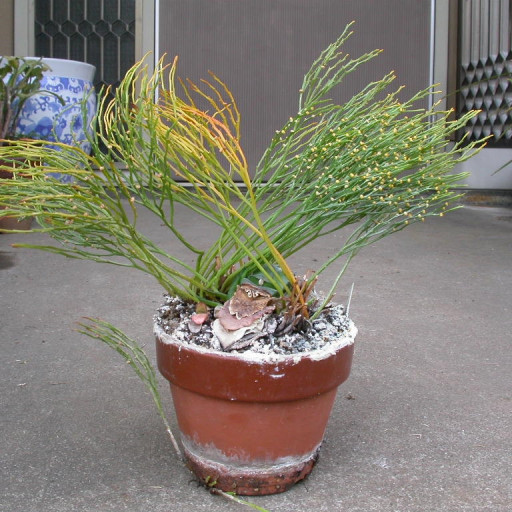
Plant Overview
Known affectionately as the "Whisk Fern," Psilotum nudum is a living relic of the prehistoric world. It is a botanical anomaly that lacks the complex parts we expect from modern plants—it has no true roots and no true leaves. Instead, it looks like a bundle of bright green, Y-shaped twigs that seem to have stepped straight out of the Devonian period.
🔍 How to Identify
- 🌿 Branching Pattern: The plant is easily recognized by its "dichotomous" branching, where the stems repeatedly split into two equal parts, creating a geometric, wiry appearance.
- 🟡 Spore Cases: During the reproductive phase, it produces small, three-lobed yellow nodules called synangia. These look like tiny yellow pumpkins attached directly to the stems.
- 🍃 Scale-like Appendages: If you look closely, you won't see leaves, but rather tiny, scale-like outgrowths called prophylls that are scattered along the ridged green stems.
🏡 In Your Garden
- 🧱 Soil & Anchoring: In nature, this plant often grows as an epiphyte (on trees) or a lithophyte (on rocks). Because it lacks a traditional root system, it hates "wet feet" and dense soil; use a coarse, bark-based orchid mix to keep its underground rhizomes happy.
- 💧 Humidity Needs: As a primitive plant, it is very reliant on moisture in the air. It thrives in high-humidity environments like terrariums or greenhouses, where it can absorb water through its stems and rhizomes without the risk of drying out.
⚠️ Safety & Toxicity
- 🐾 Non-Toxic Status: Psilotum nudum is generally considered to have low toxicity to humans and common household pets. It is not known to contain the dangerous alkaloids found in some other primitive plants like Horsetails.
- 🚫 Not for Consumption: While not "poisonous" in the traditional sense, it is not edible. Ingesting the fibrous, rigid stems would likely lead to digestive discomfort or nausea.
✨ Fun Fact
Despite being called a "Whisk Fern," it isn't actually a true fern! It belongs to one of the most primitive lineages of vascular plants still alive today, and its ancestors were among the very first plants to successfully colonize the Earth's dry land nearly 400 million years ago.

Detailed Care Instructions
Psilotum Nudum, commonly known as whisk fern or skeleton fork fern, is a unique plant that requires specific conditions for optimal growth. Here are some steps to help you grow Psilotum Nudum:
- Environmental Conditions: Psilotum Nudum prefers a warm and humid environment similar to its natural habitat. Provide a temperature range between 20-30°C (68-86°F) and humidity of around 60-70%. Avoid cold drafts and temperature fluctuations.
- Light: These plants prefer bright indirect light. Place them near a window where they receive filtered or indirect sunlight throughout the day. Avoid prolonged exposure to direct sunlight as it can damage the foliage.
- Soil: Psilotum Nudum thrives in well-draining soil that mimics its natural habitat. Use a mixture of equal parts peat moss, perlite, and sand. This combination ensures good drainage while retaining some moisture.
- Watering: Maintain evenly moist soil. Water the plant when the top inch of soil feels dry to the touch. Avoid overwatering, as it can lead to root rot. Mist the plant occasionally to provide additional humidity.
- Fertilization: Psilotum Nudum does not require frequent fertilization. However, you can use a diluted balanced liquid fertilizer once every two months during the growing season (spring and summer). Follow the package instructions for proper dilution ratios.
- Propagation: Psilotum Nudum can be propagated through spores or rhizome division. Spores can be collected from mature plants and sown on a moist peat-based soil mix. Place a plastic bag over the container to create a humid environment and keep the soil consistently moist until the spores germinate. Rhizome division involves separating the plant into smaller sections with roots and replanting them in a new container.
- Pruning: Prune any dead or damaged fronds to maintain a neat and healthy appearance. Remove any brown or yellowing foliage to prevent disease or pest problems.
Remember that Psilotum Nudum is a slow-growing plant, so be patient with its growth. With proper care and attention, you can successfully cultivate this unique plant.

Place in a window with dappled sun or a spot in the middle of a room. Or directly in a window facing west or east.

To water this plant, it is important to use room temperature water. Avoid using water that is too cold or too hot as it can damage the roots. Water the plant thoroughly but avoid overwatering, as that can also damage the plant. Allow the soil to dry out slightly between waterings, but don't let it completely dry out. The plant also prefers a humid environment, so misting the leaves with water a few times a week can also be beneficial.
To fertilize this plant, you should use a balanced liquid fertilizer that is diluted in water to half the recommended strength. Apply the fertilizer once per month during the growing season, which runs from spring to fall. Be careful not to over-fertilize, as this can damage the plant's delicate root system. Always water the plant thoroughly before and after applying fertilizer.
The best soil to use with this plant is a well-draining, aerated soil mixture. It should be sandy and slightly acidic with a pH range of about 5.0 to 6.5. The soil should have a good amount of organic matter, but should not be too rich in nutrients, as this can lead to excessive growth and decreased plant health. It is important to maintain consistent moisture levels, but the soil should not be waterlogged. Fertilization should be minimal and only during the plant's active growth period. Overall, the soil should mimic the plant's natural habitat, which is typically in rocky or sandy areas with low fertility.
To propagate this plant, one can first obtain a mature plant with healthy fronds. Next, carefully remove a few fronds from the mature plant, making sure to include a section of the rhizome (underground stem).
Place the fronds with rhizome section in a container or tray filled with moist peat moss or soil. Cover the container with a plastic bag to create a humid environment and mist the fronds regularly to keep them moist.
Keep the container in a location with bright, indirect light and maintain a temperature of around 70-75°F (21-24°C). After a few weeks, new fronds should begin to emerge from the rhizome section, indicating successful propagation.
Once the new fronds have grown large enough, they can be transplanted to individual pots with well-draining soil and maintained as mature plants.








