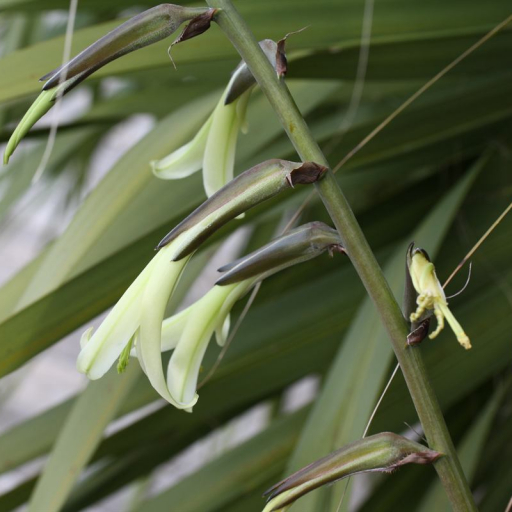
Plant Overview
Hailing from the high altitudes of the Bolivian and Argentine Andes, Puya mirabilis is often called the "Spectacular Puya" for good reason. Unlike its massive, slow-growing relatives that can take decades to bloom, this graceful bromeliad is the "overachiever" of the family, often producing stunning, orchid-like flowers in just a few years. It brings a touch of rugged Andean elegance to any collection, acting as a magnet for hummingbirds with its nectar-rich blossoms.
🔍 How to Identify
- 🍃 The Rosette: It forms a fountain-like cluster of narrow, grass-like leaves that are deep green with a silvery sheen on the underside.
- 🔔 The Flowers: Large, trumpet-shaped blooms that are a unique shade of pale chartreuse or creamy lime-green, hanging elegantly from a dark, velvety flower spike.
- 🪝 The Spines: Look closely at the leaf edges; they are lined with tiny, recurved (hooked) teeth that help the plant "climb" or protect itself in its native rocky habitat.
🏡 In Your Garden
- ⛰️ Highland Resilience: Because it originates from mountain slopes, it thrives in gritty, well-draining soil. It hates "wet feet," so use a cactus or succulent mix to prevent root rot.
- ☀️ Light & Longevity: It craves bright light to trigger its dramatic flowering. While it is monocarpic (the main rosette dies after flowering), don't panic! It will almost always produce "pups" or offsets at the base to carry on its legacy.
⚠️ Safety & Toxicity
- 🛡️ Status: Non-toxic but physically "feisty."
- 🧤 Details: While the plant isn't poisonous to cats, dogs, or humans, those tiny hooked spines along the leaves are very sharp. It’s best to place it away from walkways or areas where curious pets and toddlers might brush against it.
✨ Fun Fact
The name Puya is derived from the Mapuche Indian word meaning "point," referring to the sharp, pointed leaves. Puya mirabilis is also one of the few members of its genus that has a sweet fragrance—most of its relatives rely purely on color to attract pollinators!

Detailed Care Instructions
To grow Puya Mirabilis plant, you can follow these steps:
- Choose the right location: Puya Mirabilis plants prefer bright, indirect sunlight. Place them in a location where they can receive at least 4-6 hours of sunlight daily.
- Soil requirements: Puya Mirabilis prefers well-draining soil. Use a mixture of cactus or succulent potting mix combined with perlite or sand to enhance drainage.
- Pot selection: Select a pot with drainage holes to prevent waterlogging. Puya Mirabilis prefers to be slightly root-bound, so choose a pot that is slightly smaller than the size of the plant to promote healthy growth.
- Watering: Water the plant sparingly, allowing the soil to dry out between waterings. Puyas are drought-tolerant, so overwatering can lead to root rot.
- Fertilizer: Feed your Puya Mirabilis plant with a balanced, water-soluble fertilizer once every 1-2 months during the growing season (spring and summer). Dilute the fertilizer to half strength to avoid over-fertilization.
- Temperature and humidity: Puya Mirabilis prefers temperatures between 65-75°F (18-24°C). They can tolerate slight temperature drops but should be protected from frost. Maintain moderate humidity levels, around 40-60%.
- Pruning: Prune any dead or damaged leaves from the plant to maintain its appearance and prevent disease.
- Repotting: Puya Mirabilis generally doesn't require frequent repotting. However, if it outgrows its pot, you can repot it into a slightly larger container with fresh soil.
- Propagation: Puya Mirabilis can be propagated by collecting and planting its seeds or by dividing the offsets (pups) that grow around the base of the plant.
- Pests and diseases: Puya Mirabilis is generally resistant to pests and diseases. However, occasional pests like mealybugs or spider mites may infest the plant. Treat the affected areas with an appropriate pesticide or insecticidal soap.
Remember to research the specific care requirements for Puya Mirabilis, as practices may slightly vary depending on the specific cultivar.

Place in a bright room that is sun drenched almost all day. Or directly in a south-facing window.

Puya Mirabilis is a plant that requires adequate moisture to thrive. When watering this plant, it is important to ensure that the soil is completely moistened, but not soggy or waterlogged. Overwatering can lead to root rot and ultimately kill the plant.
The best way to water Puya Mirabilis is to water deeply and infrequently. This means watering the plant thoroughly, but allowing the soil to dry out slightly before the next watering. It is recommended to water this plant once a week during the growing season, and less frequently during the dormant season.
When watering Puya Mirabilis, it is important to water at the base of the plant, avoiding getting water on the leaves. This can prevent issues such as fungal growth or disease. It is also recommended to use room temperature or tepid water, as cold water can shock the roots and cause damage to the plant.
In addition to regular watering, Puya Mirabilis can benefit from occasional misting or spraying with a fine mist of water to increase humidity around the plant. This can help prevent the tips of the leaves from drying out and browning.
Overall, proper watering is essential for the health and vitality of Puya Mirabilis, and following these guidelines can help ensure that the plant remains healthy and vibrant.
To fertilize the Puya Mirabilis plant, use a balanced fertilizer with equal parts nitrogen, phosphorus, and potassium in the ratio of 10-10-10. Apply the fertilizer once every two to three months during the growing season, which is typically from spring through fall. Dilute the fertilizer with water according to the package instructions and apply it evenly across the soil surface. Avoid fertilizing during winter or dormancy periods.
Puya Mirabilis is a plant that requires well-draining soil that is moisture-retentive and has good aeration. The soil should be slightly acidic and rich in organic matter, with a pH range of 5.5 to 6.5. It is important to avoid soils that are heavy or clay-based, as they can lead to poor drainage and root rot. A mixture of equal parts peat moss, sand, and perlite is a good choice for Puya Mirabilis, as it provides the ideal balance of moisture retention and drainage. Additionally, adding some compost or well-rotted manure to the soil can help to promote growth and improve overall soil quality.
To propagate this plant, you need to collect the seeds from the matured flowers. Separate the seeds from the fruit pulp and plant them in a well-draining soil mixture. Keep the soil moist, but not saturated and at a warm temperature. The seeds should germinate in a few weeks to a few months. Once the seedlings have developed strong roots, they can be transplanted into individual pots or in the garden. It is important to protect the young plants from direct sunlight and extreme temperatures until they establish themselves. With proper care, the propagated plants will grow and produce beautiful flowers in a few years.








