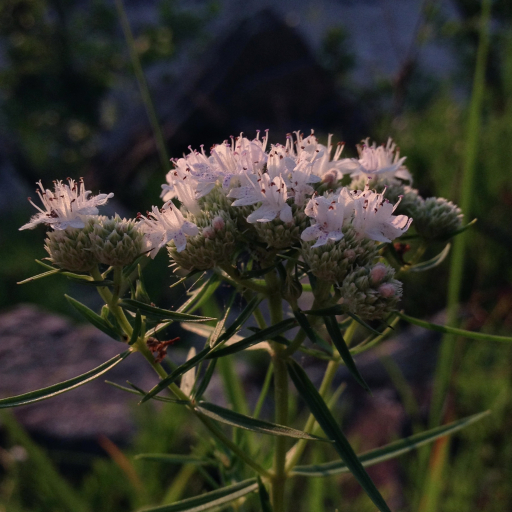
Plant Overview
Known as the "Narrowleaf Mountain Mint," this native North American perennial is a true pollinator powerhouse. Despite its name, it isn’t a true mint (genus Mentha), but it shares that signature refreshing fragrance whenever its delicate, needle-like leaves are brushed. It creates a shimmering, silvery-green haze in the garden that looks like a soft mist from a distance, making it a favorite for "moon gardens" and naturalistic meadows.
🔍 How to Identify
- 🌿 The Foliage: Unlike broader mints, this species has extremely thin, needle-like leaves that are smooth and lack the "fuzz" found on its cousins.
- ❄️ The Flowers: It produces dense, flat-topped clusters of tiny white flowers, sometimes peppered with minute purple spots, blooming from late summer into fall.
- 📐 The Stem: Like all members of the mint family, it features a distinctively square stem that is stiff, upright, and highly branched.
🏡 In Your Garden
- 🦋 Pollinator Magnet: If you want to see your garden come alive, this is the plant to choose. It is legendary for attracting an incredible diversity of beneficial insects, including honeybees, specialized wasps, and silver-spotted skippers.
- 🛡️ The "Polite" Mint: While many mints are garden thugs that take over via underground runners, Narrowleaf Mountain Mint is much better behaved. It grows in a tidy, clumping habit and spreads slowly, making it manageable for smaller flower beds.
- 💧 Adaptable Nature: It is surprisingly tough. While it prefers moist, well-drained soil, it is remarkably drought-tolerant once established and can thrive in clay or rocky soils where other plants might struggle.
⚠️ Safety & Toxicity
- ✅ Status: Generally considered safe and non-toxic.
- 🍵 Human Use: The leaves are often used to make a mild, minty tea. However, it contains pulegone (an essential oil), which should be consumed in moderation and avoided entirely by pregnant individuals.
- 🐾 Pets: It is not listed as a major toxin for cats or dogs, but the high essential oil content in the leaves can cause mild stomach upset if ingested in large quantities by curious pets.
✨ Fun Fact
Unlike many flowers that offer nectar only to specific "specialist" bees, the shallow blossoms of the Mountain Mint offer an "open buffet" to almost any insect, making it one of the top-ranked plants for supporting local biodiversity in North America.

Detailed Care Instructions
To grow Pycnanthemum Tenuifolium (also known as slender mountain mint), here are steps you can follow:
- Determine the right location: Pycnanthemum Tenuifolium requires full sun to partial shade. Find a spot in your garden that receives at least 6 hours of direct sunlight per day.
- Prepare the soil: Ensure the soil is well-draining to prevent root rot. If your soil is heavy clay, amend it with organic matter such as compost or peat moss to improve drainage.
- Planting: Start by digging a hole in the prepared soil, large enough to accommodate the plant's root ball. Place the plant in the hole, ensuring that the top of the root ball is level with the surrounding soil. Backfill the hole and gently pat down the soil around the plant to remove any air pockets.
- Watering: Water the plant thoroughly after planting to settle the soil. Pycnanthemum Tenuifolium prefers consistently moist soil, so ensure it has regular watering. However, avoid overwatering, as it can cause root rot.
- Mulching: Apply a layer of organic mulch around the plant to help retain soil moisture and suppress weed growth. Leave a small space around the stem to prevent rotting.
- Fertilizing: Pycnanthemum Tenuifolium generally doesn't require additional fertilization if grown in nutrient-rich soil. If your soil is lacking in nutrients, you can apply a balanced slow-release fertilizer once a year in early spring.
- Pruning: Prune the plant in early spring to encourage bushier growth and to remove any dead or damaged branches. This will also help maintain the plant's shape and prevent it from getting overgrown.
- Division: Pycnanthemum Tenuifolium can be divided every few years to propagate new plants. Dig up the clump and carefully separate the roots, ensuring that each division has a healthy amount of roots attached. Replant the divisions in prepared soil and water thoroughly.
Remember to be patient, as it may take some time for the plant to establish and start growing vigorously. Provide regular care and maintenance, and you will soon enjoy a healthy and thriving Pycnanthemum Tenuifolium plant in your garden.

Place in a bright room that is sun drenched almost all day. Or directly in a south-facing window.

Pycnanthemum Tenuifolium plant requires regular watering, especially during hot and dry weather conditions. When watering, it is essential to ensure that the soil is moist to a depth of at least one inch. It is recommended to water the plant deeply once a week, rather than frequent light watering, which can lead to shallow roots and poor growth.
To avoid boggy soil, it is crucial to provide proper drainage during watering and avoid overwatering. After watering, allow the soil to drain completely before repeating the process. Avoid watering the foliage to prevent fungal diseases.
During periods of high humidity or if the plant is grown in dense soil, it may require less frequent watering. The best way to check if the plant requires watering is to touch the soil and ensure that it is not completely dry to the touch.
Consider adding a layer of mulch to the soil around the plant to help retain moisture and regulate soil temperature. Additionally, ensure the plant is grown in well-draining soil and avoid planting it in areas with standing water.
To fertilize this plant, use a balanced fertilizer with equal amounts of nitrogen, phosphorus, and potassium. Fertilize once a month during the growing season, starting in the early spring and stopping in late fall. Mix the fertilizer according to the package instructions and apply it to the soil around the base of the plant, being careful not to get it on the leaves or stem. Water the plant thoroughly after fertilizing to help the nutrients soak into the soil.
The ideal soil for growing this particular plant should be well-draining and have a pH level within the range of 6.0-7.0. The soil should be rich in organic matter and should be able to hold moisture without becoming waterlogged. It is recommended to mix the soil with compost or other organic matter to improve its texture and nutrient content. Avoid using heavy clay soils or those that are too sandy, as they may not provide the necessary support, nutrients, and moisture retention required for the plant's growth and development. Additionally, adding a layer of mulch to the soil surface can help retain moisture and suppress weed growth, which can benefit the growth and overall health of the plant.
Here are the steps for propagating this plant:
- Begin by collecting seeds from mature plants. Look for the dried flower heads and extract the small seeds.
- Fill a seed tray with potting soil and water it until it is evenly moist.
- Scatter the seeds on the surface of the soil, and press them down gently so that they are in contact with the soil.
- Cover the tray with plastic wrap or a clear plastic lid to create a humid environment.
- Place the tray in a warm, well-lit area, but avoid direct sunlight.
- Keep the soil moist but not waterlogged, and check the tray frequently for signs of growth.
- Once the seedlings have grown a few sets of true leaves, they can be transplanted into individual pots or into a larger container.
- Water the young plants regularly and keep them in a sunny spot. They will need to be gradually acclimated to outdoor conditions before being planted in the ground.
- Once the plants are established, they can be propagated by division in the spring or fall. Dig up a mature plant and separate it into smaller pieces, each with roots and leaves. Replant the divisions and water them well until they take root.








