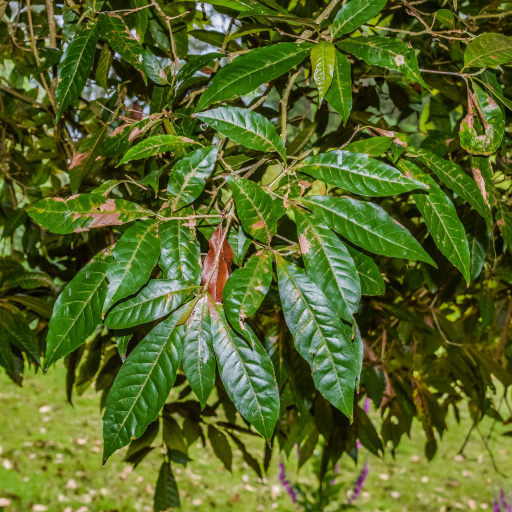
Plant Overview
Known as the Royal Oak or Mexican Royal Oak, this majestic evergreen tree is a crown jewel of the Mexican cloud forests. Despite its "Royal" title, it is a rugged survivor, adapted to the misty, high-altitude ridges of the Sierra Madre. It is prized by collectors for its oversized, glossy foliage and its surprisingly large, decorative acorns.
🔍 How to Identify
- 🍃 The Leaves: Look for large, leathery, oblong leaves that can reach up to 8 inches in length. Unlike many common oaks, these are usually not deeply lobed; instead, they have smooth or slightly wavy margins and a polished, dark-green sheen.
- 🥜 The Acorns: One of its most striking features is the size of its fruit. The acorns are notably large and sit in a shallow, scaly "cupule" (cap). They often appear in pairs or small clusters along the branches.
- 🌳 Growth Habit: This is a medium-to-large tree that develops a dense, rounded crown. When young, the bark is relatively smooth and grey, becoming more furrowed and textured as the tree reaches maturity.
🏡 In Your Garden
- 💧 Humidity over Aridity: Because its native home is the cloud forest, the Royal Oak thrives in areas with consistent humidity. It isn’t a fan of bone-dry desert air; if you live in a dryer climate, it will appreciate a spot that stays cool and sheltered from scorching afternoon winds.
- 🌱 Root Stability: Like most oaks, Quercus germana develops a deep taproot early in life. This makes it very drought-tolerant once established, but it also means it "hates" being moved. Choose its forever-home carefully, as transplanting a mature specimen often leads to failure.
- ⛰️ Soil Preference: It prefers slightly acidic to neutral soil that drains well. It is particularly sensitive to "wet feet" (standing water), which can lead to root rot in heavy clay soils.
⚠️ Safety & Toxicity
- 🐾 Mild Toxicity: Like almost all members of the Quercus genus, the leaves and acorns contain high levels of tannins.
- 🐕 Pet Safety: While humans aren't likely to graze on it, the acorns can be toxic to dogs, horses, and cattle if consumed in large quantities, potentially leading to gastrointestinal distress or kidney issues.
- 👶 Kid Friendly: The tree is safe to touch and climb, making it a wonderful addition to a family garden, provided children are taught not to "taste-test" the acorns.
✨ Fun Fact
The species name germana translates to "German," which is a bit of a botanical mystery! The tree is strictly native to Mexico and has no natural connection to Germany. It was named by the botanists Schlechtendal and Chamisso in the 1830s, possibly as a nod to a colleague or a mislabeled specimen in a collection.

Detailed Care Instructions
To grow Quercus Germana, also known as German Oak, you can follow these steps:
- Choose a suitable location: Quercus Germana prefers full sun to partial shade and well-drained soil. Ensure that the chosen spot has enough space for the oak tree to grow and mature.
- Prepare the soil: The soil should be fertile, loamy, and well-draining. If the soil is heavy or clay-based, amend it with organic matter such as compost or well-rotted manure to improve drainage and fertility.
- Germination: Quercus Germana acorns can be collected in the fall from mature trees. Soak the acorns in water for 24 hours before sowing to enhance germination. Plant the acorns in pots or directly in the ground, about 1 inch deep. Keep the soil consistently moist but not waterlogged.
- Transplanting: Once the seedlings have emerged and grown a few inches tall, they can be transplanted to their permanent location. Ensure there is adequate spacing between the trees to allow for their growth. Water the transplants regularly during the first year to help establish their root systems.
- Care and maintenance: Quercus Germana generally requires little maintenance once established. Regular watering during dry spells and mulching around the base of the tree to retain soil moisture are beneficial. Irrigate deeply rather than shallowly to encourage deep root growth.
- Pruning: Pruning is generally not required for Quercus Germana, but if desired, it is best done during late winter or early spring before new growth emerges.
- Pest and disease control: Monitor the tree for pests like leaf-feeding insects and caterpillars. If necessary, use organic pest control methods such as insecticidal soaps or neem oil. Be on the lookout for diseases such as oak wilt or powdery mildew, and address any issues promptly.
- Patience: Quercus Germana is a slow-growing tree, so be patient as it takes time to reach its full size and stature.
Remember to research and understand the specific needs of Quercus Germana and adjust your care accordingly.
Here are some details on how to water the Quercus Germana plant:
- Monitoring: It is crucial to monitor the soil moisture level regularly to determine when watering is required. This can be done by checking the top few inches of the soil using your finger or a moisture meter.
- Watering schedule: Quercus Germana plants generally prefer a moderate amount of water. However, the frequency and amount of water required may vary depending on factors such as temperature, humidity, and soil conditions. Aim to water the plant deeply but infrequently to encourage deep root growth.
- Watering technique: When watering, ensure that the water reaches the plant's root zone. Avoid simply wetting the surface of the soil, as this may not provide adequate hydration to the entire root system. Instead, consider using a drip irrigation system, soaker hose, or a watering can with a narrow spout to directly water the soil around the plant's base.
- Consider the environment: Take into account the season and weather conditions when determining the watering frequency. Adjust accordingly during hot, dry periods or rainy seasons to avoid over or under watering. It may be useful to create a watering schedule and adjust it based on the plant's response.
- Drainage: Proper drainage is essential for Quercus Germana plants. Make sure that the soil has good drainage properties and does not become waterlogged. Excessive moisture can lead to root rot and other issues.
- Mulching: Applying a layer of organic mulch around the base of the Quercus Germana plant can help retain soil moisture and regulate temperature. This can reduce water loss through evaporation and provide a buffer against extreme weather conditions.
Remember, these guidelines are general suggestions, and it's essential to consider the specific needs and conditions of your Quercus Germana plant. Observe how it responds to watering, consult with local gardening experts, and adjust your watering technique accordingly.
To fertilize the Quercus Germana plant, follow the provided instructions:
- Choose a balanced, slow-release fertilizer specifically designed for woody plants.
- Before applying the fertilizer, make sure the soil is moist but not waterlogged. If needed, water the plant a day or two in advance.
- Read the fertilizer packaging for specific dosage instructions based on the plant's size and age. Generally, use about one tablespoon of fertilizer per square foot of the root zone.
- Apply the fertilizer evenly around the base of the plant, keeping it at least six inches away from the trunk. Avoid getting the fertilizer on the foliage.
- Gently work the fertilizer into the top inch of soil using a garden fork or hand cultivator.
- After fertilizing, water the plant thoroughly to help the nutrients penetrate into the root zone.
- For best results, fertilize the Quercus Germana plant once in early spring before new growth emerges.
- Monitor the plant's growth and adjust the fertilization schedule as needed, taking into account the environmental conditions and overall health of the plant.
The Quercus Germana plant thrives in well-draining soil that provides adequate moisture retention while also allowing excess water to drain away. It prefers soil that is rich in organic matter, as it enhances nutrient availability and promotes healthy root development. The pH level of the soil should typically range between slightly acidic to neutral.
Additionally, the soil should be loose and well-aerated to facilitate proper root respiration and minimize the risk of waterlogged conditions. The plant benefits from soils that have good water-holding capacity, as it ensures consistent hydration without risking excessive moisture levels.
While it does not require any specific soil type, a loamy soil with a balanced texture, composed of equal parts sand, silt, and clay, is often an excellent choice for the Quercus Germana plant. This type of soil provides a favorable combination of drainage, aeration, and water-holding capacity, offering an ideal growing environment for the plant.
Regularly amending the soil with organic matter, such as compost or well-rotted manure, is highly beneficial. This practice enhances soil fertility, improves water retention, and encourages beneficial microbial activity within the soil, which aids in nutrient uptake.
In summary, the Quercus Germana plant prefers well-draining, loamy soil that is rich in organic matter and provides proper moisture retention. It benefits from a loose, well-aerated soil composition to facilitate root respiration and minimize waterlogged conditions.
Quercus Germana is a plant that can be propagated through several methods. Here are detailed steps on how to propagate it:
- Identify a healthy and mature Quercus Germana plant from which you can take cuttings. Look for a plant that is free from diseases or pests.
- Prepare a clean and sharp pair of pruning shears or scissors. It is important to have sterile tools to reduce the risk of spreading diseases.
- Choose a suitable stem to take the cutting from. Look for a young, non-flowering stem that is around 6 to 8 inches in length. Make sure the stem has enough leaves but is not overly mature.
- Make a clean cut just below a set of leaves on the stem, using the pruning shears or scissors. Remove any excess leaves from the lower part of the cutting, leaving only a few leaves at the top.
- Dip the cut end of the stem into a rooting hormone powder or gel. This will help promote root development and increase the chances of successful rooting. Ensure that the hormone is evenly distributed on the cut.
- Prepare a propagation medium. Quercus Germana cuttings can be rooted in a well-draining soil mix or a mixture of peat moss and perlite. Fill a small pot or container with the chosen medium, leaving about an inch of space at the top.
- Create a planting hole in the medium using your finger or a pencil. Insert the cutting into the hole, ensuring that at least a couple of inches of the stem are submerged into the medium.
- Gently press the soil around the stem to hold it in place. Make sure the cutting is stable and upright.
- Water the cutting thoroughly, ensuring that the soil is evenly moist but not waterlogged. Maintain a consistent level of moisture throughout the rooting process, as drying out can hinder successful propagation.
- Place the pot or container in a warm and partially shaded area. Avoid direct sunlight, as it can damage the delicate cutting. A temperature range of 60-75°F (15-24°C) is ideal for rooting.
- Mist the cutting with water using a spray bottle regularly to maintain high humidity levels. Covering the cutting with a clear plastic bag or a propagator can also help retain humidity.
- Monitor the cutting closely for any signs of rooting, which usually takes several weeks to a few months. New growth and the emergence of roots from the bottom of the pot are positive signs that the cutting has successfully rooted.
- Once the cutting has developed a strong root system, it can be transplanted into a larger container or directly into the ground. Follow appropriate transplantation procedures, such as ensuring the soil is well-prepared and providing adequate water and sunlight.
By following these detailed steps, you can successfully propagate Quercus Germana without relying on its common names.








