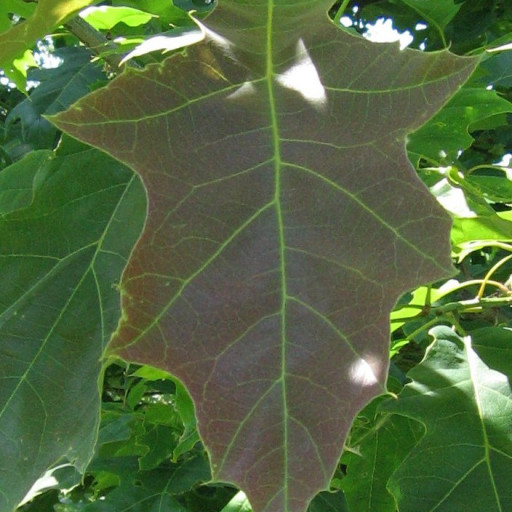
Plant Overview
The Northern Red Oak is a majestic titan of the North American forest, often nicknamed the "Champion Tree" for its rapid growth and impressive stature. Renowned for its fiery crimson autumn display, it has been a cornerstone of landscape design and timber history for centuries. Whether providing deep shade for a backyard or acting as a sanctuary for local wildlife, this oak is a living symbol of endurance and natural beauty.
🔍 How to Identify
- 🍃 Pointed Foliage: Unlike the rounded lobes of white oaks, the Red Oak features leaves with 7 to 11 waxy, bristle-tipped lobes and deep, elegant V-shaped notches.
- ⛷️ "Ski Trail" Bark: On mature trees, the dark gray bark develops long, flat-topped ridges that look like silvery tracks running vertically down the trunk, often referred to as "ski trails."
- 🥜 Saucer-Capped Acorns: The nuts are large and sit in a shallow, saucer-shaped cup covered in tight, thin scales—resembling a tiny, wide-brimmed beret.
🏡 In Your Garden
- 🌳 Growth Nuance: While many oaks are known for being slow, the Northern Red Oak is surprisingly fast, often gaining two feet of height per year. Because it develops a deep, stubborn taproot early on, it hates being moved; choose its permanent "forever home" carefully to avoid transplant shock.
- 🍂 Soil & Space: This tree thrives in slightly acidic, well-drained soil and is more tolerant of urban pollution than its cousins. However, it needs plenty of elbow room—its wide, spreading canopy can eventually reach 75 feet across, making it better suited for large lawns than cramped side yards.
⚠️ Safety & Toxicity
- 🐕 Tannin Warning: The acorns and young leaves contain high concentrations of tannins, which can be toxic if ingested. While most humans find them too bitter to eat raw, curious dogs or horses can suffer from digestive upset or kidney issues if they consume them in large quantities.
- 👶 Child Safety: The tree is physically safe for children to climb once mature, though the sharp bristles on fallen leaves can be a bit prickly during autumn play.
✨ Fun Fact
The wood of the Northern Red Oak is incredibly porous. Its internal "water pipes" (xylem) are so large and open that if you take a short, straight-grained piece of the wood and dip one end in soapy water, you can actually blow through the other end and create bubbles!

Detailed Care Instructions
| Humidity | Normal |
| Lighting | Full Sun |
| Toxicity | Poisonous |
| Difficulty | Medium |
| Hibernation | Cold Period |
| Hardiness Zones | 3 - 7 |
To grow a Quercus rubra plant, also known as the northern red oak, you can follow these steps:
- Select a suitable location: Find a spot in your garden that receives full sun or partial shade. Ensure the soil is well-draining and fertile.
- Acquire seeds or seedlings: You can either purchase Quercus rubra seeds from a nursery or collect acorns from mature trees. If using acorns, choose those that are plump, well-shaped, and free from disease or damage.
- Germinate the seeds: If using seeds, you can either stratify them or sow them directly into containers. Stratification involves placing seeds in moist sand or potting mix inside a plastic bag in the refrigerator for 30-60 days to simulate winter conditions. Sow the stratified or untreated seeds about 1 inch deep into pots filled with a mixture of equal parts sand and peat moss.
- Provide optimal conditions: Keep the pots indoors in a cool location, such as the basement or garage, for 6-8 weeks to allow for germination. Maintain a consistent moisture level by misting the soil regularly.
- Transplant the seedlings: Once the seedlings have developed a few leaves and are strong enough to handle, transplant them into individual containers or directly into the ground. Choose a location with enough space for the oak tree to grow.
- Water appropriately: Water regularly to keep the soil consistently moist but not waterlogged. Avoid overwatering as this can lead to root rot.
- Provide proper care: Fertilize the Quercus rubra plant once a year in early spring with a slow-release, balanced fertilizer. Prune any damaged or diseased branches as needed. Monitor the growth and health of the tree regularly.
- Protect from pests and diseases: Keep an eye out for common oak threats such as gypsy moth caterpillars, oak wilt disease, and powdery mildew. Take appropriate measures if you notice any signs of infestation or disease.
- Be patient: Quercus rubra is a slow-growing tree, and it may take several years for it to reach maturity. Provide it with proper care and patience, and you will be rewarded with a beautiful oak tree.
Remember to also check with local regulatory authorities before planting Quercus rubra, as it may be considered an invasive species in some regions.

Place in a window with dappled sun or a spot in the middle of a room. Or directly in a window facing west or east.

To properly water the plant, you should wait until the top layer of soil is dry before watering it. Gently pour water onto the soil until it is well saturated, taking care not to get water on the leaves. Allow any excess water to drain out of the bottom of the pot or container. It is important not to over-water the plant as this can lead to root rot.
For optimal growth, apply a balanced fertilizer to the soil around the plant in early spring before new growth appears. Use a slow-release fertilizer with equal amounts of nitrogen, phosphorus, and potassium. Avoid over-fertilizing as it can lead to excessive foliage growth with reduced hardiness and disease susceptibility. Water thoroughly after fertilizing.
The recommended type of soil for this plant is a rich, well-draining soil with a slightly acidic pH level. The soil should be loamy and contain a good amount of organic matter such as compost or leaf litter. It should also be able to retain moisture without becoming waterlogged. Avoid using heavy clay soils or sandy soils that do not hold moisture well. Additionally, it is important to avoid using soil that has been contaminated with chemicals or pesticides, as this can be harmful to the plant.
To propagate this plant, you can start by collecting acorns from a mature tree during the fall season. Choose acorns that are healthy and without any cracks or holes. The acorns can be planted immediately or stored in a cool, dry place until spring.
Prepare a well-draining potting mix and fill a small seed tray or 4-inch pot with the soil. Plant one acorn per container and bury the acorn about an inch deep. Water the soil to keep it consistently moist but not waterlogged.
Place the tray or pot in a warm, bright location but out of direct sunlight. The ideal temperature for germination is around 68-70 degrees Fahrenheit.
The acorns should start to sprout within 2-3 weeks. Once the seedlings have their first set of true leaves, they can be carefully transplanted into larger pots or directly into the ground in a suitable location.
Be patient when propagating this plant as it can take several years for the tree to reach maturity and produce acorns of its own.
Common pests of the northern red oak include Larvae. Make a habit of checking your northern red oak frequently for pests so that any infestations can be caught and managed early.








