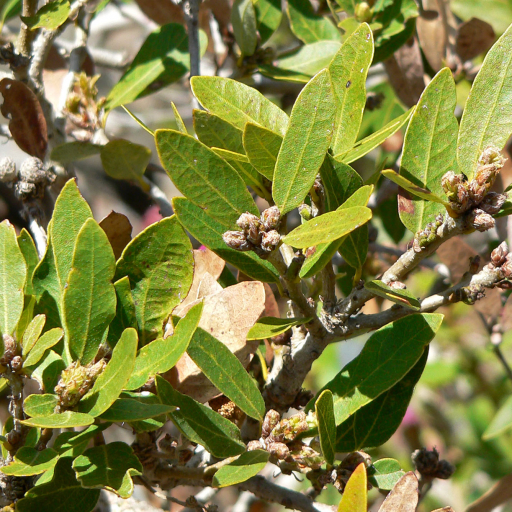
Plant Overview
Known as the Huckleberry Oak, this resilient evergreen shrub is the "mountain climber" of the oak family. Found clinging to the rocky slopes of the Sierra Nevada and Klamath Mountains, it earned its nickname because its tiny, leathery leaves look more like a blueberry or huckleberry bush than a traditional towering oak. It is a master of survival, designed to endure heavy snow and howling alpine winds by staying low to the ground.
🔍 How to Identify
- 🌿 The Leaves: Small, oval, and thick. Unlike the deeply lobed leaves of a classic English Oak, these are smooth-edged and look remarkably like Huckleberry (Vaccinium) leaves.
- 🎨 Two-Toned Foliage: The tops of the leaves are a vibrant, waxy green, while the undersides feature a pale, grayish-blue tint that helps the plant conserve moisture.
- 🌰 Miniature Acorns: It produces tiny, slender acorns that sit in shallow, thin-scaled caps. They often appear in pairs at the ends of the branches.
- 🪵 Prostrate Habit: Instead of a trunk, this oak grows as a dense, spreading mat or a low-mounded shrub, rarely exceeding chest height.
🏡 In Your Garden
- 🏔️ Rock Garden Specialist: This is not a plant for a swampy backyard. It thrives in "lean," rocky soil and requires exceptional drainage. It is a perfect choice for high-altitude landscaping or "wild" mountain gardens.
- 💧 Drought Nuance: Once established, it is incredibly drought-tolerant. In fact, over-watering is the most common cause of failure, as the plant is adapted to dry, crumbly slopes where water never sits for long.
- 🦉 Ecology Expert: In the wild, these dense thickets provide essential "high-rise" housing for montane chipmunks and nesting sites for birds like the Dusky Flycatcher.
⚠️ Safety & Toxicity
- 🐾 Pet Safety: Like all members of the Quercus genus, the leaves and acorns contain tannins. While not typically "deadly," they can cause stomach upset, vomiting, or lethargy in dogs and cats if chewed on in large quantities.
- 🧒 Kid-Friendly: It is generally safe for gardens, though the low, stiff branches can be a tripping hazard for small children running through a landscape.
✨ Fun Fact
The Huckleberry Oak is a "fire-sprouter." Even if a wildfire sweeps across the mountain and burns the shrub to the ground, its deep, woody root system remains unharmed, allowing it to send up fresh green shoots just weeks after the smoke clears.

Detailed Care Instructions
To grow Quercus vacciniifolia (huckleberry oak), follow these steps:
- Seed Collection: Collect ripe acorns from a parent tree. Choose healthy, fully formed acorns and avoid those with any signs of damage or disease.
- Acorn Stratification: Place the collected acorns in a plastic bag filled with moist peat moss or vermiculite. Keep the bag in the refrigerator for about three months to simulate winter conditions (cold stratification). This process helps break down seeds' dormancy.
- Potting Mix: Prepare a well-draining potting mix using equal parts of peat moss, perlite, and sand. Fill small pots or seed trays with this mixture.
- Sowing Seeds: Remove the acorns from stratification, and plant them about 2 inches deep in the potting mix. Cover the acorns with a thin layer of soil.
- Watering and Placement: Keep the potting mix evenly moist but not soggy. Place the pots in a warm location with indirect sunlight.
- Regular Care: Check the moisture level regularly and water whenever the topsoil feels dry. Provide adequate sunlight by placing the seedlings near a south-facing window or under grow lights.
- Transplantation: Once the seedlings have grown to a height of around 6-8 inches and have developed a strong root system, it's time to transplant them into larger pots or into the ground. Make sure to choose a location with well-draining soil and partial shade.
- Outdoor Planting: If you wish to plant Quercus vacciniifolia directly in the ground, wait until the seedlings are about a foot tall before transplanting them outdoors. Dig a hole twice the size of the root ball, place the sapling, and backfill with soil. Water thoroughly after planting.
- Maintenance: Regularly water the young plants until they establish a strong root system. A layer of organic mulch around the base of the tree can help conserve moisture and inhibit weed growth. Avoid overwatering, as huckleberry oak prefers a slightly drier soil.
- Monitoring: Keep an eye out for pests and diseases. Prune any damaged or dead branches as necessary.
By following these steps, you can successfully grow Quercus vacciniifolia plants. Remember that oak trees require patience, as they take several years to reach maturity.

Place in a bright room that is sun drenched almost all day. Or directly in a south-facing window.

1. Observe the soil: Before watering Quercus Vacciniifolia, observe the soil to ensure it's dry to a depth of around two inches. Insert your finger or a soil moisture meter to determine the moisture level.
2. Use lukewarm water: When watering Quercus Vacciniifolia, use lukewarm water and avoid using cold water. Coldwater can shock the plant roots and cause damage.
3. Pour water slowly: When watering, pour the water slowly onto the soil surface. Avoid watering the leaves as it can cause fungal diseases.
4. Water deeply: To ensure the water reaches the roots of the Quercus Vacciniifolia plant, water it deeply. Allow the water to soak into the soil, stopping when the water begins to run off.
5. Avoid overwatering: Overwatering can harm the plant, so avoid watering if the soil is already moist.
6. Check drainage: Ensure that the pot or container Quercus Vacciniifolia is planted in has proper drainage. Standing water can lead to root rot and other issues.
7. Water according to the season: During the hot summers, Quercus Vacciniifolia may require more frequent watering, while during cooler seasons, it may require less.
8. Monitor the plant: Monitor the plant regularly, including checking the soil moisture levels and the overall health of the plant, to ensure it's healthy and thriving.
To fertilize this plant, apply a slow-release fertilizer on the soil surface in early spring before new growth appears. Use a balanced fertilizer with equal amounts of nitrogen, phosphorus, and potassium. Avoid applying too close to the trunk and water thoroughly after applying the fertilizer. For established plants, apply fertilizer once a year.
Quercus Vacciniifolia is a type of plant that grows best in soil that is well-drained and has high amounts of organic matter. The soil pH should be slightly acidic, with a range between 5.5 and 6.5. To ensure optimal growth, it is recommended to use a soil mix that consists of equal parts of peat moss, perlite, and vermiculite. Additionally, adding small amounts of compost and leaf mold to the soil mix can help to improve soil fertility and nutrient content. It is important to note that Quercus Vacciniifolia plants do not tolerate compacted soils, so it is recommended to avoid using heavy clay soil or soils that have been heavily amended with sand. Overall, a loose, aerated, and nutrient-rich soil will provide the ideal growing conditions for Quercus Vacciniifolia plants.
Propagation of Quercus Vacciniifolia plant can be done through various methods such as cutting, layering, and seed sowing. The most common and easiest method is seed sowing. The seeds should be collected from mature trees in the fall season and sown immediately. Before sowing, the seeds should be soaked in water for at least 24 hours to enhance germination. The soil used for sowing should be well-drained and rich in organic matter. The seeds should be sown at a depth of 1 to 2 inches and watered regularly. Germination of seeds can take up to a month or more.
Another method of propagation is through stem cutting. Take a 6 to 8-inch-long stem cutting from a healthy and mature tree in the summer season. Remove all the lower leaves and plant the cutting in a container filled with well-drained soil and keep it under shade. Use rooting hormone to enhance root formation. Water regularly and keep the soil slightly moist. Within a few weeks, the cutting will start growing new leaves and will be ready for transplantation.
Layering is another method of propagation that involves bending the lower branches of the mother plant and covering them with soil. When the stem starts developing roots, it can be separated from the mother plant and transplanted. This method is suitable for plants that have low branches.








