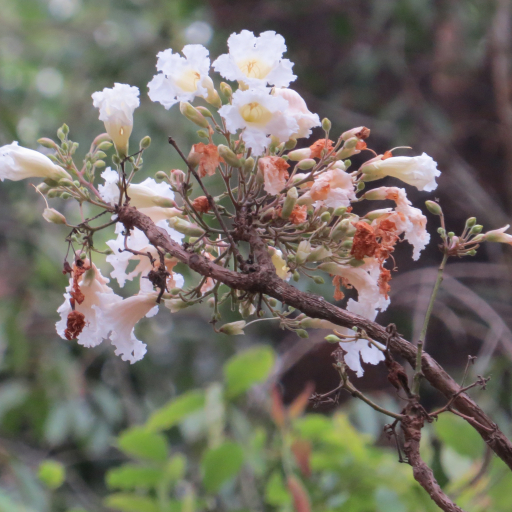
Plant Overview
Known as the Padri Tree or the Snake Tree, Radermachera xylocarpa is a majestic deciduous tree native to the rocky hills and dry forests of India. It is celebrated for its ethereal, trumpet-shaped blossoms that fill the night air with a delicate fragrance and its peculiar, snake-like seed pods. In its native habitat, it is often viewed as a symbol of resilience, thriving in rugged terrains where other trees might struggle.
🔍 How to Identify
- 🍃 Lace-like Foliage: The leaves are "bi-pinnate" or "tri-pinnate," meaning they are divided into many small, pointed leaflets, giving the tree a soft, fern-like silhouette despite its large size.
- 🔔 Trumpet Blossoms: It produces stunning, funnel-shaped flowers that are white or pale pink with a distinct yellow, hairy throat. They usually bloom in large, dense clusters at the ends of branches.
- 🐍 The "Snake" Pod: The most iconic feature is the fruit—a long, woody, and curved capsule that can grow up to 3 feet long. These pods hang from the branches and look remarkably like dangling snakes.
🏡 In Your Garden
- 🌳 Space Requirements: This is a medium-to-large tree, not a houseplant. It needs plenty of room for its canopy to spread and its deep taproot to anchor. Because of this taproot, it hates being moved once planted, so choose its "forever home" carefully.
- ☀️ Sun & Soil: It thrives in full sun and prefers well-draining, slightly rocky soil. It is remarkably drought-tolerant once established, making it an excellent choice for xeriscaping or low-water tropical gardens.
- 💨 Wind Resistance: Thanks to its sturdy, woody trunk and flexible branches, it stands up well to seasonal winds, though the fragrant flowers may drop quickly after a heavy breeze.
⚠️ Safety & Toxicity
- ✅ Safe Status: Radermachera xylocarpa is generally considered non-toxic to humans, dogs, and cats.
- 🦴 Physical Hazard: While not chemically poisonous, the "snake" pods are very hard and woody. If they fall from a height, they could potentially cause minor injury, and the large seeds inside should not be ingested by curious pets as they are a choking hazard.
✨ Fun Fact
The name xylocarpa literally translates to "woody fruit" (from the Greek xylon for wood and karpos for fruit). These pods are so tough that they often remain on the tree long after the leaves have fallen, rattling in the wind like nature’s own percussion instruments!

Detailed Care Instructions
To grow a Radermachera Xylocarpa plant, also known as the China doll plant or Serpent tree, you can follow the below steps:
- Choose a suitable location: Select an indoor or outdoor location that receives bright, indirect sunlight. Ensure the temperature remains between 65-75°F (18-24°C) and humidity levels are moderate.
- Pot selection: Use a well-draining pot with drainage holes at the bottom. The size of the pot should accommodate the size of the plant and allow for root growth.
- Soil preparation: Use a well-draining, lightweight potting mix that retains some moisture but doesn't become waterlogged. Adding perlite or sand can improve drainage.
- Planting process: Place the plant in the center of the pot and fill it with the prepared potting mix, leaving some space at the top for watering. Gently press the soil around the base of the plant to secure it.
- Watering: Water the plant thoroughly but avoid waterlogging. Allow the top inch of soil to dry out before watering again. Maintain moderate humidity levels by misting the leaves occasionally.
- Fertilizer: Use a balanced, water-soluble fertilizer once a month during the growing season (spring and summer). Follow the instructions on the fertilizer package for dilution and application rates.
- Pruning: Prune the plant to maintain its desired shape and promote bushiness. Remove dead or damaged leaves and branches regularly. Pinch back new growth to encourage branching.
- Repotting: Repot the plant every 2-3 years or when the current pot becomes too small for the root growth. Move it to a slightly larger pot using fresh potting mix.
- Pest control: Inspect the plant regularly for common pests like aphids, mealybugs, or spider mites. If found, treat with insecticidal soap or neem oil according to the product instructions.
- Propagation: You can propagate Radermachera Xylocarpa through stem cuttings. Take a 4-6 inch (10-15 cm) long cutting from the new growth, remove the lower leaves, and place it in a well-draining potting mix. Keep the cutting warm and moist until roots develop.
Remember, Radermachera Xylocarpa plants are sensitive to cold drafts and overwatering. Observe and adjust your care routine as needed, and enjoy seeing your plant grow and thrive.
The plant should be watered regularly, but not excessively. Before watering, check the soil’s moisture level by sticking a finger an inch into the soil. If the soil feels dry, it is time to water. Water the plant until the water runs out of the drainage holes, and then empty the saucer beneath the plant to prevent standing water. Be careful not to leave the plant in standing water, as this can lead to root rot. In the winter, reduce watering frequency since the plant will be in a dormant state.
To fertilize the plant, use a balanced water-soluble fertilizer with equal amounts of nitrogen, phosphorus, and potassium. Dilute the fertilizer to half strength and apply every two weeks during the growing season. During the dormant period, reduce the frequency of fertilization to once a month. Be careful not to over-fertilize, as this can lead to burnt roots and stunted growth.
When growing Radermachera Xylocarpa, it is important to consider the type of soil it needs. The plant prefers well-draining, nutrient-rich soil that is slightly acidic with a pH level of 5.5 to 6.5. A combination of peat moss, pine bark, and perlite is ideal for this plant's soil mixture as it provides good drainage, aeration, and moisture retention.
Before planting the Radermachera Xylocarpa, it is important to ensure the soil is adequately moist but not excessively wet. The plant should be planted at the same level as it was in its previous container, and the soil surface should be gently compacted to remove any air pockets.
Over time, the soil can become depleted of nutrients, so it is important to fertilize the Radermachera Xylocarpa regularly. Slow-release fertilizers that contain nitrogen, phosphorus, and potassium are ideal for maintaining the plant's health and promoting growth.
Overall, the key to healthy growth for the Radermachera Xylocarpa is to maintain a consistent soil moisture level, provide adequate drainage, and ensure the soil is rich in nutrients.
Propagation of this plant can be done by using stem cuttings during the spring and summer months. Cut a stem that is approximately 6 inches in length, making sure that it has at least two leaves on it. Remove all of the lower leaves, leaving only the top two leaves on the stem. Dip the end of the stem into a rooting hormone powder, and plant it into a pot filled with a well-draining potting soil. Water the cutting thoroughly and place it in a bright, but indirect sunlight location. Keep the soil moist and mist the leaves regularly. After a few weeks, new growth should appear, indicating that the cutting has rooted and is ready to be transplanted into its permanent location.








