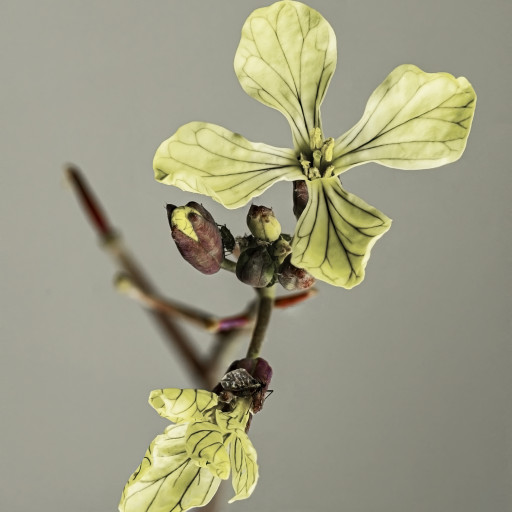
Plant Overview
Often mistaken for its domestic cousin or wild mustard, the Wild Radish is a resilient pioneer of the meadows. Known as "Jointed Charlock," this plant is famous for its "beaded" seed pods and its ability to thrive in the toughest soils. In many cultures, it’s seen as a symbol of untamed persistence, springing up in cracked pavement and abandoned fields alike.
🔍 How to Identify
- 🌸 The "Cross" Flowers: As a member of the mustard family, it features four petals arranged in a cross. They are usually white or pale yellow, often etched with delicate, dark purple or brown veins.
- 🍃 Bristly Foliage: The leaves are rough to the touch and covered in stiff hairs. The lower leaves are deeply lobed (lyrate), while the upper ones are smaller and simpler.
- 📿 Jointed Pods: Unlike the smooth pods of many plants, these seed pods are constricted between each seed, looking like a tiny, bumpy green string of beads.
🏡 In Your Garden
- 🌱 The Taproot Anchor: This plant develops a long, sturdy taproot very quickly. This makes it drought-tolerant but also means it hates being moved—if you want it in your wildflower patch, it’s best to let it grow where it sprouts.
- 🐝 Pollinator Buffet: It is a high-value plant for biodiversity. Bees, hoverflies, and butterflies are drawn to its nectar, making it a great "decoy" plant to keep pollinators in your garden and away from more sensitive crops.
⚠️ Safety & Toxicity
- 🥗 Human Consumption: The young leaves and flower buds are generally safe and edible for humans, offering a sharp, peppery "radish" kick to salads.
- 🐎 Livestock Warning: While safe for us, it can be toxic to livestock—especially horses and cattle—if consumed in large quantities. It contains glucosinolates that can cause digestive irritation and "mustard poisoning" in grazing animals.
✨ Fun Fact
The Wild Radish is a master of "UV signaling." While the flowers look plain to us, under ultraviolet light (which bees can see), they display bright, glowing patterns that act as a landing strip, guiding insects directly to the nectar!

Detailed Care Instructions
| Color | White, Pink, Yellow |
| Humidity | Normal |
| Invasive | Weed |
| Lighting | Full Sun |
| Toxicity | Poisonous |
| Bloom Time | Spring |
| Difficulty | Medium |
| Plant Type | Annual |
| Hibernation | Cold Period |
| Mature Size | Up To 5 Feet Tall |
| Hardiness Zones | 2-11 |
To grow Raphanus raphanistrum, also known as wild radish or jointed charlock, follow these steps:
- Choose the right location: Select a sunny spot in your garden or a location that receives at least 6-8 hours of direct sunlight per day.
- Prepare the soil: Wild radish prefers well-drained soil that is fertile and rich in organic matter. Amend the soil with compost or well-rotted manure to improve its nutrient content and drainage.
- Sow the seeds: Directly sow the seeds in the prepared soil during early spring or fall when the soil is cool and moist. Scatter the seeds evenly and lightly cover them with a thin layer of soil. Space the seeds about 2-3 inches apart to allow enough room for the plants to grow.
- Watering: Keep the soil consistently moist during the germination period, which typically takes around 7-10 days. After the plants have established themselves, water them when the top inch of soil feels dry. Avoid overwatering, as wild radish plants can tolerate some drought.
- Thinning: Once the seedlings have grown a few inches tall, thin them to give each plant enough space for proper growth. Remove the weaker seedlings, leaving only the strongest ones.
- Mulching: Apply a layer of organic mulch around the plants to suppress weed growth and retain moisture in the soil. This will also help to keep the soil temperature cool during hot summer months.
- Fertilization: Wild radish plants generally do not require heavy fertilization. However, you can provide a balanced, slow-release fertilizer once or twice during the growing season to promote healthy growth.
- Pests and diseases: Monitor the plants regularly for any signs of pests or diseases such as aphids, flea beetles, or powdery mildew. Use appropriate organic pest control methods if necessary.
- Harvesting: Wild radish plants produce edible seed pods that can be harvested when they turn brown and dry. You can collect the seeds for culinary use or to save them for future plantings.

Place in a window with dappled sun or a spot in the middle of a room. Or directly in a window facing west or east.

The plant requires regular watering, particularly during dry periods. It is important to ensure the soil is moist but not waterlogged. Overwatering can lead to root rot and other problems. It may be helpful to use a watering can or hose with a gentle spray nozzle to avoid damaging delicate foliage. Water should be directed at the base of the plant, rather than directly onto the leaves. It is also important to avoid watering during the hottest part of the day to prevent water from evaporating too quickly. Regular inspections of the soil moisture level and adjustment of the watering schedule as necessary can help ensure the health and vitality of the plant.
To fertilize this particular plant, it is recommended to use a balanced fertilizer with equal parts nitrogen, phosphorus, and potassium. Apply the fertilizer during the growing season, typically from spring to summer, using a slow-release formula. It is important to follow the package instructions and not over-fertilize as it can harm the plant. Additionally, it is beneficial to add compost or organic matter to the soil to improve nutrient quality.
The ideal soil type for growing this plant is a well-draining loamy soil. It prefers a pH range between 6.0 and 7.5. The soil should be fertile and rich in organic matter. Adding compost or aged manure to the soil will help to improve soil quality. The plant can tolerate some dryness, but it requires consistent moisture for optimal growth. Avoid planting in heavy clay soils or soils that are waterlogged, as this can impede growth and development. Adequate soil preparation and maintenance will ensure healthy growth and a bountiful harvest.
Raphanus Raphanistrum can be propagated through seeds. The seeds can be collected from mature plants and sown directly in the soil, or they can be started indoors in small containers. To start them indoors, moisten some soil and fill small containers with it. Then, gently press the seeds into the soil and cover with a thin layer of soil. Keep the containers in a warm, well-lit area and water regularly. Once the seedlings have grown a bit and are strong enough, they can be transplanted into larger containers or directly into a garden bed where they will mature and produce seeds of their own. It's important to note that these plants can become invasive and may require some management to prevent them from taking over an area.








