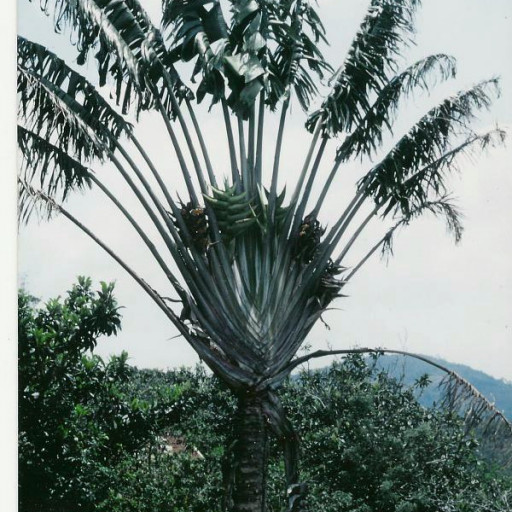
Plant Overview
Often called the "Traveler's Palm," this architectural titan isn't actually a palm at all—it is a close relative of the Bird of Paradise. Native to the island of Madagascar, it earned its nickname from the legendary belief that thirsty travelers could find life-saving water stored within its hollow leaf bases. Its striking, symmetrical fan shape makes it one of the most dramatic and photographed plants in the tropical world.
🔍 How to Identify
- 🍃 The Great Fan: The most distinct feature is the "distichous" growth habit, where leaves emerge in a single plane, creating a massive, two-dimensional green fan.
- 🍌 Banana-Like Foliage: The individual leaves are enormous, paddle-shaped, and look almost identical to banana leaves, often reaching up to 10 feet in length.
- 🪵 False Trunk: As the plant matures, it sheds lower leaves to reveal a sturdy, greyish-brown trunk that resembles a palm tree, though it is technically an herbaceous plant.
🏡 In Your Garden
- 💨 Wind Sensitivity: While it loves the sun, its giant leaves are prone to "fringing" or shredding in high winds. If you want the leaves to stay solid and pristine, plant it in a sheltered courtyard or a spot protected by a fence.
- 📏 Space Hog: This is not a "set it and forget it" windowsill plant. In the ground, it can reach heights of 30 to 50 feet. If you are growing one in a container, be prepared to move it outdoors once it begins its rapid growth spurt.
- 💧 Moisture Lover: Unlike desert-dwelling palms, Ravenala craves consistent moisture and rich, loamy soil. It has a high transpiration rate, meaning it "breathes" out water quickly, so it doesn't tolerate long droughts well.
⚠️ Safety & Toxicity
- ✅ Non-Toxic Status: Ravenala madagascariensis is generally considered non-toxic to humans, cats, and dogs. It is a much safer architectural choice for pet owners than the Sago Palm.
- 🩹 Physical Hazards: The primary safety concern is mechanical. The leaf sheaths are very heavy, and falling dead fronds can be surprisingly heavy. Additionally, the edges of the dried stems can be sharp, so wear gloves when pruning.
✨ Fun Fact
🌊 A Natural Compass: There is an old maritime myth that the fans of the Traveler’s Palm naturally grow on an East-West axis, serving as a biological compass for lost explorers. While they do follow the sun, they aren't quite accurate enough to replace your GPS!

Detailed Care Instructions
| Color | Green Leaves; White Flowers With Green Spathes; Blue Seeds |
| Soil Ph | 6-7 |
| Lighting | Full Sun |
| Toxicity | Toxic |
| Soil Type | Rich, Free-Draining Soil Or Compost |
| Bloom Time | Usually Summer |
| Plant Type | Evergreen Perennial |
| Mature Size | Up To 100 Feet In Height; Up To 36 Feet Leaf Spread (Usually Around 30 Feet In Height And 10 Feet Spread Outdoors, Depending On Variety And Environment) |
| Native Area | Madagascar |
| Sun Exposure | Full Sun Or Partial Shade |
| Hardiness Zones | 10-12 |
Here are some steps to help you grow a Ravenala Madagascariensis plant:
- Choose the right location: Ravenala Madagascariensis plants thrive in full sun or partial shade, so look for a spot in your garden or yard that receives bright, indirect sunlight. They also prefer a humid environment, so if you live in a dry area, you might need to create more moisture around the plant.
- Prepare the soil: Ravenala Madagascariensis prefers well-drained soil with plenty of organic matter. Prepare the soil by adding compost or aged manure to improve its fertility and drainage. The pH level should ideally be slightly acidic to neutral.
- Planting: Dig a hole that is twice as wide and deep as the root ball of your Ravenala Madagascariensis plant. Place the plant in the hole, making sure that the top of the root ball is level with the ground. Backfill the hole with soil, gently firming it around the plant.
- Watering: Water the plant thoroughly after planting to settle the soil and provide moisture to the roots. Continue to water regularly, keeping the soil consistently moist but not waterlogged. Ravenala Madagascariensis plants appreciate frequent misting to mimic their natural humid habitat.
- Fertilizing: Fertilize the plant during the growing season with a balanced slow-release fertilizer. Follow the package instructions for proper application rates. Avoid over-fertilizing, as this can lead to excessive leaf growth but inhibit blooming.
- Pruning: Remove any dead, damaged, or yellowing leaves to maintain the health and appearance of your plant. Pruning should be done in spring or early summer.
- Protecting from harsh conditions: If you live in a region with cold winters, it's important to protect your Ravenala Madagascariensis plant from frost. Cover it with a frost cloth or move it indoors if necessary.
- Propagation: Ravenala Madagascariensis plants can be propagated through division or seeds. Dividing the plant requires some expertise and is best done in early spring. Collect mature seeds from the plant, remove their outer covering, and sow them in well-draining soil.
With proper care and appropriate growing conditions, your Ravenala Madagascariensis plant should grow and thrive, adding a unique tropical touch to your landscape or indoor space.

Place in a bright room that is sun drenched almost all day. Or directly in a south-facing window.

The best approach to watering Ravenala Madagascariensis plants is to pay close attention to the plant's moisture needs. First and foremost, make sure that the soil or growing medium you are using drains well and is not prone to waterlogging. When watering, aim to give the plant a good thorough soak, allowing the water to penetrate deeply into the soil. However, be careful not to oversaturate the soil, as this can lead to root rot.
To determine when to water your Ravenala Madagascariensis, check the top layer of soil for dryness. If the soil feels dry to the touch, it is probably time to water. Depending on the size of your plant and its location, you may need to water it once or twice a week. It's important to note that in hot, dry weather or if the plant is in a container, it may require more frequent watering.
When watering, try to avoid getting water on the leaves and stem of the plant, as this can promote fungal diseases. Instead, aim to water the soil directly at the base of the plant.
Finally, be sure to adjust your watering regimen as needed depending on the season, humidity, and other environmental factors. It's always best to err on the side of caution and underwater rather than overwater your Ravenala Madagascariensis plant.
To fertilize this plant, use a balanced, slow-release fertilizer that contains a mixture of nitrogen, phosphorus, and potassium. Apply the fertilizer in the spring and summer months, following the instructions on the package for dosage and application frequency. Be sure to water the plant thoroughly after fertilizing to help distribute the nutrients throughout the soil. Avoid over-fertilizing, as this can lead to burnt leaves or unhealthy growth.
The ideal soil for the growth and development of Ravenala Madagascariensis should have a well-draining and aerated texture. The soil should have a pH range between 5.5-7.5 and should be rich in organic matter such as compost or decomposed leaves. The plant prefers to grow in loamy soil which is a mixture of sand, silt, and clay in equal proportion. The soil should be able to hold some moisture without becoming waterlogged. The ideal soil will allow the plant roots to penetrate easily and prevent water from stagnating around the roots. The use of a slow-release fertilizer can provide the necessary nutrients for growth. A soil mix that meets these requirements will help ensure healthy growth of Ravenala Madagascariensis plant.
To propagate this plant, take a mature mother plant and use sharp, sterilized shears to remove a side shoot, also known as a pup. Cut as close to the mother plant as possible, without damaging the base of the pup.
Prepare a potting soil mix of peat moss and perlite or vermiculite to approximate a well-draining soil. Fill a clean, small container with this potting mix.
Plant the pup at the same depth it was growing on the mother plant. Ensure the soil is evenly moist, but not drenched. Water the new pup and container until it drains from the bottom, then place it in indirect sunlight or partial shade.
Maintain even moisture, keeping the potting mix a bit moist, but not wet. Wait until the pup has developed its own root system and is firmly rooted in the new soil before transplanting it into a larger container.
Once the new plant is established in the pot, water it occasionally until the soil is dry. Then, give it a thorough watering, ensuring the soil is hydrated. Keep the new plant in partial sunlight until it has a chance to grow strong and develop a healthy root system.
Common pests of the traveller's palm include Scale insect, mealybugs, spider mites. Make a habit of checking your traveller's palm frequently for pests so that any infestations can be caught and managed early.








