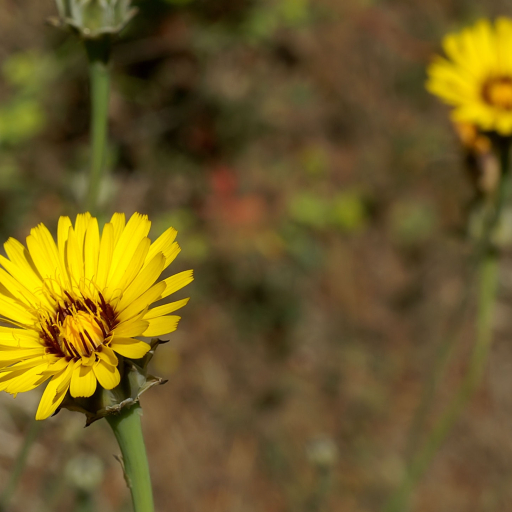
Plant Overview
Often called the False Sowthistle or Tingitana, this Mediterranean native is a master of the coast. With its striking "bullseye" flowers that look like a dandelion redesigned by an artist, it is a hardy survivor frequently found clinging to rocky cliffs and sandy dunes. In North Africa and the Canary Islands, it has been a traditional foraging staple for centuries, valued for its ability to thrive where other greens wither.
🔍 How to Identify
- 🌼 The "Bullseye" Bloom: Unlike a standard dandelion, the bright lemon-yellow petals surround a distinct, dark purplish-brown central disk, creating a target-like appearance.
- 🍃 Waxy Foliage: The leaves are a soft, powdery blue-green (glaucous) and often have wavy, tooth-like edges that clasp tightly around the base of the stem.
- 🥛 Milky Latex: If a leaf or stem is broken, the plant secretes a thick, white milky sap, a characteristic of the broader daisy family it belongs to.
🏡 In Your Garden
- 🏜️ Drought Warrior: This plant thrives on "tough love." It evolved for sandy shores and rocky outcrops, meaning it prefers well-draining, sandy soil and will actually suffer in heavy, waterlogged clay.
- ☀️ Sun Seeker: The flowers are highly light-sensitive; they require full, direct sun to fully expand. If planted in the shade, the plant will become "leggy" and its signature blooms may stay closed.
⚠️ Safety & Toxicity
- 🥗 Edible History: For humans, the young leaves are considered edible and are traditionally used in Mediterranean salads, offering a slightly bitter, nutty flavor.
- 🐾 Pet Precautions: While not considered high-risk, the milky sap can be a mild skin irritant. If ingested in large quantities by curious pets, it may cause minor digestive upset. Always forage with 100% certainty of identification.
✨ Fun Fact
🏺 Ancient Salad: In parts of North Africa, such as Tunisia, this plant is known locally as Grizim. It is still traditionally gathered from the wild today to be eaten fresh or steamed as a nutritious addition to local couscous dishes!

Detailed Care Instructions
To grow Reichardia Tingitana, also known as yellow snapdragon or Moroccan arugula, follow these steps:
- Climate: Ensure that your region's climate is suitable for growing Reichardia Tingitana. It thrives in Mediterranean or subtropical climates.
- Soil requirements: Reichardia Tingitana prefers well-draining soil with a pH range of 6.5 to 7.5. Amend the soil with organic matter like compost to improve its fertility and drainage.
- Planting time: Sow the seeds in early to mid-spring, after the frost has passed. You can sow directly into the ground or start indoors and later transplant.
- Sowing seeds: Scatter the seeds thinly over the prepared soil surface. Lightly press them down or cover them with about 1/8 inch of soil. Space the seeds around 4-6 inches apart.
- Watering: Keep the soil moist but not waterlogged during the germination period. After the plants are established, water moderately, allowing the top inch of soil to dry out between watering.
- Sunlight: Place the plants in a location that receives full sun or partial shade. Reichardia Tingitana requires at least 6 hours of direct sunlight each day to thrive.
- Thinning and spacing: Once the seedlings have reached about 2 inches in height, thin them to allow sufficient space for growth. Space the plants around 8-12 inches apart.
- Fertilization: Apply a balanced fertilizer according to the package instructions, typically during the growing season from spring to late summer. Avoid over-fertilization, as it can result in excessive foliage growth.
- Pest control: Monitor your plants for pests like aphids, caterpillars, or snails. Use organic pest control methods or insecticidal soap to protect your plants from damage.
- Harvesting: Harvest Reichardia Tingitana leaves when they are young and tender, starting about 30-40 days after sowing. Simply cut the outer leaves, allowing the inner ones to continue growing.
With proper care and maintenance, your Reichardia Tingitana plants should grow well and provide you with delicious greens to enjoy in salads and other dishes.

Place in a bright room that is sun drenched almost all day. Or directly in a south-facing window.

To properly water this plant, you should first check the soil around its base to ensure it is dry before watering. Overwatering can lead to root rot and other issues. When you are ready to water, pour the water slowly and evenly around the base of the plant until the water begins to seep through the bottom drainage holes. Avoid splashing water on the leaves as this can cause damage or encourage fungal growth. Allow the soil to dry out partially before watering again, as this plant prefers slightly dry conditions. Consider using a well-draining soil mix and a pot with drainage holes to prevent waterlogged soil.
To fertilize the Reichardia Tingitana plant, follow these instructions:
- Choose a balanced, water-soluble fertilizer with equal parts of nitrogen (N), phosphorus (P), and potassium (K). A general-purpose fertilizer with an NPK ratio of 10-10-10 or 20-20-20 is suitable.
- Dilute the fertilizer according to the package instructions. Usually, this involves mixing a certain amount of fertilizer with a specific volume of water.
- Apply the fertilizer solution to the soil around the base of the Reichardia Tingitana plant. Do this once every two weeks during the growing season, which usually begins in spring and lasts until late summer or early autumn.
- Avoid applying the fertilizer directly to the leaves or flowers of the plant, as this may cause burns or damage.
- Water the plant thoroughly after fertilizing to ensure the nutrients reach the roots and are evenly distributed in the soil.
- Monitor the plant for any signs of nutrient deficiencies or excesses. Adjust the fertilizer application accordingly based on the plant's response.
- During the winter months or periods of dormancy, reduce or stop fertilizing the plant as it requires less nutrients during these times.
Remember to always follow the specific instructions provided with the fertilizer product you choose, as different brands may have slightly different application rates and recommendations.
The ideal soil for this plant should be well-draining and loamy, with moderate fertility. It should contain a mix of sand, silt, and clay to allow for proper aeration and good water retention. Organic matter such as compost or peat moss can be added to increase soil fertility and improve soil structure. The soil pH should be between 6.0 and 7.5, which is slightly acidic to slightly alkaline. Additionally, this plant prefers soil that is not too dry or waterlogged, so proper watering and drainage are crucial for its growth and health.
To propagate Reichardia Tingitana, follow these steps:
- Choose a healthy parent plant: Select a mature Reichardia Tingitana plant that is disease-free and has a strong, well-established root system. This will increase the success rate of propagation.
- Prepare the planting container: Fill a container with a well-draining potting mix. The container should be large enough to accommodate the root system of the parent plant and provide ample space for growth.
- Take a cutting: Use clean, sharp pruning shears to take a 4-6 inch cutting from the parent plant. Make sure the cutting has at least two sets of leaves. The cutting can be taken from a stem or shoot.
- Remove lower leaves: Strip the lower set of leaves from the cutting, ensuring there are no leaves touching the potting mix.
- Apply rooting hormone (optional): If desired, dip the cut end of the stem in a rooting hormone powder or gel. This can help stimulate root growth and increase the chances of successful propagation.
- Plant the cutting: Make a small hole in the potting mix and gently insert the cut end of the stem into the hole. Press the potting mix around the cutting to secure it in place.
- Provide optimal conditions: Place the container in a warm and bright location, but away from direct sunlight. Maintain a temperature of around 70-80°F (21-27°C) for optimal rooting.
- Water regularly: Keep the potting mix consistently moist, but not waterlogged. Avoid overwatering as it can lead to root rot. Mist the cutting with water regularly to maintain humidity around the plant.
- Wait for rooting: After a few weeks, check for signs of root development. Gently tug on the cutting, and if there is resistance, it indicates that roots have formed.
- Transplant the rooted cutting: Once significant root growth is observed, the rooted cutting can be carefully transplanted into a larger container or directly into the garden, depending on your preference.
Remember, propagating Reichardia Tingitana may require patience and care, as not all cuttings will successfully root. It is always recommended to have multiple cuttings to increase the chances of successful propagation.








