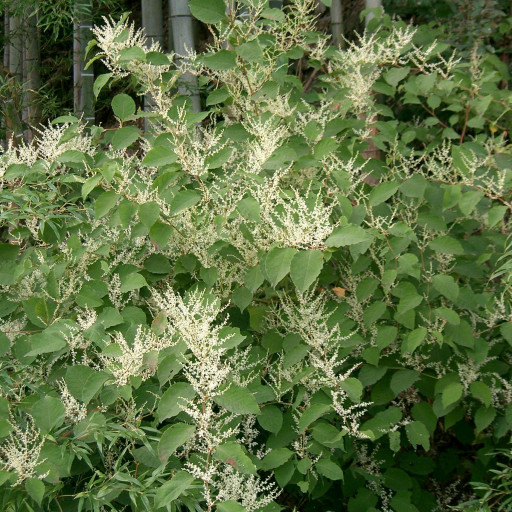
Plant Overview
Known as the "Bamboo’s Evil Twin" or Japanese Knotweed, this plant is a master of survival and a titan of the botanical world. Originally brought to the West as a prize ornamental in the 19th century, its heart-shaped leaves and elegant white flowers hide a secret: a root system so powerful it can push through solid concrete. It is famous—and often feared—for its incredible ability to regenerate from a tiny fragment of its stem.
🔍 How to Identify
- 🎋 The Stems: Look for hollow, bamboo-like stalks that are greenish with distinct purple or reddish speckles. They grow in dense, zigzagging thickets.
- 🍃 The Leaves: These are broadly oval or "shield-shaped" with a flat base, reaching up to 6 inches long. They are arranged in a distinct staggered pattern along the stem.
- ☁️ The Flowers: In late summer and early autumn, the plant produces delicate, creamy-white clusters of tiny flowers that droop elegantly from the leaf axils.
🏡 In Your Garden
- 🚫 A Formidable Invader: While it looks lush, this plant is listed as one of the world's most invasive species. It doesn't just grow; it conquers. It is highly discouraged to plant this in a home garden because it can damage foundations, pipes, and retaining walls.
- ⛏️ The Underground Network: The reason it is so hard to manage is its rhizomes (underground stems). These can reach 10 feet deep and spread 20 feet horizontally, meaning what you see above ground is only the tip of the iceberg.
- ✂️ Resilience: Do not compost cuttings! Even a piece of root the size of a fingernail can grow into a completely new plant, leading to unintended "outbreaks" in your compost pile or local park.
⚠️ Safety & Toxicity
- 🟢 Non-Toxic to Touch: Japanese Knotweed is not poisonous to humans or pets. In fact, the young shoots are technically edible and have a tart flavor similar to rhubarb.
- 🏗️ Structural Danger: The primary "safety" risk is to your property. Because of its strength, it can cause significant structural damage to homes and driveways, often affecting property values and even mortgage approvals in some regions.
- ☣️ Chemical Caution: If you are trying to remove it, be cautious with heavy herbicides, which are often the only way to kill the deep root system. Keep pets and children away from treated areas.
✨ Fun Fact
Japanese Knotweed is a botanical "time traveler." Its underground rhizomes can remain dormant in the soil for up to 20 years, waiting for the perfect conditions to suddenly spring back to life!

Detailed Care Instructions
| Color | Green Foliage With Creamy White Flowers |
| Soil Ph | 3.0-8.5 |
| Humidity | High |
| Lighting | Part Sun |
| Toxicity | Poisonous |
| Soil Type | Widely Tolerant, From Loamy To Cobble |
| Bloom Time | Late Summer To Early Autumn |
| Difficulty | Medium |
| Plant Type | Herbaceous Perennial |
| Mature Size | Up To 13 Feet Tall |
| Native Area | Japan, China, And Parts Of Taiwan And Korea |
| Sun Exposure | Full Sun |
| Hardiness Zones | 4-10 |
To successfully grow Reynoutria japonica, also known as Japanese knotweed, follow these steps:
- Choose a suitable location: Select a sunny or partially shaded spot in your garden. Japanese knotweed can grow in various soil types but prefers moist, fertile soil.
- Control its spread: Japanese knotweed is notorious for its rapid growth and invasive nature. To prevent its spread, it's recommended to grow it in containers or use root barriers to restrict its growth.
- Planting method: You can plant either from seed or start with a cutting or division from an established plant. If using seeds, sow them in spring or fall. For cuttings or divisions, perform it in spring or early summer. Dig a hole that is slightly larger than the root ball, place the plant in the hole, and backfill with soil, gently firming it around the plant.
- Watering: Initially, provide enough water to establish the plant's roots. Regular watering is essential, especially during dry periods. Keep the soil consistently moist but not waterlogged.
- Fertilization: Japanese knotweed generally doesn't require much fertilization. However, adding compost or organic matter to the soil before planting can enhance its growth.
- Maintenance: Japanese knotweed tends to grow vigorously, so regular maintenance is necessary. Remove any weeds that compete with it and keep the area around the plant clear. Trim back any unwanted growth to prevent it from spreading excessively.
- Overwintering: In colder regions, Japanese knotweed dies back during winter. In late autumn, after the first frost, cut the plant back to the ground and discard the foliage to prevent the spread of viable seeds.
- Disease and pest control: Japanese knotweed is relatively tolerant of diseases and pests. However, being invasive, its growth should be monitored closely to prevent its spread.
- Legal obligations: Before planting Japanese knotweed, ensure that it is legal to do so in your area. In many places, it is considered an invasive species and its cultivation is regulated or prohibited.
Remember that Japanese knotweed can be difficult to control due to its aggressive growth habit. Therefore, it's important to manage it properly and prevent its spread beyond your garden.

Place in a window with dappled sun or a spot in the middle of a room. Or directly in a window facing west or east.

To water this plant, it is important to thoroughly soak the soil around the base of the plant. This can be done either by watering the plant by hand using a watering can or hose, or by placing a layer of mulch or compost around the base of the plant to retain moisture. It is important not to over-water the plant, as this can lead to root rot and other issues. Instead, it is recommended to water the plant deeply and then allow the soil to dry out slightly before watering again. Additionally, it is important to provide proper drainage to prevent standing water around the roots of the plant.
To fertilize this plant, first test the soil to check its pH level. If the pH level is below 6.0, add lime to the soil. The ideal pH level for this plant is between 6.0 and 7.0. Use a balanced fertilizer with equal parts nitrogen, phosphorus, and potassium. Apply the fertilizer in early spring before new growth appears and then again mid-summer. Water the plant well before and after fertilizing to ensure the nutrients reach the roots and are not lost to evaporation. Avoid applying fertilizer to dry soil as it can cause root burn. Always follow the instructions on the fertilizer package for the proper amount to apply.
The ideal soil for this plant species should have a pH ranging from 5.5 to 7.0. It should be well-draining, with good organic matter content. Mix in compost or aged manure prior to planting to improve soil quality. Avoid planting in heavy clay soils, as this species prefers loamy or sandy soils. Additionally, it is recommended to regularly apply a balanced fertilizer to promote healthy growth.
To propagate this plant, you can take stem cuttings of the plant during the active growing season. Choose a healthy stem that is about 6 inches in length, and make a clean cut just below a leaf node using a sharp, sterile knife or scissors. Remove any leaves from the lower half of the stem, leaving only a few at the top. Dip the cut end of the stem in a rooting hormone powder and plant it in a pot filled with moist, well-draining potting soil. Keep the cutting in a warm, bright area with indirect sunlight and mist it regularly to keep it moist. After a few weeks, the cutting should develop roots and new growth. Once the plant has established, it can be transplanted into a larger container or into the ground.








