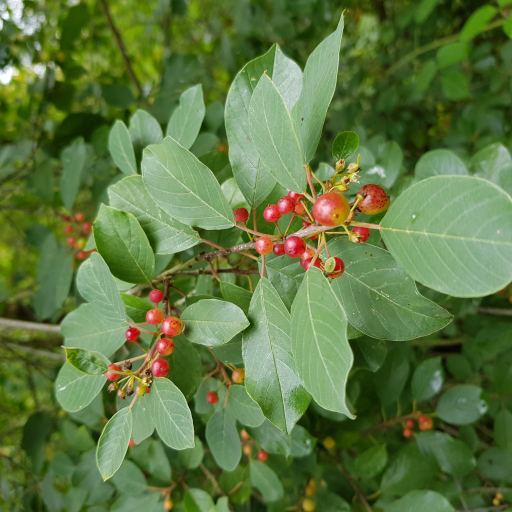
Plant Overview
Often called the Glossy Buckthorn or Alder Buckthorn, this versatile shrub is a master of adaptation, found everywhere from soggy marshlands to dry woodland edges. While it lacks the sharp thorns of its cousins, it makes up for it with a lush, polished appearance that has made it a common—if sometimes controversial—sight in landscapes across Europe and North America.
🔍 How to Identify
- 🍃 Glossy Foliage: True to its name, the leaves have a shimmering, lacquered sheen. They are oval-shaped with smooth edges (no teeth) and a distinct pattern of parallel veins.
- 🫐 Multicolored Berries: One of the easiest ways to spot it is by the fruit; you will often see green, red, and black berries all on the same branch at once as they ripen at different speeds.
- 🌳 Alternate Branching: Unlike the Common Buckthorn, which has leaves nearly opposite each other, the Glossy Buckthorn’s leaves and twigs grow in a staggered, alternate pattern along the stem.
🏡 In Your Garden
- 🌱 Invasive Nature: While beautiful, this plant is a prolific spreader. In North America, it is often classified as an invasive species because its seeds (spread by birds) can quickly take over a wetland, shading out native wildflowers.
- 🦋 The Brimstone Connection: In its native European range, it is the primary "host plant" for the bright yellow Brimstone butterfly. If you are looking to support specialist pollinators in Europe, this shrub is an ecological powerhouse.
⚠️ Safety & Toxicity
- 🚫 Status: Toxic if Ingested. All parts of the plant, especially the bark and berries, contain chemicals that act as a potent laxative.
- 🤢 Symptoms: Consumption of the berries by humans, dogs, or cats can lead to severe abdominal pain, vomiting, and dehydration. While birds eat the berries with no ill effects, they should be kept far out of reach of children and pets.
✨ Fun Fact
🧨 The Gunpowder Shrub: For centuries, the wood of the Glossy Buckthorn was harvested to create a very specific, high-quality charcoal. This "Buckthorn Charcoal" was once considered the finest material in the world for making high-grade gunpowder!

Detailed Care Instructions
Rhamnus frangula, also known as Alder Buckthorn, can be grown from seeds or nursery-bought seedlings. Here are some steps to grow Rhamnus frangula successfully:
- Choose a suitable location: Rhamnus frangula prefers moist, well-drained soil that is rich in organic matter. It thrives in full sun to partial shade.
- Plant the seeds or seedlings: If starting from seeds, sow them directly in the ground in the fall or early spring. If using seedlings, plant them in the ground at least 2-3 feet apart.
- Water regularly: Keep the soil consistently moist, especially during dry periods. Water deeply and allow the soil to dry slightly between waterings.
- Mulch: Mulch around the base of the plant to help retain soil moisture and suppress weeds.
- Fertilize: Rhamnus frangula is not a heavy feeder, but you can apply a balanced fertilizer in the spring to encourage growth.
- Prune: Prune your Rhamnus frangula plant as needed to maintain its shape and size. You can also prune to encourage new growth and improve air circulation.
- Monitor for pests and diseases: Keep an eye out for common pests such as aphids, scale, and caterpillars, as well as diseases like leaf spot. Treat any issues promptly to prevent them from spreading.
By following these steps, you can successfully grow Rhamnus frangula and enjoy its attractive foliage and berries in your garden.

Place in a window with dappled sun or a spot in the middle of a room. Or directly in a window facing west or east.

To properly water this plant, you should thoroughly soak the soil around it until the water begins to drain from the bottom of the pot or out of the ground. The frequency of watering will depend on various factors such as the type of soil, weather conditions, and the plant's location. It is essential to ensure that the soil remains moist but not waterlogged as this can lead to root rot. It is better to water less frequently but deeply rather than giving small amounts more frequently. Overwatering should be avoided, and any excess water should be discarded to prevent waterlogging.
To properly fertilize the plant that goes by the scientific name Rhamnus Frangula, you should apply a balanced fertilizer in the early spring before new growth appears. Use a slow-release fertilizer to avoid burning the roots of the plant. Follow the instructions on the fertilizer package for the correct application rate for your specific plant size. Water the plant thoroughly after fertilizing to ensure the nutrients are absorbed properly. Repeat this fertilization process once or twice more during the growing season, typically every 4-6 weeks. Avoid over-fertilizing, as this can harm the plant.
The preferred soil for this plant is a well-draining, loamy soil, with a pH of 6.0 to 7.5. It should be rich in organic matter and able to retain moisture without becoming waterlogged. The soil should be fertile and have good aeration to promote root growth and development. It may benefit from the addition of compost or other organic matter to improve soil quality and nutrient availability. It is important to avoid using heavy clay soils or soils with poor drainage, as this can lead to root rot and other plant diseases.
Rhamnus Frangula, also known as Alder Buckthorn, can be propagated through several methods such as seed propagation, stem cuttings, and root division.
Seed propagation involves harvesting mature seeds from the plant in late summer or early fall. The seeds should be planted in a well-draining potting mix and kept moist until they germinate. It is important to stratify the seeds by subjecting them to cold temperatures for a period of time before planting to mimic the natural conditions that they would experience in the wild.
Stem cuttings can also be taken from a healthy, mature plant in the spring or early summer. The cuttings should be about 6 inches long and taken from the top portion of the plant. Remove any leaves from the lower half of the cutting and dip the cut end in a rooting hormone before planting in a well-draining potting mix. Keep the soil consistently moist and the cutting should root within a few weeks.
Root division is another effective method for propagating Rhamnus Frangula. This involves digging up a mature plant and dividing the roots into several sections. Replant the divided sections in a suitable location with well-draining soil and keep them well-watered until they establish themselves.
Whichever method you choose, it is important to provide the newly propagated plants with the proper care and maintenance to ensure their success. With the right conditions, Rhamnus Frangula can be easily propagated and grown in your garden.







