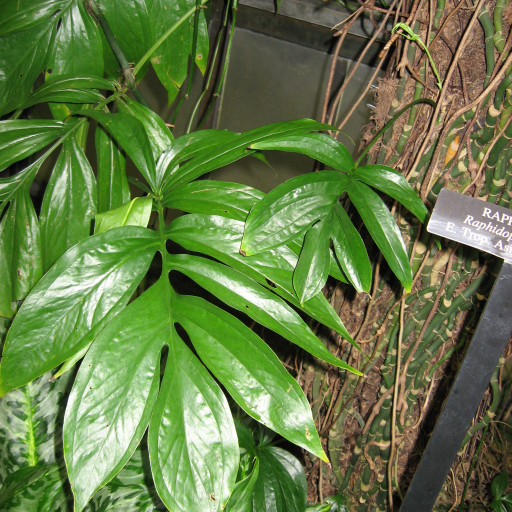
Plant Overview
Often called the Dragon Tail Plant, Rhaphidophora decursiva is a jungle showstopper that truly earns its mythical nickname as it matures. Starting life with simple, solid green leaves, it eventually undergoes a dramatic transformation into massive, deeply lobed foliage that resembles the scales and tail of a dragon. Native to the damp, high-altitude forests of the Himalayas and Southeast Asia, it brings a prehistoric, architectural vibe to any indoor plant collection.
🔍 How to Identify
- 🐉 Leaf Metamorphosis: Juvenile leaves are small, solid, and oval. As the plant climbs and matures, the leaves develop deep slits (fenestrations) that reach all the way to the midrib, creating a distinct "combed" appearance.
- 🌿 Leathery Texture: The foliage is remarkably thick and waxy, featuring a deep forest-green color with a high-gloss finish that reflects light.
- 🧗 Robust Stems: It produces thick, succulent-like stems and aggressive aerial roots designed to anchor the plant firmly to tree trunks or moss poles.
🏡 In Your Garden
- 🏗️ The Vertical Requirement: This plant is a dedicated climber. To see those iconic "dragon tail" leaves, you must provide a moss pole or cedar totem. If allowed to trail downward, the leaves will often revert to their small, juvenile form.
- 🌤️ Light Nuance: While it loves bright, indirect light, its thick leaves can actually tolerate slightly lower light than a Monstera deliciosa. However, for the fastest "tail" development, keep it in a spot where it can see the sky but not the direct afternoon sun.
- 💧 Drainage is Vital: It is highly sensitive to "wet feet." Use a chunky aroid mix (bark, perlite, and soil) to ensure the roots can breathe, as compacted, soggy soil will quickly lead to yellowing leaves.
⚠️ Safety & Toxicity
- 🚫 Toxic Status: Toxic to both humans and pets.
- 👄 The Details: Like most Aroids, it contains insoluble calcium oxalate crystals. If leaves are chewed or swallowed, they cause immediate stinging, swelling of the mouth and throat, and digestive upset. It is best kept on high shelves or secured tightly to a pole away from curious cats and dogs.
✨ Fun Fact
In the wild, Rhaphidophora decursiva is an expert at "phototropism"—it will actually grow toward the darkest shadows (skototropism) when it's a seedling to find a tree trunk to climb, only turning toward the light once it has started its journey upward!

Detailed Care Instructions
| Color | Bluish Green To Green Foliage With Yellowish Blooms |
| Soil Ph | 5.5-6.5 |
| Humidity | High |
| Lighting | Shade |
| Toxicity | Toxic |
| Soil Type | Well-Draining, Sandy, Loamy, Clay |
| Bloom Time | Summer |
| Difficulty | Medium |
| Plant Type | Evergreen Epiphyte, Araceae |
| Hibernation | Cold Period |
| Mature Size | Up To 30 Feet Tall And 20 Inches Wide |
| Native Area | India, Asia, China |
| Temperature | 18°C - 24°C |
| Sun Exposure | Partial Shade, Indirect Light |
| Hardiness Zones | 4-11 |
To grow a Rhaphidophora Decursiva plant, you can follow these steps:
- Choose a healthy plant: Look for a Rhaphidophora Decursiva plant with vibrant green foliage and no signs of pests or disease. Select a smaller plant if you want it to grow in a pot, or a larger one if you have a spacious indoor or outdoor area.
- Choose the right pot or location: Rhaphidophora Decursiva plants can grow well in pots or in the ground. If using a pot, ensure it has drainage holes, as these plants prefer well-draining soil. If planting in the ground, choose a location with partial shade to full shade.
- Soil: These plants prefer a well-draining and nutrient-rich soil mix. You can use a potting mix that includes peat moss, perlite, and compost. If planting in the ground, improve the soil by mixing in organic matter.
- Planting: Dig a hole in the pot or ground that is slightly larger than the plant's root ball. Place the plant in the hole, making sure the top of the root ball is level with or slightly below the soil surface. Gently firm the soil around the plant to provide support.
- Watering: Rhaphidophora Decursiva plants prefer consistently moist soil but not soggy conditions. Water the plant regularly, ensuring the top inch of soil remains moist. Avoid over-watering, as it can lead to root rot.
- Fertilizing: Feed the plant with a balanced, water-soluble fertilizer once a month during the growing season (spring and summer). Follow the manufacturer's instructions for application rates.
- Provide support: As the Rhaphidophora Decursiva plant grows, it will produce aerial roots that can be trained to climb on a support structure like a trellis or moss pole. Secure the plant to the structure using plant clips or soft ties.
- Pruning: Regularly check for dead or damaged leaves and remove them to maintain the plant's appearance and health. You can also prune the plant to control its size if necessary. Pruning can be done in spring.
- Humidity: These plants thrive in higher humidity levels. You can increase humidity by misting the leaves with water or placing a tray of water near the plant to increase moisture in the surrounding air.
- Repotting: Rhaphidophora Decursiva plants may need to be repotted every 1-2 years, or when the roots start to outgrow the current pot. Choose a pot that is one size larger and carefully transplant the plant into the new pot, ensuring not to damage the roots. Use fresh potting mix during repotting.
With proper care and ideal growing conditions, your Rhaphidophora Decursiva plant should thrive and grow impressively over time.

Place in a window with dappled sun or a spot in the middle of a room. Or directly in a window facing west or east.

To take care of this plant and ensure healthy growth, it is important to water it appropriately. Firstly, it is important to note that this plant prefers well-draining soil, so water should not be allowed to accumulate at the bottom of the pot or on the leaves.
When watering the plant, it is recommended to wait until the top inch or so of soil is dry before watering again. This can be achieved by feeling the soil with your finger or using a moisture meter.
When watering, pour water slowly and evenly around the base of the plant until it begins to drain out the bottom of the pot. Allow the excess water to drain off completely before placing the plant back in its saucer or decorative pot.
It is also important to avoid getting water on the leaves of the plant, as this can lead to fungal growth or damage the delicate leaves. Consider using a watering can with a narrow spout to help water the base of the plant without splashing water on the leaves.
Overall, paying careful attention to watering and ensuring the soil is allowed to dry out a bit between waterings can help promote healthy growth and prevent issues with overwatering.
- Choose a balanced liquid fertilizer with equal parts nitrogen, phosphorus, and potassium.
- Dilute the fertilizer according to package instructions, typically 1 teaspoon per gallon of water.
- Water the plant thoroughly before applying the fertilizer to avoid root burn.
- Apply the fertilizer to the soil, making sure to evenly distribute it around the root zone.
- Avoid getting the fertilizer on the leaves or stems, as it may cause damage.
- Fertilize every 2-3 months during the growing season (spring and summer).
- Reduce fertilization in the fall and winter months to avoid overfeeding the plant.
- Monitor the plant for any signs of nutrient deficiencies or fertilizer burn, and adjust fertilization accordingly.
Rhaphidophora Decursiva plant prefers well-drained soil with a pH range of 5.5 to 7.5. The soil should be rich in organic matter and should not be too dense or compact, as this can hinder the plant's root growth. It is recommended to use a soil mix that is composed of peat moss, perlite, vermiculite, and sphagnum moss. This type of soil mix provides good aeration and proper drainage, as well as ample nutrients for the plant's growth. Additionally, the soil should not be allowed to completely dry out, as the plant requires a consistently moist environment. Regular fertilization with a balanced fertilizer can also promote healthy growth and vibrant foliage.
Propagating this plant can be done through stem cuttings. First, select a healthy plant with mature stems to take cuttings from. Using a clean and sharp pair of scissors, choose a stem with at least two nodes and cut it just below the bottom node.
Remove the leaves from the bottom node and dip the cut end in rooting hormone. Then, plant the cutting in a well-draining soil mixture and water it thoroughly.
Cover the cutting with a clear plastic bag to create a greenhouse effect and place it in a bright and warm location with indirect sunlight. Mist the cutting occasionally and check the soil moisture regularly.
After a few weeks, roots should start to develop and once the cutting has established a healthy root system, it can be transplanted into a pot with soil.
Common pests of the dragon tail include Mealybugs, spider mites, fungus gnats, thrips. Make a habit of checking your dragon tail frequently for pests so that any infestations can be caught and managed early.








