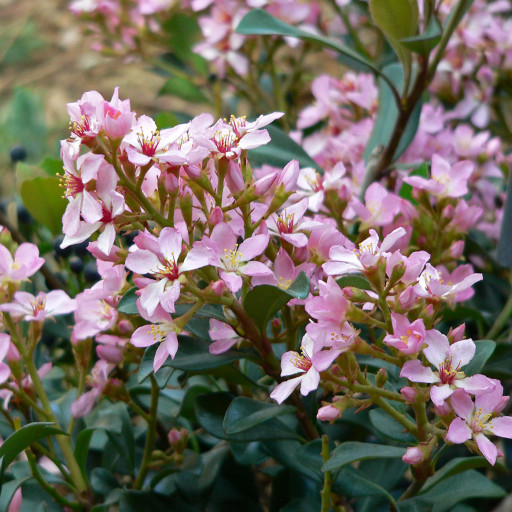
Plant Overview
Commonly known as the Indian Hawthorn, this resilient evergreen is a staple in temperate and coastal landscapes. Despite its name, it is actually native to southern China and East Asia, not India. It is beloved for its "tidy" nature, forming naturally rounded mounds that erupt in a "snowstorm" of pink or white blossoms every spring.
🔍 How to Identify
- 🌸 Starry Blooms: Look for dense clusters of five-petaled flowers, typically in shades of blush pink or pearly white, featuring prominent, pin-like stamens.
- 🍃 Serrated Foliage: The leaves are thick, leathery, and oval-shaped with lightly toothed edges. New growth often emerges with a beautiful bronze or burgundy tint.
- 🫐 Dark Pomes: In late summer and autumn, the plant produces small, dark blue-to-purple berry-like fruits that persist into the winter.
🏡 In Your Garden
- ⚓ Coastal Warrior: This is one of the best shrubs for seaside gardening. It is incredibly salt-tolerant and can handle the harsh, briny winds that would wither more delicate species.
- ✂️ Low Maintenance: Because of its slow growth and naturally mounded habit, it rarely needs heavy pruning. If you do want to shape it, wait until immediately after it finishes flowering to avoid cutting off next year's buds.
- 🌬️ Leaf Health: To prevent "Entomosporium leaf spot" (tiny red dots on leaves), ensure the plant has excellent air circulation and avoid overhead watering that keeps the foliage damp.
⚠️ Safety & Toxicity
- ✅ Pet Safe: The Indian Hawthorn is generally considered non-toxic to dogs, cats, and horses, making it a "worry-free" choice for family backyards.
- 🚫 Berry Caution: While the berries are not considered highly toxic, they are not meant for human consumption. Ingesting large quantities may cause mild stomach upset in small children.
✨ Fun Fact
🐦 The Bird Buffet: While the berries are bland and mealy to humans, they are a vital high-energy snack for songbirds like Cedar Waxwings and Robins during the cold winter months when other food sources are scarce.

Detailed Care Instructions
| Color | Pink, White |
| Soil Ph | Acidic, Neutral, Alkaline |
| Humidity | Normal |
| Lighting | Part Sun |
| Soil Type | Moist, Well-Drained |
| Bloom Time | Spring |
| Difficulty | Medium |
| Plant Type | Shrub |
| Mature Size | 4–6 Ft. Tall And Wide |
| Native Area | Asia |
| Sun Exposure | Full Sun |
| Hardiness Zones | 8-10 |
To grow Rhaphiolepis Indica, also known as Indian Hawthorn, follow these steps:
- Choose a suitable location: Indian Hawthorn prefers full sun to partial shade. Ensure the soil is well-draining and slightly acidic.
- Prepare the soil: Incorporate organic matter like compost or aged manure into the soil to improve fertility and drainage. Avoid heavy clay soils.
- Planting: Dig a hole that is slightly wider and deeper than the plant's root ball. Carefully remove the plant from its container and gently loosen the roots. Place the plant in the hole, making sure it sits at the same depth as it was in the container. Fill the hole with soil and firm it gently around the plant.
- Watering: Provide enough water during planting to settle the soil around the roots. After that, water deeply but infrequently to encourage deep root growth. Avoid overwatering, as it can lead to root rot.
- Mulching: Apply a layer of organic mulch around the base of the plant to help retain moisture, suppress weeds, and regulate soil temperature.
- Pruning: Rhaphiolepis Indica can benefit from regular pruning to maintain shape and promote new growth. Prune after blooming to remove spent flowers and stimulate bushier growth.
- Fertilizing: Feed the plant with a slow-release, balanced fertilizer in spring to promote healthy growth and flower production. Follow the instructions on the fertilizer packaging for the appropriate dosage.
- Pest and disease control: Indian Hawthorn is generally resistant to pests and diseases. However, keep an eye out for common garden pests like aphids, scale insects, and spider mites. Treat them with insecticidal soap or horticultural oil if necessary.
- Winter protection: In colder regions, protect your Rhaphiolepis Indica from harsh winter conditions by covering it with burlap or providing a windbreak.
- Regular maintenance: Monitor the plant regularly for signs of stress, disease, or nutrient deficiencies. Adequate watering, proper fertilization, and timely pruning will help keep your Rhaphiolepis Indica healthy and flourishing.
Remember to consult local gardening resources or experts for specific guidance based on your climate and growing conditions.

Place in a window with dappled sun or a spot in the middle of a room. Or directly in a window facing west or east.

When watering this plant, it is important to make sure that the soil is moist but not waterlogged. Overwatering can lead to root rot and other issues, so it is important to monitor the soil moisture level carefully.
One way to check the soil moisture is to stick your finger into the soil up to the first joint. If the soil feels moist, you can hold off on watering for a few more days. If the soil is dry, it is time to water.
When watering, use room temperature water and water the soil around the plant, rather than pouring water directly on the leaves or flowers. This will help prevent issues with fungal growth and other problems.
To ensure that the water penetrates deeply into the soil, water slowly and deeply, rather than giving the plant a quick drink. Stop watering once the soil is moist but not saturated, and avoid letting water pool around the base of the plant.
It is also important to avoid letting the soil dry out completely between waterings. This can cause the plant to become stressed and may even lead to wilting or leaf drop. By providing consistent, moderate moisture, you can help ensure that your plant stays healthy and vibrant.
To fertilize this plant, you should apply a slow-release, balanced fertilizer in early spring, before new growth emerges. Follow the manufacturer's instructions for application rates and amounts. Be sure to water the plant thoroughly after fertilizing. Avoid over-fertilizing, as this can lead to excessive growth and reduced overall health of the plant.
Rhaphiolepis Indica is a plant species that requires fertile and well-drained soil to grow. The soil should have good moisture-retention capacity, but not too much so that it becomes waterlogged. It should have a pH level that ranges from slightly acidic to neutral.
The best type of soil for Rhaphiolepis Indica is loamy soil. Loamy soil is a type of soil that contains a good mix of sand, silt, and clay. This soil type has good drainage and aeration properties, which makes it suitable for Rhaphiolepis Indica to grow.
If the natural soil is not loamy, then it can be amended to make it more suitable for the plant. This can be done by adding organic matter such as compost, peat moss, or aged manure. These materials help to increase the soil's water-holding capacity, improve its structure, and provide essential nutrients for the plant's growth.
It is important to note that Rhaphiolepis Indica is sensitive to high levels of salt in the soil. Therefore, it is recommended to avoid using soil that has been treated with chemical fertilizers or has high salt content.
In summary, the soil for Rhaphiolepis Indica should be fertile, well-drained, slightly acidic to neutral in pH, and preferably loamy. The soil can be amended with organic matter to improve its properties. Avoid using soil with high salt content.
Propagation of this plant can be done by taking softwood cuttings in the early summer months. Cuttings should be taken from new growth, about 4-6 inches long, and should have several nodes. Remove the lower leaves and dip the cut end in rooting hormone. Plant the cutting in a well-draining potting mix and keep it moist. Place the pot in a warm, bright area, but out of direct sunlight. The cutting should root in 2-3 weeks. Once it has rooted, it can be transplanted into a larger pot or directly into the garden.
Common pests of the indian hawthorn include Scale insect, aphids, larvae. Make a habit of checking your indian hawthorn frequently for pests so that any infestations can be caught and managed early.








