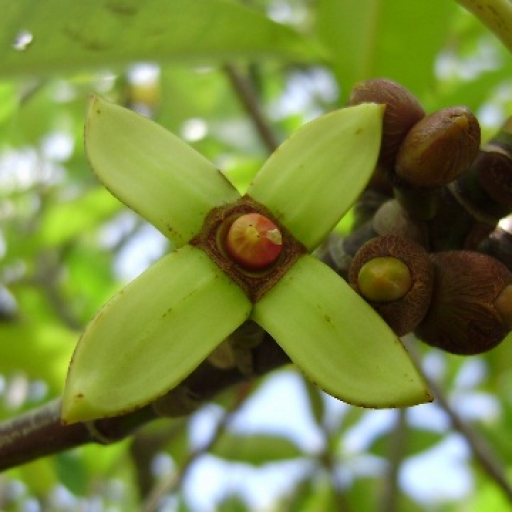
Plant Overview
Known as the Tall-stilt Mangrove, Rhizophora apiculata is a true architect of the shoreline. Often found framing tropical estuaries across Southeast Asia and the Pacific, these trees are the ultimate survivors, thriving in the harsh, salty "no-man's-land" between the ocean and the shore. They act as natural coastal buffers against tsunamis and storms, earning them a reputation as the silent, sturdy guardians of the coast.
🔍 How to Identify
- 👣 The "Walking" Roots: It is most easily recognized by its high, arching stilt roots (prop roots) that lift the main trunk above the water, making the tree look like it is standing on many spindly legs.
- 🍃 Apiculate Leaves: The leaves are thick, leathery, and dark green. If you look closely at the tip, you’ll see a tiny, sharp point—this "apicula" is exactly how the plant gets its scientific name.
- 🕯️ Cigar Propagules: Instead of traditional round seeds, this mangrove produces long, green, spear-shaped "propagules" that hang from the branches like heavy candles before dropping into the mud.
🏡 Habitat & Ecology
- 🌊 Saltwater Specialists: Unlike most plants that would wither in salt, this mangrove filters out excess salt through its roots. It requires brackish or saltwater and deep, anaerobic mud to truly thrive, making it a rare choice for home gardens unless you are managing a coastal restoration or a large brackish aquarium.
- 🌬️ The Breathing Tree: Because the mud it grows in lacks oxygen, the tree "breathes" through its roots. The bark of the stilt roots is covered in tiny pores called lenticels that gulp in air during low tide to keep the submerged parts of the plant alive.
⚠️ Safety & Toxicity
- ✅ Non-Toxic: Rhizophora apiculata is generally considered safe and non-toxic to humans and pets.
- 🪵 Tannin Rich: While not poisonous, the bark is incredibly high in tannins (historically used for dyeing and tanning leather). If chewed or handled excessively, the sap can be very astringent and may cause mild skin or mouth dryness, but it is not a safety risk.
✨ Fun Fact
These trees practice "vivipary," which is like a plant version of a live birth! The seeds germinate and grow into long seedlings while still hanging from the parent branch. When they finally drop, they are already "mini-trees" ready to spear into the mud or float for weeks until they find a new place to grow.

Detailed Care Instructions
Here are the steps to grow Rhizophora apiculata, also known as the mangrove plant:
- Obtain seeds or seedlings: You can either collect seeds from mature Rhizophora apiculata trees (usually found in coastal areas and mangrove swamps) or purchase seedlings from a nursery.
- Prepare a suitable growing medium: Rhizophora apiculata grows naturally in muddy or sandy coastal soils. You can replicate these conditions by mixing equal parts sand and organic-rich compost to create a well-draining soil mixture.
- Choose a suitable container: Fill a container with the prepared soil mixture. Make sure the container has drainage holes to prevent waterlogging.
- Plant the seeds/seedlings: If using seeds, soak them in water for 24 hours to enhance germination. Plant the seeds or seedlings about 1 inch deep into the soil. Space them at least 6 inches apart if planting multiple seeds/seedlings.
- Provide the right environmental conditions: Rhizophora apiculata requires a warm and humid environment. It grows best in areas with temperatures ranging from 20-35°C (68-95°F). Keep the soil consistently moist but not waterlogged.
- Provide sunlight: Rhizophora apiculata thrives in full sunlight. Place the container in an area where it can receive at least 6-8 hours of direct sunlight each day.
- Maintain watering and humidity: Regularly water the plant to keep the soil moist, but avoid overwatering. Also, mist the plant regularly to provide humidity, especially if you are growing it indoors.
- Prune if necessary: As the plant grows, you may need to prune any dead or damaged branches to maintain its health and shape.
- Transplanting: You may choose to transplant the Rhizophora apiculata plant into its permanent location once it has grown to a suitable size. This should typically be done in coastal areas or near water bodies with salt or brackish water.
- Monitor for pests and diseases: Keep an eye out for any signs of pests or diseases, such as leaf spots or wilting. Apply appropriate measures, such as using organic pesticides or fungicides, if necessary.
Remember that Rhizophora apiculata is a coastal plant adapted to brackish water and tidal environments, so replicating these conditions as closely as possible will increase the plant's chances of successful growth.

Place in a bright room that is sun drenched almost all day. Or directly in a south-facing window.

Rhizophora Apiculata is a plant species that is commonly found in tropical and subtropical regions. It is a unique plant that plays a vital role in coastal ecosystems and offers several benefits. To ensure that the plant grows and thrives properly, it is crucial to water it appropriately.
Here are some tips for watering Rhizophora Apiculata plant:
1. Ensure that the plant is planted in well-draining soil as it prefers moist but not waterlogged conditions.
2. Water the plant thoroughly, making sure that the soil is moist up to a few inches deep. However, avoid overwatering as it can lead to root rot and other problems.
3. As a general rule of thumb, water the plant once or twice a week during the growing season. In the dormant season, reduce watering frequency to prevent waterlogging.
4. Water the plant early in the morning or late in the evening when the sun is not too harsh, as this will prevent the water from evaporating too quickly.
5. Use a watering can or a gentle hose nozzle to water the plant gradually and avoid damaging its delicate roots.
By following these simple tips, you can give your Rhizophora Apiculata plant the best possible care, ensuring its healthy growth and development.
To properly fertilize this plant, you will want to choose a fertilizer that is rich in nitrogen, phosphorus, and potassium. Ideally, it should have an N-P-K ratio of 10-5-10 or something similar. Apply the fertilizer to the soil around the base of the plant, making sure not to get any on the leaves or stems. Water the plant thoroughly after fertilizing to help the nutrients penetrate the soil. You can fertilize this plant once every 4-6 weeks during the growing season. Avoid fertilizing during the dormant season.
Rhizophora Apiculata plants are commonly found in coastal areas and are able to thrive in a variety of soil types. However, for optimal growth, it is recommended to use a soil that is moist but well-draining, with a mixture of organic matter such as compost or peat moss. The pH level should be between 5.5 and 7.5. Additionally, it is important to choose a soil that is not overly salty or contaminated with pollutants as this can harm the plant. Some options for suitable soils include loamy soils, sandy soils, and clay soils that have been amended with organic matter. Overall, it is important to provide a nutrient-rich soil that is able to retain moisture and promote healthy root growth for this plant.
To propagate this plant, first, select mature branches with several nodes. Cut these branches into sections, making sure each section has at least two nodes.
Next, remove the lower leaves from the cuttings and coat the cuttings in hormone rooting powder.
Prepare a well-draining potting mix, such as a mixture of peat moss, perlite, and sand.
Insert the cuttings into the potting mix and water them well. Keep the soil moist and place the pot in a warm, indirect light location.
After several weeks, the cuttings should begin to develop new roots and leaves. At this point, they can be transplanted into larger pots or planted directly in the ground.








