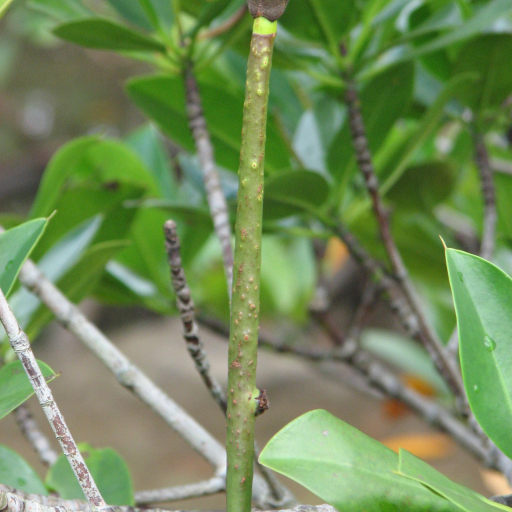
Plant Overview
Often called the Loop-root Mangrove or Asiatic Mangrove, Rhizophora mucronata is a coastal architect that literally builds land with its feet. These trees are the "walking forests" of the shoreline, recognized by their dramatic, arching roots that look like giant spiders frozen in the mud. In many cultures, they are revered as the "guardians of the coast," protecting villages from the fury of tsunamis and storm surges.
🔍 How to Identify
- 👣 Stilt Roots: The most iconic feature is the mass of arching, branched aerial roots (prop roots) that emerge from the trunk to support the tree in unstable, soft mud.
- 🍃 Mucronate Leaves: The leaves are leathery, elliptical, and bright green, but look closely at the tip—you’ll find a tiny, hair-like point (a "mucro"), which gives the plant its scientific name.
- 🥖 Cigar Propagules: Instead of traditional round seeds, this plant produces long, green, cigar-shaped "propagules" that can reach up to 70cm long, hanging from the branches like heavy ornaments.
🏡 In Your Garden & Ecology
- 🌊 Salt Specialist: While most plants die in salt, this mangrove thrives by filtering salt at the root level. If you are growing one in a brackish aquarium or a coastal pond, it requires high humidity and "wet feet" at all times.
- 🦀 The Nursery Nuturer: In its natural habitat, its complex root system creates a safe haven for juvenile fish and crabs. In a home "mangrove" setup, it acts as a powerful natural filter, absorbing nitrates and phosphates from the water.
- 🌱 Substrate Preference: It prefers deep, soft mud or fine sand. It hates being moved once the stilt roots begin to "walk" and anchor into the ground, as the taproot is quite delicate.
⚠️ Safety & Toxicity
- ✅ General Safety: Rhizophora mucronata is generally considered non-toxic to humans and common household pets like cats and dogs.
- 🧪 Tannin Content: The bark is incredibly rich in tannins (historically used for dyeing nets). While not "poisonous," the sap can be mildly irritating to sensitive skin or cause an upset stomach if the leaves are chewed by curious pets.
✨ Fun Fact
This plant practices "vivipary," which essentially means it gives birth to live young! Instead of dropping a seed that might drown in the tide, the seed germinates while still attached to the parent tree. It grows into a heavy, weighted spear (the propagule) so that when it finally falls, it stabs directly into the mud to start growing immediately.

Detailed Care Instructions
To grow Rhizophora mucronata, also known as the Red Mangrove, you can follow these steps:
- Obtain seeds or propagules: Rhizophora mucronata is typically propagated by seeds or propagules (developed embryos). You can either collect seeds from mature fruits or obtain propagules from a local nursery or botanical garden.
- Prepare a planting container: Use a pot or container with drainage holes. Fill it with a mixture of equal parts of sand and peat moss. This will provide a well-draining medium for the plant.
- Plant the seeds or propagules: If using seeds, soak them in water for 24 hours prior to planting. Place the seeds or propagules in the container, about half an inch deep, with the pointed end facing up.
- Provide the right conditions: Rhizophora mucronata thrives in tropical and subtropical regions. It requires full sun and brackish or saltwater conditions to grow successfully. If you don't have access to brackish water, you can create a mixture of freshwater and sea salt to provide a suitable environment.
- Water regularly: Keep the soil slightly moist at all times. It is crucial to maintain the right moisture levels for the plant's growth. Overwatering or drying out the soil can harm the plant.
- Monitor the temperature: Ensure that the plant is kept at temperatures between 68°F (20°C) and 86°F (30°C). Avoid exposing the plant to temperatures below 50°F (10°C) or above 95°F (35°C).
- Transplant into a larger container: Once the seedlings or propagules have established a root system and have grown several leaves (usually after a few months), they can be transplanted into larger containers or directly into a suitable coastal location.
- Provide support: If growing in containers, make sure to provide support for the plants to mimic their natural growth habit. Mangroves have prop roots that help stabilize them in muddy or sandy areas, so adding small stakes or wooden supports can assist in their growth.
- Maintain appropriate salinity levels: If growing in a coastal location, monitor the salinity levels of the water regularly to ensure they remain within the optimal range for Rhizophora mucronata. They prefer brackish water with salinity levels between 20-30 parts per thousand.
- Monitor and prune: Keep an eye out for any pests or diseases, and promptly address any issues that arise. Prune excess growth to maintain an appropriate shape and prevent overcrowding.
Remember, growing Rhizophora mucronata requires specific environmental conditions and a patience since it takes several years for the plant to reach maturity.

Place in a bright room that is sun drenched almost all day. Or directly in a south-facing window.

In order to water this specific plant, it is important to note the specific requirements of its habitat. It is a plant that thrives in aquatic or marshy environments, meaning that it needs to be watered frequently with brackish or saltwater. It is important to avoid giving it tap water or fresh water, as this can harm the plant.
One recommended watering technique involves filling a container with brackish or saltwater, and allowing the plant's roots to soak in it for a short period of time, before draining the water and allowing the excess to drip off. Another method involves misting the leaves of the plant with a sprayer filled with the same type of water, providing it with necessary hydration.
Overall, it is important to monitor the plant closely, taking note of any changes in its appearance or behavior that may indicate inadequate watering. With proper care and attention, Rhizophora Mucronata can thrive and grow into a beautiful addition to any aquatic or marshy environment.
To fertilize this plant, use a balanced fertilizer with equal parts nitrogen, phosphorus, and potassium. Mix the fertilizer with soil and water the plant thoroughly. Fertilize the plant regularly throughout the growing season, but avoid over-fertilizing as it can lead to salt build-up in the soil. Additionally, make sure to maintain proper soil pH levels for optimal nutrient absorption by the plant.
Rhizophora Mucronata is a type of plant that grows naturally in wet and salty soil conditions, such as mangrove swamps. The soil that is best suited for this plant is a mixture of sand and clay with a high salt content. It is important to make sure that the soil is well-draining so that the plant does not become waterlogged and susceptible to root rot. The pH of the soil should be neutral to slightly acidic. It is also important to add organic matter to the soil to provide nutrients to the plant. The soil should be kept moist but not overly wet, and the plant requires regular watering to thrive. Soil that is too dry or too wet can negatively impact the growth of the plant. Overall, the soil for Rhizophora Mucronata should be well-draining, with a high salt content, neutral to slightly acidic pH, and containing organic matter for nutrient support.
Rhizophora Mucronata can be propagated through various methods. One method is through stem cuttings. To do this, select a healthy stem from the plant and make a clean cut at a 45-degree angle just below a node. Remove any leaves from the bottom 2-3 inches of the stem and dip the cut end in rooting hormone. Plant the cutting in a pot with well-draining soil and keep it moist and in a warm, humid location until it roots.
Another method of propagation for Rhizophora Mucronata is via seeds. Collect mature seeds from the plant and soak them in water for 24 hours. Plant the seeds in a pot with well-draining soil and keep it moist and in a warm, humid location until the seeds germinate.
Another propagation method is through layering. To do this, select a low-hanging branch and gently bend it towards the ground, burying the tip of the stem in soil. Anchor the stem in place with a wire or stake. Keep the soil moist and in a warm, humid location until roots develop. Cut the new plant from the parent once it has rooted.
Lastly, Rhizophora Mucronata can also be propagated through aerial layering. To do this, make a small incision in a branch and wrap it with damp sphagnum moss. Cover the moss with plastic wrap and secure it in place. Keep the moss moist and in a warm, humid location until roots develop. Once the roots have developed, cut the new plant from the parent and plant it in a pot with well-draining soil.








