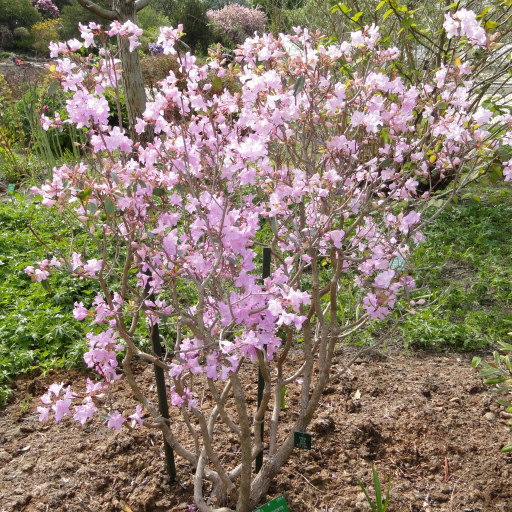
Plant Overview
Known as the "Rusty-leaved Rhododendron," this hardy evergreen hails from the misty, high-altitude mountains of Southwest China and Myanmar. It is a favorite among woodland gardeners for its reliability and its unique, shimmering foliage that seems to change color as the breeze catches the undersides of the leaves. Often used as a foundation for breeding modern hybrids, it remains a classic for its wild, elegant charm.
🔍 How to Identify
- 🍃 Rusty Undersides: The most striking feature is the dense covering of tiny, reddish-brown scales on the leaf bottoms, giving the foliage a distinct copper-like glow when viewed from below.
- 🌸 Speckled Blooms: In mid-to-late spring, it produces clusters of funnel-shaped flowers ranging from pale lavender to deep rosy-pink, usually decorated with delicate crimson or brown freckles on the upper petals.
- 🌿 Upright Growth: Unlike prostrate varieties, this species grows as an upright, multi-stemmed shrub that can eventually reach the height of a small tree if left unpruned.
🏡 In Your Garden
- ⛰️ Highland Resilience: Reflecting its origins in alpine thickets, this is one of the more sun-tolerant and wind-resistant Rhododendrons, making it a great choice for gardens that aren't perfectly sheltered.
- 🧪 Acidic Appetites: It is an "ericaceous" plant, meaning it strictly requires acidic soil. If your garden has alkaline or lime-heavy soil, the plant will struggle to take up nutrients; in such cases, it is best grown in large containers with specialized peat-free acidic compost.
⚠️ Safety & Toxicity
- 🚫 Toxic Status: All parts of the plant, including the leaves and nectar, are toxic if ingested.
- 🐾 Pets & Livestock: It contains grayanotoxins, which can cause digestive upset, weakness, or heart issues in dogs, cats, and horses. Always plant it in a location where curious pets or children won't be tempted to "sample" the greenery.
✨ Fun Fact
The "rusty" scales on the leaves aren't just for show—they are a sophisticated evolutionary adaptation that helps the plant regulate moisture and protects it from the intense UV radiation found at high mountain elevations!

Detailed Care Instructions
Rhododendron rubiginosum, also known as Rusty Leaved Rhododendron, is a beautiful shrub that can be grown in gardens. Here are some tips on how to grow Rhododendron rubiginosum plant:
- Location: Choose a spot in your garden that receives partial shade to full sun. Rhododendrons prefer dappled light and protection from hot, afternoon sun.
- Soil: Rhododendrons prefer acidic, well-draining soil. If your soil is not acidic, you can amend it with peat moss or sulfur to lower the pH level.
- Planting: Plant your Rhododendron rubiginosum in early spring or late fall. Dig a hole twice as wide as the root ball and plant the shrub at the same depth it was in its container.
- Watering: Keep the soil consistently moist, especially during the plant's establishment period. Water deeply once a week, depending on rainfall and weather conditions.
- Mulching: Apply a layer of mulch around the base of the plant to help retain moisture and keep weeds at bay.
- Fertilizing: Rhododendrons do not require a lot of fertilization. You can apply a slow-release, acid-loving fertilizer in the spring, and avoid fertilizing in late summer or fall.
- Pruning: Rhododendrons do not require heavy pruning, but you can trim back any dead or damaged branches in the early spring.
- Protection: Rhododendrons are susceptible to pests like aphids and lace bugs, so regularly inspect your plants for any signs of infestation and treat them accordingly.
By following these tips, you can successfully grow Rhododendron rubiginosum in your garden and enjoy its beautiful blooms and foliage.

Place in a window with dappled sun or a spot in the middle of a room. Or directly in a window facing west or east.

To water the Rhododendron Rubiginosum plant, you should first check the soil moisture by inserting your finger a few inches into the soil. If the top layer of soil feels dry to the touch, the plant likely needs watering.
When watering, aim to moisten the entire root zone, which typically extends to the drip line of the plant. Avoid watering the leaves or flowers directly as this can promote disease. Use a watering can or hose with a gentle spray to ensure even distribution of water.
Make sure not to overwater the plant, as this can lead to root rot. Allow the soil to dry out slightly between waterings, especially during the dormant season. Additionally, be mindful of the temperature and humidity levels, as these factors can influence the plant's water requirements.
It is helpful to provide good drainage for the plant by planting it in well-draining soil and ensuring that water does not accumulate around the roots. This will help prevent waterlogged conditions that can harm the plant.
Overall, regular monitoring of soil moisture and adjusting watering frequency based on the plant's needs will help maintain healthy growth for the Rhododendron Rubiginosum.
To fertilize the Rhododendron Rubiginosum plant, use a slow-release, acidic fertilizer in the spring before new growth appears. Apply the fertilizer on the soil around the plant, avoiding direct contact with the roots. Water the plant thoroughly after fertilizing to help the nutrients penetrate the soil. Repeat every year to promote healthy growth and vibrant blooms. Avoid over-fertilizing, as this can damage the plant.
The Rhododendron Rubiginosum plant thrives in well-draining acidic soil with a pH level between 4.5 and 6.0. It is important to choose a soil that is rich in organic matter, such as peat moss or compost, to provide adequate nutrients for the plant's growth. Additionally, adding perlite or sand to the soil mix can improve drainage and prevent waterlogging, which can lead to root rot. It is also recommended to amend the soil with sulfur or aluminum sulfate to lower the pH level if necessary. Overall, choosing a high-quality, acidic soil mix will promote healthy growth and vibrant blooms for the Rhododendron Rubiginosum plant.
To propagate Rhododendron Rubiginosum plant, you can use several methods such as layering, division, or cutting.
One way to propagate this plant is through layering, which involves bending a branch of the plant down to the ground and covering it with soil. After several months, roots will begin to grow from the buried portion of the branch, at which point it can be cut off from the parent plant and transplanted.
Another method is division, which involves separating the plant into smaller sections with roots attached. To do this, carefully dig up the plant and gently pull apart the root ball into smaller clumps. Each clump can then be replanted into its own pot or location in the garden.
Lastly, you can propagate Rhododendron Rubiginosum plant through cuttings, which involves taking a small section of a stem or branch and planting it in a pot with well-draining soil. Make sure to keep the soil moist and provide the cutting with indirect light until roots have formed.
Overall, propagating Rhododendron Rubiginosum plant can be a rewarding and simple process with the right techniques and care.








