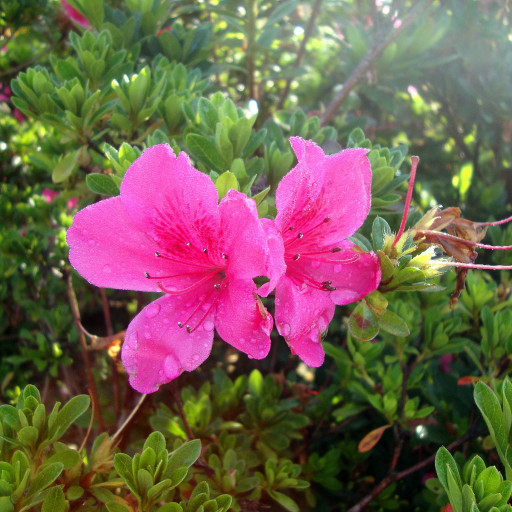
Plant Overview
Often called the Sims' Azalea or the Indian Azalea (despite being native to East Asia), this vibrant shrub is a staple of Lunar New Year celebrations and springtime windowsills. Originating from the misty slopes of China and Thailand, it has been bred into thousands of cultivars that burst with neon-bright, papery blooms. While it looks like a delicate floral arrangement, it is actually a long-lived woody perennial that thrives when treated like a forest-floor resident.
🔍 How to Identify
- 🍃 Fuzzy Foliage: The dark green, elliptical leaves are covered in tiny, fine hairs (pubescence), which help the plant manage moisture and give the foliage a slightly matte, textured feel.
- 🌸 Funnel-Shaped Blooms: The flowers are broad and trumpet-like, often featuring five lobes. They come in a spectacular range of pinks, reds, and whites, sometimes with darker speckles on the upper petals.
- 🌿 Dense Branching: It grows as a compact, multi-stemmed shrub. In its natural habitat, it can reach several feet, but indoor versions are often pruned into neat, rounded globes or miniature "trees."
🏡 In Your Garden & Home
- 🧪 The Acid Factor: This plant is "ericaceous," meaning it has a strict requirement for acidic soil. If the pH is too high, the plant cannot absorb iron, leading to yellowing leaves with green veins—a cry for help known as chlorosis.
- 💧 Cool and Damp: Unlike tropical houseplants that love heat, the Sims' Azalea prefers "cool feet." It hates parched air from heaters, which causes its buds to drop before they ever open. Keeping the soil consistently moist (but not soggy) and the air humid is the secret to a long bloom season.
⚠️ Safety & Toxicity
- 🚫 Toxic Status: All parts of the Rhododendron simsii contain Grayanotoxins.
- 🐾 Danger to Pets & Kids: If leaves or flowers are ingested, it can cause salivation, vomiting, and diarrhea. In more severe cases involving pets, it can lead to low blood pressure or heart rhythm issues. It is best kept on high mantles or shelves away from curious nibblers.
✨ Fun Fact
In Chinese culture, this plant is sometimes called the "Thinking of Home Bush" (sixiang shu). It is frequently featured in classical poetry to represent the bittersweet longing for one's hometown during the blooming season.

Detailed Care Instructions
| Color | Pink, White, Red |
| Soil Ph | 4.5-6 |
| Humidity | Normal |
| Lighting | Part Sun |
| Soil Type | Sandy Loam To Clay Loam |
| Bloom Time | Spring |
| Difficulty | Medium |
| Plant Type | Perennial Shrub |
| Hibernation | Cold Period |
| Mature Size | Height 6 Feet |
| Native Area | Asia |
| Temperature | 16°C - 21°C |
| Sun Exposure | Sun To Partial Shade |
| Hardiness Zones | 8-11 |
To grow Rhododendron Simsii plants, also known as Azalea plants, you can follow these steps:
- Choose the right location: Rhododendron Simsii plants prefer partial shade or filtered sunlight. They should be protected from harsh, direct sunlight. Choose a spot with well-draining soil that is slightly acidic with a pH of around 5.5-6.5.
- Planting: Prepare the soil by loosening it with a garden fork. Dig a hole that is slightly larger than the rootball of the plant. Place the plant in the hole, ensuring that it is at the same level as it was in the nursery container. Gently fill the hole with soil and pat it down around the plant to eliminate any air pockets.
- Watering: Rhododendron Simsii plants need regular watering to keep the soil moist but not waterlogged. Water deeply once or twice a week, allowing the top inch of soil to dry out slightly between watering sessions. Avoid overhead watering, as it can promote the growth of fungal diseases.
- Mulching: Apply a layer of organic mulch such as pine needles or bark chips around the base of the plant. This helps retain soil moisture and regulate soil temperature. Mulching also prevents weeds from growing and competing with the plant.
- Fertilizing: Rhododendron Simsii plants benefit from an organic slow-release fertilizer specially formulated for acid-loving plants. Apply the fertilizer in early spring before new growth begins. Follow the instructions on the product label for proper dosage and application.
- Pruning: After the flowers fade, you can prune the plant to maintain its shape and promote bushier growth. Prune just above a leaf node to encourage branching and avoid cutting into old wood.
- Protection: Protect the plant from strong winds and cold temperatures. Use windbreaks or plant them near structures that offer some protection. In colder areas, consider covering the plant with burlap during winter to shield it from freezing temperatures.
- Pest and disease control: Rhododendron Simsii plants can be susceptible to pests such as aphids and lacebugs. Regularly inspect the plants for any signs of infestation and treat with appropriate organic insecticides if needed. Additionally, keep an eye out for diseases like powdery mildew or leaf spot, and treat accordingly.
By following these guidelines, you can successfully grow Rhododendron Simsii plants and enjoy their beautiful blooms.

Place in a window with dappled sun or a spot in the middle of a room. Or directly in a window facing west or east.

To water this particular plant, you need to first check the soil for moisture levels. Insert your finger about one inch into the soil and if it feels dry, it's time to water. When watering, use room temperature water and try to avoid getting water on the leaves to prevent the possibility of disease. Allow the water to drain out of the bottom of the pot, and make sure the plant is not standing in any excess water. Depending on the environmental conditions, you may need to water this plant once or twice a week.
To fertilize the plant, use a water-soluble fertilizer formulated for acid-loving plants, such as ammonium sulfate or a rhododendron-specific fertilizer. Apply the fertilizer in early spring before new growth appears, and then again after the plant has finished blooming in late summer or early fall. Follow the package instructions for the appropriate amount and frequency of application. Avoid over-fertilization, as this can damage the plant's roots. Water the plant thoroughly after fertilizing to ensure the nutrients are absorbed into the soil.
Rhododendron Simsii is a type of plant that requires a specific type of soil in order to thrive. The soil should be well-draining and rich in organic matter, as this plant prefers acidic conditions. The ideal soil pH should be between 4.5 and 6.0, so adding peat moss and/or sulfur can help to lower the soil pH if needed. It is also important to avoid using soil that is too heavy or clay-like, as this can suffocate the roots and prevent proper drainage. A mixture of equal parts peat moss, coarse sand, and pine bark is often recommended for growing Rhododendron Simsii plants.
To propagate this plant, you will need to take stem cuttings from a healthy plant. Choose a stem that is about 4-6 inches long and has at least 2-3 sets of leaves. Using a sharp knife or scissors, make a clean cut just below a node (where a leaf attaches to the stem).
Remove the leaves from the bottom half of the stem, leaving only a few leaves on the top. Dip the cut end of the stem in rooting hormone powder and plant it in a pot filled with moist, well-draining soil.
Cover the pot with a plastic bag to create a mini greenhouse and place it in a bright, indirect light. Keep the soil moist but not waterlogged and mist the leaves occasionally to maintain high humidity.
After a few weeks, check for roots by gently tugging on the stem. If you feel resistance, roots have started to form. Once the roots are at least 1-2 inches long, transplant the new plant to a larger pot or in the garden.








