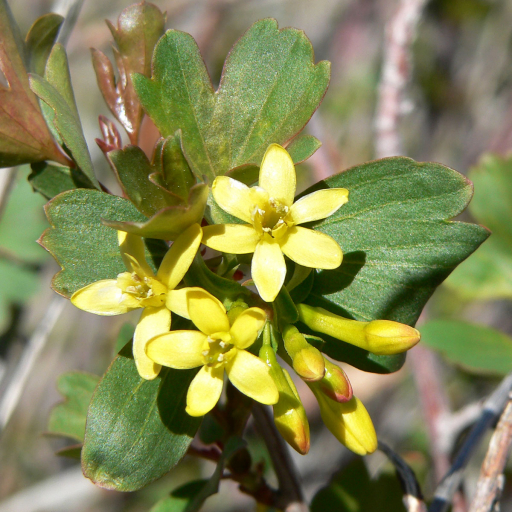
Plant Overview
Often called the "Clove Currant" for its intoxicating spicy-sweet scent, Ribes aureum is a versatile spring showstopper. Native to the American West, this hardy shrub provides a triple-threat of garden value: dazzling golden blooms, edible summer berries, and brilliant autumn foliage. It is a rugged survivor that looks just as home in a manicured hedge as it does in a wild, rocky landscape.
🔍 How to Identify
- 🌼 The Flowers: Clusters of trumpet-shaped, golden-yellow blooms appear in early spring. They are famous for their intense fragrance, which smells remarkably like cloves or vanilla.
- 🍁 The Foliage: Small, glossy green leaves featuring three to five distinct lobes, much like a miniature maple leaf. In the fall, the entire shrub transforms into a vibrant display of reds and oranges.
- 🍒 The Berries: Smooth, translucent fruits that transition through a sunset of colors—starting green, moving to yellow or orange, and finally ripening into a deep purplish-black.
🏡 In Your Garden
- 🐝 Pollinator Buffet: Because the flowers are deeply tubular, they are a primary early-season food source for long-tongued bees and hummingbirds. Planting one is like installing a natural neon sign for local wildlife.
- 🏜️ Drought Resilience: Unlike many other currants that crave constant moisture, the Golden Currant is remarkably drought-tolerant once its root system is established. It’s an excellent choice for xeriscaping or stabilizing slopes.
- ✂️ Pruning Nuance: This plant can become "leggy" or sprawling if left to its own devices. Pruning about a third of the oldest wood every winter encourages fresh, vigorous growth and better fruit production the following year.
⚠️ Safety & Toxicity
- 🍴 Human Edibility: The ripe, dark berries are safe and delicious for humans. They are traditionally used in pemmican, jams, and pies, though they have a tart "wild" kick compared to store-bought fruit.
- 🐾 Pet Safety: While the berries are generally considered non-toxic to dogs and cats, the high fiber and sugar content in wild fruits can cause mild digestive upset if a pet overindulges.
- 🧤 Thornless Comfort: Unlike its cousin the Gooseberry, Ribes aureum is typically thornless, making it a "friendly" shrub for high-traffic areas where children or pets play.
✨ Fun Fact
✨ The Buffalo Currant: Indigenous peoples across the Great Plains, including the Blackfoot and Cheyenne, relied on these berries as a vital ingredient in pemmican—a concentrated mixture of fat and protein that served as the ultimate survival food during long winters.

Detailed Care Instructions
| Humidity | Normal |
| Lighting | Part Sun |
| Difficulty | Medium |
| Hardiness Zones | 3 - 8 |
To grow Ribes Aureum, also known as Golden Currant, you can follow these steps:
- Choose the right location: Golden Currant plants prefer full sun to partial shade. Pick a location with well-drained soil.
- Prepare the soil: Amend the soil with organic matter such as compost to improve drainage and fertility. Golden Currant can tolerate various soil types but prefers slightly acidic to neutral soil pH.
- Planting: Dig a hole that is slightly larger than the root ball of the plant. Place the plant in the hole and backfill with soil, firming it gently around the roots.
- Watering: Water the plant thoroughly after planting to settle the soil. Golden Currant requires regular watering, especially during dry periods. Make sure the soil is consistently moist but not waterlogged.
- Mulching: Apply a layer of organic mulch around the base of the plant to help retain moisture and suppress weed growth. Keep the mulch a few inches away from the stem to prevent rot.
- Pruning: Prune Golden Currant plants annually in late winter or early spring to remove dead or damaged branches and to promote healthy growth.
- Fertilizing: Golden Currant plants generally do not require much fertilization. However, if your soil is nutrient-poor, you can feed them with a balanced slow-release fertilizer in early spring.
- Pest and disease control: Golden Currant is relatively resistant to pests and diseases. However, regular monitoring for common issues such as aphids or powdery mildew is recommended. If problems occur, treat them accordingly using organic or chemical controls.
By following these steps, you should be able to grow a healthy Ribes Aureum plant. Remember to provide adequate care, including regular watering, mulching, and annual pruning.

Place in a bright room that is sun drenched almost all day. Or directly in a south-facing window.

The best way to water this plant is to deeply saturate the soil around the base of the plant. It is important to water it regularly, especially during periods of drought or extreme heat. One way to test if it needs to be watered is to stick your finger about an inch into the soil and see if it feels dry. If it does, it's time to water. However, be sure not to overwater as this plant prefers well-drained soil. It is recommended to water it in the morning to allow the foliage to dry throughout the day. Avoid watering the foliage as this can contribute to fungal diseases. A layer of mulch around the base of the plant can also help retain moisture in the soil.
To fertilize this plant, use a balanced fertilizer such as a 10-10-10 or 20-20-20 in the early spring before new growth appears, and again in midsummer. Be sure to follow the manufacturer's instructions for application rates and methods. Avoid applying fertilizer directly to the plant's foliage or stems. Instead, spread it evenly around the plant's dripline and water thoroughly afterward. Avoid over-fertilizing, as this can lead to excessive growth and reduced fruiting or flowering.
Ribes Aureum is a deciduous shrub that belongs to the Grossulariaceae family. It is native to North America and typically grows up to a height of 3 meters. In order to cultivate this plant, it is essential to choose the right type of soil. The ideal soil for Ribes Aureum should be well-drained, loamy, and rich in nutrients. A pH level between 6.0 to 7.0 is considered optimum for its growth. The soil should also be well-aerated to allow the roots to breathe properly. Adding organic matter such as compost, manure, or leaf litter can help improve soil quality and provide the necessary nutrients for the plant. It is important to avoid using heavy clay soils, which can be poorly drained and lead to root rot. It is recommended to plant Ribes Aureum in a sunny location with partial shade and water it regularly during dry periods.
Ribes aureum is a deciduous shrub, native to North America. It is a member of the gooseberry family, and it produces yellow-green flowers and edible fruit. Propagating Ribes aureum can be done through both seed and cutting methods.
To propagate Ribes aureum using seed, collect ripe fruit from the plant during the summer months. Remove the seeds from the fruit, and rinse them clean. Stratify the seeds for 90-120 days by placing them in damp sand or peat moss and storing them in the refrigerator. After stratification, sow the seeds in a potting mix in a container with drainage holes and keep the soil moist. Germination usually takes 2-4 weeks.
To propagate Ribes aureum using cuttings, take hardwood cuttings in late fall or early winter. Cut a 6-8 inch section of a stem and remove the leaves from the lower half of the cutting. Dip the cut end of the stem in rooting hormone, and plant it in a container filled with a rooting medium such as a mixture of sand and peat moss. Keep the rooting medium moist, and place the container in a warm, bright location. The cutting should root in 4-6 weeks, and once established, it can be transplanted into a larger container or planted outdoors in the spring.
Common pests of the golden currant include Larvae. Make a habit of checking your golden currant frequently for pests so that any infestations can be caught and managed early.








