Plant Overview
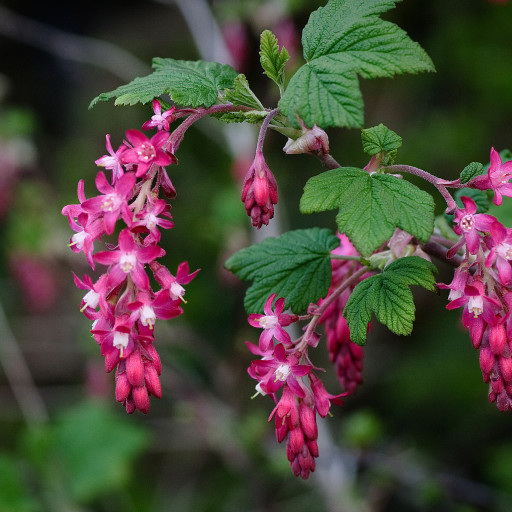
Known as the "Flowering Currant" or "Winter Currant," Ribes sanguineum is widely celebrated as the definitive harbinger of spring in the Pacific Northwest. While its relatives are often grown for their tart fruit, this species is the "glamour girl" of the family, prized for its dramatic, cascading pink and crimson blossoms. For many gardeners, the sight of its first buds is a signal that the gray days of winter are finally over.
🔍 How to Identify
- 🌸 The Flowers: The most striking feature is the drooping clusters (racemes) of small, tubular flowers. They range in color from pale shell-pink to a deep, blood-red, depending on the variety.
- 🍃 The Foliage: Its leaves are palmately lobed—meaning they look a bit like a small, rounded maple leaf. They have a distinctively crinkled texture and a pale, slightly fuzzy underside.
- 👃 The Scent: If you crush a leaf or brush against the stems, you'll notice a strong, spicy, and resinous aroma. Some describe it as "clove-like," while others find it a bit "foxy" or pungent.
🏡 In Your Garden
- 🕊️ Pollinator Magnet: This plant is an essential early-season food source. Because it blooms when little else is awake, it is a primary nectar source for migrating rufous hummingbirds and queen bumblebees.
- ✂️ Pruning Nuance: Unlike many shrubs, the Flowering Currant prefers to be pruned immediately after it finishes blooming. Since it develops next year’s buds on "old wood" (this year's growth), cutting it back in late winter would mean accidentally cutting off all your spring color.
- 💧 Drainage is Key: While it is surprisingly drought-tolerant once established, it absolutely hates "wet feet." Ensure it is planted in well-draining soil to prevent root rot during rainy seasons.
⚠️ Safety & Toxicity
- ✅ Status: Generally non-toxic and safe for home landscapes.
- 🫐 The Berries: Following the flowers, the plant produces dark blue-black berries with a waxy, white coating. While technically edible, they are notoriously bland, dry, and "insipid" compared to culinary currants.
- 🐾 Pets & Kids: It is considered safe for cats, dogs, and horses. However, consuming large quantities of any raw berry may cause minor stomach upset in small children or sensitive pets.
✨ Fun Fact
The Flowering Currant was first introduced to the gardening world by the famous Scottish botanist David Douglas in the 1820s. He was so captivated by its beauty that he sent seeds back to London, where it became an overnight sensation in Victorian-era gardens!

Detailed Care Instructions
To grow Ribes sanguineum, commonly known as red-flowering currant, follow these steps:
- Location: Choose a suitable location based on the plant's requirements. Ribes sanguineum prefers full sun to partial shade, but it can tolerate some shade.
- Soil: The plant grows well in well-draining and fertile soil. Prepare the soil by adding organic matter, such as compost, to improve its fertility and drainage.
- Planting: Dig a hole slightly larger than the root ball of the plant. Place the plant in the hole, ensuring that the soil line of the plant matches the surrounding ground level. Backfill the hole with soil, gently firming it around the plant.
- Watering: Water the plant thoroughly after planting and continue to water regularly, especially during dry spells. Keep the soil consistently moist but not waterlogged.
- Mulching: Apply a layer of organic mulch, such as wood chips or straw, around the base of the plant. Mulching helps retain moisture, suppresses weed growth, and improves soil structure. Ensure the mulch is not directly touching the stem.
- Pruning: Prune Ribes sanguineum lightly after flowering to maintain its shape and encourage new growth. Remove any dead, damaged, or diseased branches.
- Fertilizing: Apply a balanced, slow-release fertilizer in the spring, following package instructions, to provide nutrients for the plant's growth.
- Pests and diseases: Monitor the plant for any signs of pests or diseases, such as aphids or powdery mildew. If problems arise, treat them promptly by using appropriate organic or chemical solutions.
- Propagation: Ribes sanguineum can be propagated through softwood cuttings in early summer or hardwood cuttings in winter. Take a cutting from a healthy plant, remove the lower leaves, dip the cut end in rooting hormone, and plant it in a pot filled with a well-draining propagation mix. Keep the cutting consistently moist and wait for roots to develop.
With proper care and a suitable environment, Ribes sanguineum should thrive and provide beautiful red flowers in spring.

Place in a bright room that is sun drenched almost all day. Or directly in a south-facing window.

Ribes Sanguineum is a deciduous shrub that typically grows in woodland areas. It prefers well-draining soil and has a moderate tolerance for drought. When watering, it is important to ensure that the soil is moist but not waterlogged. Overwatering can lead to root rot and other diseases.
A good way to determine whether or not the plant needs water is to stick your finger about an inch into the soil. If it feels dry at this depth, water the plant. The best time to water is early in the morning or late in the evening, when temperatures are cooler and water is less likely to evaporate quickly. When applying water, try to focus on the soil around the plant's roots rather than the foliage. This helps to ensure that the water is actually reaching the plant's roots where it is needed.
Overall, Ribes Sanguineum is a relatively low-maintenance plant that can thrive with minimal watering. As with all plants, it is important to pay attention to its specific needs and adjust your watering schedule accordingly.
To fertilize this plant, use a balanced fertilizer with equal parts nitrogen, phosphorus, and potassium, such as a 10-10-10 or 20-20-20 blend. Apply the fertilizer in early spring, before new growth appears, and again in late summer/early fall if desired. Follow the instructions on the fertilizer package for the appropriate amount to use based on the size of your plant. Be sure to water the plant thoroughly after fertilizing to help distribute the nutrients evenly in the soil.
The best soil to use for the plant that goes by the scientific name Ribes Sanguineum is one that is well-draining but also retains moisture. It should be rich in organic matter and have a slightly acidic to neutral pH level. A soil mixture that contains peat moss, compost, and sand or perlite for drainage is ideal. The plant prefers to be grown in soil that is not too heavy or compact, as this can lead to poor drainage and root rot. It also benefits from regular fertilization, especially in the early growth stages. Overall, a high-quality, nutrient-rich soil is key to ensuring the health and growth of Ribes Sanguineum.
To propagate this plant, you can take softwood cuttings in late spring or early summer. Choose a healthy stem with several leaves and cut it at a 45-degree angle. Remove the lower leaves and dip the bottom of the stem in rooting hormone powder. Plant the cutting in a well-draining potting mix and keep it moist. Place it in a warm, bright area with indirect sunlight and cover it with a plastic bag to create a humid environment. Once roots have formed, after a few weeks or months, you can transplant the cutting into its own container or in a desired outdoor location.








