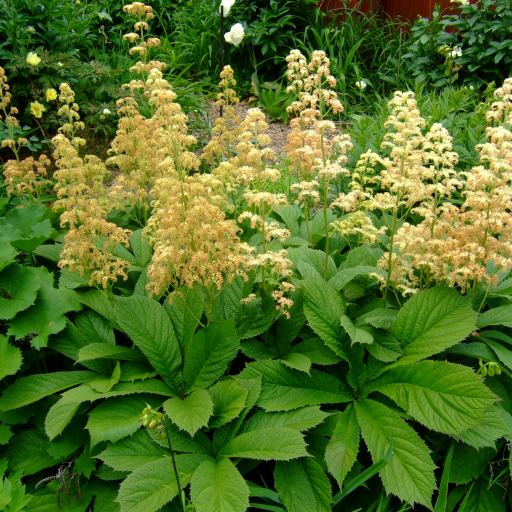
Plant Overview
Known as the "Featherleaf Rodgersia," this architectural giant looks like it belongs in a prehistoric rainforest rather than a modern backyard. Native to the damp mountain valleys of China, it is prized by gardeners for its massive, crinkled foliage that changes color throughout the seasons. It’s the perfect choice for adding high-drama texture to those soggy, shaded corners where other plants might struggle to breathe.
🔍 How to Identify
- 🍃 Leaf Structure: Large, compound leaves arranged in a "pinnate" (feather-like) pattern. Unlike its cousins with palm-shaped leaves, these segments are spaced out along the stem.
- 🌸 Flower Plumes: In mid-summer, it sends up tall, frothy wands of tiny star-shaped flowers that range from creamy white to deep, dusty rose.
- 📏 Textured Surface: The foliage is deeply veined and "quilted," often emerging with a striking bronze or metallic tint in the spring before maturing into a rich forest green.
🏡 In Your Garden
- 💧 The Thirst is Real: This is a true "bog lover." It thrives in soil that remains consistently moist or even wet. If the ground dries out, the magnificent leaves will quickly turn brown and crispy at the edges.
- 🌬️ Shelter from the Storm: Because the leaves are so large and heavy, they can act like sails in high winds. Plant it in a sheltered spot to prevent the stems from snapping or the foliage from looking "tattered."
- ⏳ Slow and Steady: Don't be discouraged if it takes a few years to reach its full size. It focuses on building a strong rhizome (underground stem) before it explodes into its full, 3-to-4-foot glory.
⚠️ Safety & Toxicity
- 🐾 Non-Toxic: Generally considered safe and non-toxic for cats, dogs, and horses. It is an excellent "worry-free" addition to a pet-friendly landscape.
- 👶 General Caution: While not poisonous, the leaves are quite fibrous and rough. It’s best to discourage children from "sampling" the plant, as it is not intended for consumption and could cause mild stomach upset.
✨ Fun Fact
The genus Rodgersia was named in honor of Rear Admiral John Rodgers, a 19th-century American naval officer who commanded the expedition during which the first specimens of these plants were "discovered" by Western botanists!

Detailed Care Instructions

Place in a window with dappled sun or a spot in the middle of a room. Or directly in a window facing west or east.

The presence of a dry surface layer of soil does not indicate that the plant requires water. Instead, stick your finger 1-2" (3-5 cm) deep in the soil to feel dampness or moisture content. If the soil seems dry, it's time to water your greens. If the soil is still moist, however, it is better not to water your plant and instead wait a day or two. Overwatering or waterlogging raises the risk of root rot. So if the soil takes longer than a week to dry, check the light conditions because it's likely that the plant isn't getting enough light. It's fine if the upper layer of soil is dry between waterings, but the deeper soil layer should always have some moisture.








