Plant Overview
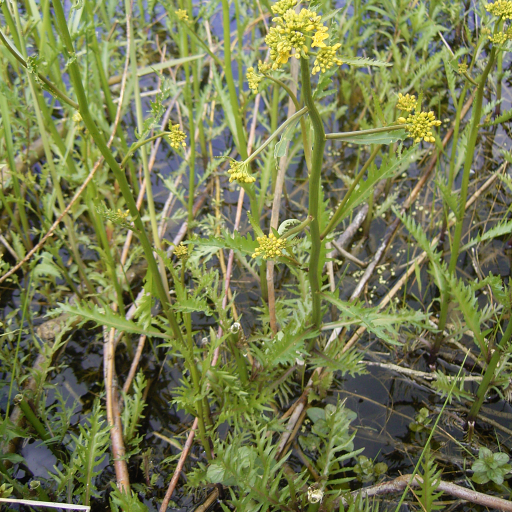
Known as the Great Yellowcress, Rorippa amphibia is a master of adaptation that lives a "double life" both in and out of the water. This hardy perennial is a common sight along the muddy banks of European and Asian rivers, where it acts as a resilient anchor for the shoreline. Its name "amphibia" perfectly describes its ability to morph its physical appearance based on whether it is submerged in a flood or basking in the summer sun.
🔍 How to Identify
- 🌿 Chameleon Leaves: The plant exhibits "heterophylly," meaning it grows different leaves for different levels. Submerged leaves are often deeply feathery and divided, while leaves above water are long, lance-shaped, and serrated.
- 🌼 Cross-Shaped Blooms: Like other members of the mustard family, it produces small, bright yellow flowers with four petals arranged in the shape of a cross.
- 🧪 Hollow Stems: The stems are thick and often hollow, which allows the plant to stay buoyant and transport oxygen down to the roots when the water level rises.
🏡 In Your Garden & Habitat
- 💧 Water’s Edge: This plant thrives in "wet feet" conditions. It is ideal for the margins of large wildlife ponds or bog gardens where the soil remains consistently saturated or even submerged.
- 🏃 A Vigorous Spreader: It travels through aggressive underground rhizomes. In a small garden pond, it is best kept in a submerged basket; otherwise, it may quickly colonize the entire shoreline and crowd out more delicate species.
- 🦋 Pollinator Magnet: Despite the tiny size of the individual flowers, their bright color and nectar attract hoverflies and small bees during the mid-summer months.
⚠️ Safety & Toxicity
- 🟢 Non-Toxic: Rorippa amphibia is generally considered non-toxic to humans, dogs, and cats.
- 🦠 Environmental Warning: Because it grows in stagnant or slow-moving water, the plant can harbor waterborne parasites or absorb heavy metals from runoff. It is strongly advised not to forage or consume plants growing in public waterways or near industrial areas.
✨ Fun Fact
The Great Yellowcress is a biological "transformer." If a river floods and stays high for weeks, the plant will stop growing its sturdy land leaves and begin sprouting feathery, fern-like aquatic leaves to better absorb carbon dioxide from the water!

Detailed Care Instructions
| Humidity | High |
| Lighting | Part Sun |
| Difficulty | Easy |
| Hibernation | Cold Period |
| Hardiness Zones | 5 - 9 |
To grow Rorippa amphibia, also known as brooklime, you can follow these steps:
- Determine the conditions: Brooklime is a semi-aquatic perennial plant so it prefers growing in wet or moist soil. Ideally, it should be planted in a location that provides partial shade.
- Prepare the soil: The soil should be fertile and well-draining. If your soil is heavy or clayey, mix in some organic matter like compost to improve its drainage.
- Collect seeds or establish transplant: You can collect seeds from existing brooklime plants or purchase them from a nursery or online. Alternatively, you can establish new plants from divisions or transplants.
- Sow the seeds or plant transplant: If sowing seeds, scatter them over the prepared soil and lightly press them into the surface to ensure good contact with the soil. If transplanting, dig a hole slightly larger than the root ball and gently place the plant in it, covering with soil and pressing down gently.
- Watering: Keep the soil consistently moist but not waterlogged. Water regularly, especially during dry periods or if the plant is growing in a container.
- Mulch: Apply a layer of organic mulch around the plant. This will help retain soil moisture and suppress weed growth.
- Care: Brooklime requires minimal care once established. Remove any weeds as they appear to prevent competition for nutrients and water. Prune back the plant occasionally to maintain its shape and promote new growth.
- Propagation: Brooklime can spread by seed or rhizomes, allowing it to form large colonies. If desired, you can propagate new plants by dividing established clumps or collecting and sowing seeds.
- Winter care: In areas with cold winters, brooklime may die back in winter. However, it usually regrows from rhizomes in the spring. If growing in containers, you may need to protect them from freezing temperatures by moving them indoors or providing insulation.
By following these steps, you can successfully grow Rorippa amphibia or brooklime in your garden or pond.

Place in a bright room that is sun drenched almost all day. Or directly in a south-facing window.

Rorippa amphibia is a semi-aquatic perennial plant that requires regular watering to thrive. To water this plant, fill a watering can with room temperature or lukewarm water and pour it slowly onto the soil surrounding the plant until the soil is moist, but not saturated. Avoid getting water on the leaves and stem of the plant, as this can cause damage or encourage the growth of fungal diseases. Water the plant regularly, keeping the soil consistently moist but not waterlogged. Adjust the watering schedule as needed based on factors like weather conditions, humidity levels, and the age and size of the plant.
To fertilize the Rorippa Amphibia plant, use a balanced fertilizer with equal parts nitrogen, phosphorus, and potassium. Apply the fertilizer in early spring or fall before new growth appears. Spread the fertilizer evenly around the base of the plant and water it in thoroughly. Avoid applying fertilizer during the height of summer when the plant is dormant. For best results, maintain soil pH between 6.0 and 7.5 and ensure the soil is consistently moist but well-draining.
Rorippa Amphibia prefers moist soils with high water-holding capacity. The soil should be rich in organic matter and well-drained to avoid waterlogging. The pH range of the soil should be slightly acidic to neutral (6.0 - 7.0). The plant can tolerate some degree of salinity and can grow in a wide range of soil textures, including sandy, loamy, and clay soils. It is also recommended to supplement the soil with some fertilizer during the growing season.
Rorippa amphibia is a plant that can be propagated through seeds and through stem cuttings. To propagate through seeds, collect ripe seed pods from the parent plant and allow them to fully dry out. Then, crack open the pods to collect the small, black seeds inside. Sow the seeds in a moist potting mix and keep them warm and moist until they successfully germinate.
To propagate through stem cuttings, take a stem cutting from the parent plant, making sure it is at least 4 inches long and includes a few leaves. Remove the leaves from the bottom half of the stem and dip the cut end in rooting hormone. Plant the stem cutting in a potting mix that is moist but not too wet. Keep the cutting in a warm and humid environment and mist it regularly. Within a few weeks, roots should start to form and the cutting can be transplanted into a larger pot or directly into the ground.








