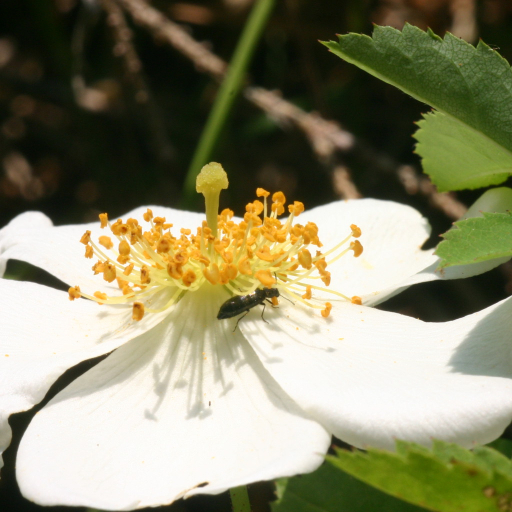
Plant Overview
Often called the "Field Rose," Rosa arvensis is the quintessential beauty of the English countryside, often seen draped over ancient hedgerows like a floral lace. Historically linked to the "White Rose of York," this wild species possesses a quiet, romantic elegance that contrasts with the loud, heavy-petaled cultivars of modern gardens. It is a favorite of naturalists who seek to invite the untamed spirit of the woodland into their own backyard.
🔍 How to Identify
- 🌸 Single White Blooms: The flowers are simple and cup-shaped, featuring five delicate white petals that surround a bright cluster of golden stamens.
- 🌿 The Central Column: A key botanical giveaway is the "style" (the center part of the flower), which is fused into a single, prominent column—a feature that distinguishes it from the common Dog Rose.
- 🍇 Purple-Red Hips: In autumn, the plant produces small, smooth, oval-shaped red fruits (hips) that lack the "crown" of sepals often seen on other rose varieties.
🏡 In Your Garden
- 🌳 Shade Tolerance: Unlike its sun-worshipping cousins, the Field Rose is remarkably resilient in dappled shade. It is the perfect solution for brightening up North-facing walls or the edges of a wooded area.
- 🦋 A Pollinator Party: Because the flowers are "single" (meaning the nectar is easy to reach), it is a vital food source for hoverflies, bees, and butterflies that struggle with the complex layers of hybrid tea roses.
⚠️ Safety & Toxicity
- ✅ Generally Non-Toxic: Rosa arvensis is not considered poisonous to humans, dogs, or cats. In fact, rose hips are often used in traditional teas and syrups.
- 🩹 Physical Hazard: While not chemically toxic, its stems are armed with sharp, hooked prickles. These can cause painful scratches or "rose gardener's disease" (fungal infections) if the skin is broken, so heavy-duty gloves are a must.
✨ Fun Fact
In the Victorian "Language of Flowers," the Field Rose was used to symbolize "charm" and "simplicity." It was often included in bouquets to tell the recipient that their beauty was natural and required no artifice to be admired.

Detailed Care Instructions
To grow Rosa Arvensis, also known as the Field Rose, you can follow these steps:
- Choose a sunny location: Rosa Arvensis requires full sun to thrive, so select a spot in your garden that receives at least 6 hours of direct sunlight each day.
- Prepare the soil: The soil should be well-draining and rich in organic matter. Amend the soil with compost or well-rotted manure before planting to improve its fertility and drainage.
- Planting: Dig a hole that is wide and deep enough to accommodate the plant's roots. Place the Rosa Arvensis plant in the hole, ensuring that the bud union (the swollen area between the rootstock and scion) is level with or slightly above the soil surface. Backfill the hole with soil, gently firming it around the roots.
- Watering: After planting, water the Rosa Arvensis thoroughly to settle the soil around the roots. Water regularly, especially during dry periods, to keep the soil evenly moist but not waterlogged. Deep, infrequent watering is preferable to frequent shallow watering.
- Mulching: Apply a layer of mulch around the base of the plant to help conserve moisture, suppress weeds, and insulate the roots. Use organic materials like wood chips, straw, or bark mulch.
- Fertilizing: Rosa Arvensis benefits from regular feeding. Apply a balanced, slow-release fertilizer during the growing season, following the instructions on the package. Alternatively, you can use organic fertilizers such as compost or well-rotted manure.
- Pruning: Prune Rosa Arvensis during the dormant season, typically in late winter or early spring. Remove dead, damaged, or crossing branches and shape the plant to promote airflow and sunlight penetration. Also, remove spent flowers to encourage more blooms.
- Pest and disease control: Regularly inspect the plant for any signs of pests or diseases. Common rose problems include aphids, black spot, and powdery mildew. Use organic or chemical methods as needed to control these issues.
- Provide support: Depending on the growth habit and size of your Rosa Arvensis plant, you might need to provide support like trellises, stakes, or fences to help it grow upright and prevent sprawling.
- Regular maintenance: Regularly monitor your Rosa Arvensis for any signs of stress, disease, or pest infestation. Water, fertilize, and prune as needed to keep the plant healthy and thriving.
Remember to research specific care requirements for Rosa Arvensis, as the needs may vary slightly depending on your climate and location.

Place in a bright room that is sun drenched almost all day. Or directly in a south-facing window.

To water this particular plant, it is important to thoroughly soak the soil around the base of the plant. It is recommended to water deeply and infrequently, rather than giving the plant small amounts of water frequently. This encourages the plant to develop deep roots, which can help it survive dry spells. Additionally, it is important to avoid getting water on the leaves of the plant, as this can increase the risk of disease. It is best to water in the morning or evening, avoiding the heat of the day. It is also important to ensure that the soil has good drainage, as this plant does not tolerate waterlogged soil.
To fertilize the Rosa Arvensis plant, first, choose a balanced, slow-release fertilizer specifically formulated for flowering plants. Read the instructions on the fertilizer packaging for proper usage rates.
In early spring, before new growth emerges, apply the fertilizer to the soil surrounding the base of the plant. Use a garden fork or a hand cultivator to gently incorporate the fertilizer into the topsoil, ensuring it is well mixed in. Be careful not to disturb the roots while doing so.
During the growing season, approximately every four to six weeks, apply a diluted liquid fertilizer according to the recommended dosages provided. Use a watering can or a garden sprayer to evenly distribute the fertilizer solution over the soil surface around the plant.
When applying the liquid fertilizer, avoid foliar spraying on the leaves, as it may cause damage or scorching.
Remember to water the plant thoroughly after fertilizing to ensure nutrients reach the roots. Additionally, monitor the soil moisture regularly and water as needed to maintain adequate hydration levels.
Fertilizing the Rosa Arvensis plant according to these instructions will help promote healthy growth and enhance its overall vigor and flowering potential.
The optimal soil for the Rosa Arvensis plant should be well-draining with a pH range between 6 and 7.5. The soil should be rich in organic matter and nutrients to support the plant's growth and blooming. A mixture of sandy loam, clay loam, and humus-rich compost can be used. The soil should be aerated to allow for proper root development and prevent waterlogging. It is recommended to avoid heavy soils with high clay content, as they tend to retain water and compromise the plant's health. The use of fertilizers is also advised to supplement the soil's nutrient content and promote healthy growth.
To propagate Rosa Arvensis, you can follow the steps below:
- Choose a healthy parent plant: Select a mature and healthy Rosa Arvensis plant for propagating. Ensure that the parent plant has strong and disease-free stems.
- Gather necessary tools: Collect a pair of sharp pruning shears or clippers, a clean pot or container with drainage holes, a good quality potting soil mix, and rooting hormone powder or gel (optional but recommended).
- Identify suitable stem cuttings: Look for young, green stems of the parent plant that are around 6 to 8 inches long. The stems should be firm and without any flowers or buds.
- Take the stem cuttings: Using the pruning shears, make a clean cut at a 45-degree angle just below a node (the point where the leaf or bud meets the stem). Remove any lower leaves from the bottom 2-3 inches of the cutting.
- Apply rooting hormone (optional): If desired, dip the cut ends of the stem cuttings in rooting hormone powder or gel. This helps stimulate root growth and increases the chances of successful propagation.
- Prepare the potting medium: Fill the pot or container with a well-draining potting soil mix. Moisten the soil slightly, making sure it is not too wet or dry.
- Plant the stem cuttings: Make 1-2 inch deep holes in the soil, spacing them apart. Place the lower end of the stem cutting into the hole and gently firm the soil around it, ensuring it stands upright.
- Provide proper care: Place the potted cuttings in a bright location with indirect sunlight. Avoid placing them in direct sunlight, as it may cause excess drying. Keep the soil slightly moist but not waterlogged.
- Monitor and maintain humidity: Cover the potted cuttings with a plastic bag or a clear plastic dome to create a mini greenhouse effect. This helps retain humidity and encourages root development.
- Wait and watch for roots: Over the next few weeks, regularly check for root development. Gently tug on the stem cuttings after around four weeks to check for resistance, indicating root growth.
- Transplanting to individual pots: Once the cuttings have rooted, they can be gently transplanted into individual pots filled with potting soil. This allows them to continue growing and strengthening before planting them in the desired location.
By following these steps, you can successfully propagate Rosa Arvensis and create new plants from the parent specimen.








