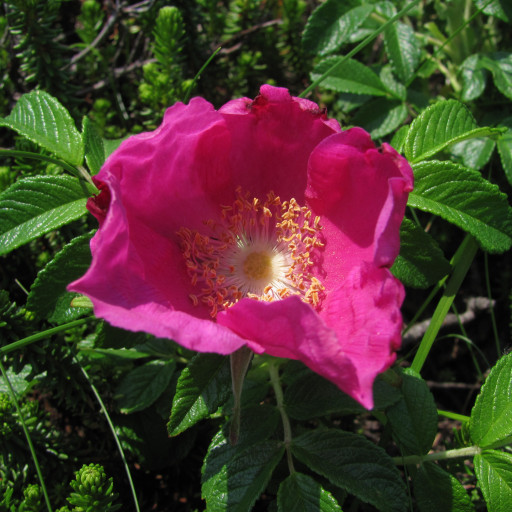
Plant Overview
Often called the "Beach Rose" or "Saltspray Rose," Rosa rugosa is the tough-as-nails survivor of the rose world. Unlike its finicky hybrid tea cousins, this shrub thrives where others fail—enduring salt spray, poor soil, and freezing winds. It’s beloved by coastal gardeners for its intoxicating clove-like fragrance and its ability to form a "living fence" that even the bravest intruder wouldn't want to cross.
🔍 How to Identify
- 🌿 The Foliage: Leaves are deep green, leathery, and distinctive for their deeply "wrinkled" (rugose) veins, which give the plant its name.
- 🌸 The Blooms: Flowers are usually single-petaled in shades of magenta, pink, or white, featuring a prominent cluster of bright yellow stamens in the center.
- 🍎 The Hips: It produces large, round, brick-red seed pods (hips) that look like cherry tomatoes and persist long after the leaves fall in autumn.
- ⚔️ The Armor: Stems are densely packed with straight, needle-like prickles of varying sizes, leaving almost no bare bark visible.
🏡 In Your Garden
- 🌊 Coastal Warrior: This is one of the few roses that actually enjoys salt air, making it perfect for beach houses or roadside planting where winter road salt is used.
- 🚫 Chemical Sensitivity: Interestingly, this "tough" plant hates modern chemistry; many chemical fungicides and pesticides can cause its leaves to yellow and drop, so it is best grown organically.
- 🐦 Wildlife Haven: Because it grows into a dense, thorny thicket, it provides incredible nesting cover for small birds and a massive feast of nectar for bees and butterflies.
⚠️ Safety & Toxicity
- ✅ Safe & Edible: Rosa rugosa is non-toxic to humans and pets. In fact, its petals and hips are gourmet ingredients used for floral teas, jams, and syrups.
- 🩹 Physical Hazard: While not poisonous, the plant is "aggressively" thorny. The prickles are small and numerous, making it a physical hazard for curious toddlers or pets who might try to run through the bush.
- 🐕 Pet Note: Safe for dogs and cats if nibbled, though the thorns can cause minor scratches to noses or paws.
✨ Fun Fact
During World War II, when citrus fruits were difficult to import, rose hips from the Rosa rugosa were harvested by the ton across Europe because they contain significantly more Vitamin C by weight than oranges!

Detailed Care Instructions
Rugosa roses are perennial, meaning they come back each year. And thanks to their hardiness, they can live for many years. Mature plants ultimately will get woody and not produce as many flowers. But you can help to prevent this by pruning out old wood annually.
Where should I place a rugosa rose outside my house?
Rugosa roses can make for an excellent specimen plant in the landscape. But they also can turn into a good screen thanks to their dense foliage. Just be sure your planting site allows for some room on all sides of the shrub, so you can navigate around it without having to contact the thorns.
What plants are similar to rugosa roses?
Many rose species are similar to rugosa roses, including the Carolina rose. It's also a low-maintenance species, though it's not as cold tolerant as the rugosa rose.
| Color | Pink, Red, Lavender, And White |
| Soil Ph | 5.6 To 6.5 |
| Humidity | Normal |
| Lighting | Full Sun |
| Soil Type | Rich, Well-Draining Soil |
| Bloom Time | Late Spring To Early Summer |
| Difficulty | Medium |
| Plant Type | Deciduous Shrub |
| Mature Size | Rugosa Roses Are Large, Sprawling Plants. They Will Easily Reach 4 To 8 Feet High And 4 To 6 Feet Wide. |
| Native Area | Eastern Russia, Korea, Japan, And Northern China |
| Temperature | 15°C - 30°C |
| Sun Exposure | Full Sun To Partial Shade |
| Hardiness Zones | 3 To 9 |
To grow a Rosa Rugosa plant, follow these steps:
- Site Selection: Choose a location that receives full sunlight. Rosa Rugosa prefers direct sunlight for at least 6 hours a day.
- Soil Preparation: The plant thrives in well-draining soil with a pH range between 6 and 7. Amend the soil with organic matter such as compost or manure to improve drainage and fertility.
- Planting: Dig a hole that is slightly wider and deeper than the root ball of the plant. Place the Rosa Rugosa carefully in the hole, making sure the crown of the plant is level with or slightly above the soil surface. Gently backfill the hole, firming the soil around the roots.
- Watering: Water the plant thoroughly after planting to settle the soil and provide initial hydration. Afterward, water deeply and regularly, especially during dry spells. The plant prefers moist soil, but avoid overwatering, as it can lead to root rot.
- Mulching: Apply a layer of organic mulch around the base of the plant to help retain soil moisture, suppress weed growth, and maintain a more stable soil temperature.
- Pruning: Rosa Rugosa blooms on new wood, so prune the plant in early spring before new growth emerges. Remove any dead or damaged branches and shape the plant as desired. Additionally, remove faded flowers throughout the blooming season to encourage more blooms.
- Fertilizing: Rosa Rugosa plants generally do not require a lot of fertilizer. However, you can apply a slow-release balanced fertilizer (such as 10-10-10) in spring and a balanced rose fertilizer again in midsummer to promote healthy growth and abundant blooms.
- Pest and Disease Control: Rosa Rugosa is known for its generally pest and disease-resistant nature, but it may occasionally encounter issues such as aphids or blackspot. Monitor the plant regularly and take appropriate measures if necessary, such as using organic pest control methods or applying fungicides.
- Winter Care: Rosa Rugosa is hardy and can withstand cold temperatures. However, in colder regions, you can mulch the base of the plant with a layer of organic mulch to provide extra insulation and protection from harsh winter conditions.
With proper care, Rosa Rugosa plants can thrive and provide beautiful fragrant flowers during the summer months.

Place in a bright room that is sun drenched almost all day. Or directly in a south-facing window.

To water this plant, it is important to first examine the soil. Check the soil moisture level by touching the soil with your finger. If the soil feels dry to the touch, it is time to water the plant.
When watering, it is important to provide enough water to reach the roots, but not so much that the plant becomes waterlogged. Use a watering can or a drip system to water the plant slowly and evenly.
In general, this plant prefers well-draining soil, so be cautious not to overwater or let water collect around the roots. You should aim to water deeply and infrequently rather than frequently and shallowly.
Finally, consider whether the plant is in a container or in the ground. Container plants may require more frequent watering than those planted in the ground as they can dry out more quickly. Adjust your watering routine accordingly.
- Choose a fertilizer with a balanced N-P-K ratio.
- Apply the fertilizer in early spring, before new growth appears.
- Use a slow-release formula to avoid burning the plant and promote steady growth.
- Spread the fertilizer evenly around the base of the plant, avoiding direct contact with the stems.
- Water the plant thoroughly after fertilizing to help the nutrients penetrate the soil.
- Repeat fertilizing once or twice during the growing season if desired, but be careful not to over-fertilize.
Rosa Rugosa plants prefer a well-draining soil that is rich in organic matter. The ideal pH range for this plant is between 5.5 and 7.0. Sandy loam or loamy soils with good drainage are perfect for Rosa Rugosas. The soil should be regularly amended with compost or well-rotted manure to enrich it with nutrients. Additionally, the soil should be kept consistently moist but not waterlogged. Overwatering can lead to root rot, which is detrimental to the plant's health. In summary, a fertile, well-draining soil that is enriched with organic matter and kept consistently moist is the best soil for Rosa Rugosa plants.
- Choose a healthy and mature plant from which to take cuttings. Look for a plant with strong, healthy stems and plenty of leaves.
- Take a sharp pair of clippers and cut a stem that is at least 6 inches long. Cut the stem at a 45-degree angle just below a leaf node.
- Strip all but the top 2-3 leaves from the stem.
- Dip the cut end of the stem in rooting hormone.
- Fill a container with potting soil and insert the stem into the soil, making sure the bottom of the stem is fully covered.
- Water the soil, then cover the container with a clear plastic bag to create a greenhouse effect. This will help keep the cutting moist and promote rooting.
- Place the container in a warm, sunny location but avoid direct sunlight.
- Once the cutting has developed roots, you can transplant it to a larger container or directly into the ground in a prepared planting area. Water the new plant regularly until it becomes established.
Common pests of the rugosa rose include Spider mites, aphids, larvae. Make a habit of checking your rugosa rose frequently for pests so that any infestations can be caught and managed early.








