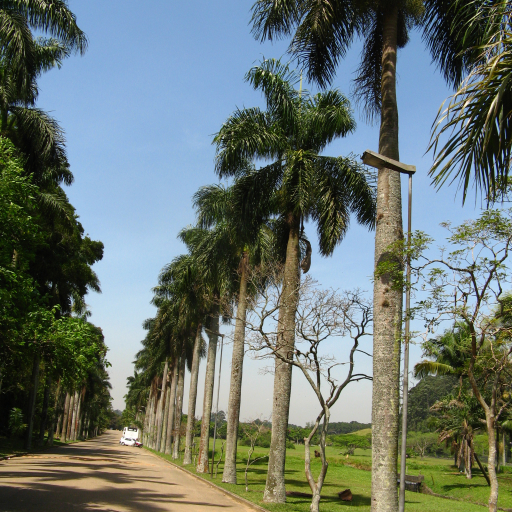
Plant Overview
The Puerto Rican Royal Palm, often called the "Palma Real," is the undisputed aristocrat of the Caribbean landscape. While it shares the regal stature of its Cuban cousin, this species is uniquely adapted to the terrain of Puerto Rico and the Virgin Islands. With its cement-gray trunk and lush green crown, it has long been a symbol of tropical elegance, often lining the entrances of grand estates and historic plazas.
🔍 How to Identify
- 🗿 The Trunk: Features a smooth, column-like trunk that is often swollen in the middle or base. It has a distinct light gray, almost concrete-like color.
- 🌿 The Crownshaft: At the very top of the wooden trunk sits a long, smooth, bright green cylinder (the crownshaft) from which the leaves emerge.
- 🍃 The Fronds: Massive, feathery (pinnate) leaves that arch gracefully. Each frond can reach up to 12 feet in length, creating a dense, rounded canopy.
- 🟣 The Fruit: Produces small, brownish-purple berries that hang in large, heavy clusters just below the crownshaft.
🏡 In Your Garden
- 🌬️ Hurricane Hero: This palm is legendary for its wind resistance. Its trunk is surprisingly flexible, and it is known to shed its heavy fronds during high winds to protect its core structure from snapping.
- 💧 Thirsty Giant: While it can handle brief dry spells once established, it thrives in rich, moist soil. It’s a "heavy feeder," meaning it appreciates regular fertilization to maintain that deep, healthy green color.
- 📐 Space Requirements: This is not a plant for small spaces. Because of its massive height (up to 60 feet) and wide canopy, it should be planted well away from power lines and roof overhangs.
⚠️ Safety & Toxicity
- ✅ Status: Non-toxic and generally safe.
- 🧤 Physical Hazards: The palm itself isn't poisonous to pets or children. However, the sheer weight of a falling dead frond can be dangerous. Always wear a hat and use caution when pruning or standing under mature trees during windy weather.
✨ Fun Fact
In Puerto Rico, the fruits of this palm, known as alimento de cerdos, were historically used as a primary food source for livestock. Even today, the tree is a vital "supermarket" for local wildlife, providing essential fats for the endangered Puerto Rican Parrot.

Detailed Care Instructions
To grow a Roystonea borinquena plant, you can follow these steps:
- Choose the right location: Roystonea borinquena plants love full sun, so choose a spot in your garden that receives at least 6-8 hours of direct sunlight per day. Ensure that the location has well-drained soil.
- Prepare the soil: Before planting, prepare the soil by removing any weeds or grass and loosening it with a garden fork or tiller. Add compost or well-rotted manure to improve the soil's fertility and drainage.
- Plant the seedling: Dig a hole slightly larger than the root ball of the seedling. Place the seedling in the hole and backfill with soil, gently firming it around the base to eliminate air pockets. Water the plant thoroughly after planting.
- Watering: Roystonea borinquena plants prefer moist, but not waterlogged, soil. Water regularly, especially during hot and dry periods. However, do not let the plant stand in water as it can lead to root rot.
- Fertilizer: Apply a slow-release balanced fertilizer during the growing season to provide essential nutrients. Follow the instructions on the fertilizer packaging for application rates.
- Pruning: Remove any dead or damaged fronds as needed to maintain a tidy appearance. Avoid excessive pruning, as it may harm the plant's growth.
- Mulching: Apply a layer of organic mulch, such as wood chips or straw, around the base of the plant to conserve moisture, suppress weed growth, and regulate soil temperature.
- Protection from cold: Roystonea borinquena plants are generally hardy in USDA zones 10-11, but if you live in a colder climate, consider growing the plant in a container so you can bring it indoors during winter or provide frost protection, such as covering it with frost blankets.
- Regular maintenance: Keep an eye out for common pests, such as mealybugs or spider mites, and treat them promptly with appropriate insecticides or horticultural soaps if necessary.
- Patience: Growing a Roystonea borinquena plant from seed can take several years to produce a mature palm tree. Be patient and enjoy the process of watching it grow.
Remember to research the specific needs of your Roystonea borinquena plant, as growing conditions may vary based on your region and climate.
To water this plant, first, determine the soil moisture level by inserting your finger into the soil up to your second knuckle. If the soil feels dry at this depth, it is time to water the plant. Use room temperature water to avoid shocking the roots. Slowly pour water onto the soil around the base of the plant until it begins to flow out of the drainage holes. Allow the excess water to drain out completely before returning the plant to its normal location. Avoid letting the plant sit in standing water as this can lead to root rot. Watering frequency will depend on factors such as temperature, humidity, and light levels, so it's important to monitor the soil moisture regularly.
To fertilize this species of plant, apply a well-balanced slow-release fertilizer around the drip line of the plant in early spring and again in midsummer. Use a fertilizer with an NPK ratio of 10-10-10 or 20-20-20. Avoid over-fertilizing, as it can lead to excessive growth and weaken the plant. Water the plant thoroughly after applying fertilizer.
For optimal growth, it is important to use well-draining soil that is rich in nutrients. The soil should have a pH level between 6.0 and 7.5. A mixture of sand, peat moss, and perlite can be a good option for growing this plant. It is also important to ensure that the soil is not too compacted, as this can hinder root growth and lead to waterlogging. Regular fertilization and soil amendments may also be necessary to maintain the health and vitality of this plant.
There are several methods to propagate this plant, including:
- Seeds: Collect mature seeds and soak them in water for 24 hours. Plant the seeds in a well-draining potting mix and keep them in a warm, moist environment. Germination typically occurs within 4-8 weeks.
- Root cuttings: Cut a healthy root from a mature plant and plant it in a well-draining potting mix. Keep the soil moist and in a warm environment. Roots should develop within 2-3 weeks.
- Stem cuttings: Take a stem cutting from a mature plant that includes several leaves and dip it in rooting hormone. Plant the cutting in moist soil and place it in a shaded area. Keep the soil moist and after several weeks, you should notice new growth.
- Division: This method can only be done with mature plants. Dig up the plant and gently separate the roots into several smaller sections. Replant each section in a well-draining potting mix and keep them moist in a warm environment. Growth should begin within a few weeks.








