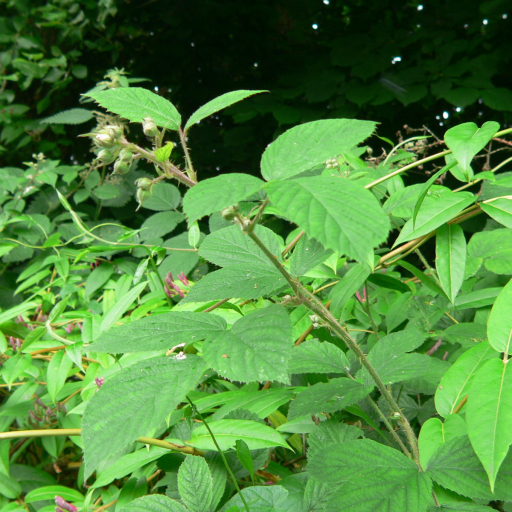
Plant Overview
Known as the Rough-leaved Blackberry, Rubus dasyphyllus is one of the many "microspecies" of the common bramble. While it might look like a typical thorny bush to the untrained eye, this plant is a powerhouse of the hedgerow, legendary for its sweet late-summer fruits and its role as a natural fortress for nesting birds. In British folklore, brambles were often thought to be protected by spirits, and there is an old superstition that one should never pick the berries after Michaelmas (late September) because the devil marks them.
🔍 How to Identify
- 🌿 The Foliage: Unlike smoother blackberries, the leaves are notably soft and velvety underneath due to a thick layer of fine hairs. The upper surface often has a deep green, slightly wrinkled texture.
- 🖋️ Glandular Stems: The arching canes are a distinguishing feature—they are covered in a mix of sharp, hooked prickles and tiny, reddish-purple stalked glands that give the stem a "fuzzy" but dangerous appearance.
- 🌸 Blush Blossoms: In early summer, it produces clusters of delicate flowers that range from pure white to a soft, candy-pink, each featuring a ring of many stamens.
🏡 In Your Garden
- 🦋 Wildlife Magnet: If you have space for a wilder corner, this plant is an ecological hero. It provides nectar for bees and butterflies, while the dense, thorny thickets offer a safe haven for small mammals and songbirds.
- ✂️ Vigorous Habit: Be aware that this plant is a "scrambler." It grows rapidly and its tips can take root wherever they touch the ground (a process called "tip-rooting"). It is best used as a natural boundary or a "living fence" rather than in a formal flower bed.
- 🍯 Fruit Harvest: The berries are small, dark purple-black, and exceptionally juicy. They are perfect for jams or crumbles, though the rough stems mean you should always wear thick gloves when foraging.
⚠️ Safety & Toxicity
- 🧤 Physical Hazard: The primary danger of Rubus dasyphyllus is its physical structure. The hooked thorns are designed to "climb" by latching onto things—including skin and clothing.
- 🐾 Pet & Child Safety: The fruit itself is non-toxic and edible. However, the stems can cause painful scratches or skin irritation for curious pets or children playing nearby.
- 🧼 First Aid: If scratched, ensure the area is cleaned thoroughly, as wild bramble thorns can sometimes carry soil-borne bacteria.
✨ Fun Fact
The Rubus family is famous among botanists for a process called "apomixis." This means the plants can produce seeds that are genetic clones of the mother plant without needing pollination, leading to hundreds of nearly identical "microspecies" like Rubus dasyphyllus!

Detailed Care Instructions

Place in a bright room that is sun drenched almost all day. Or directly in a south-facing window.

When the top few inches of soil dry out, water your plants. If the top few inches of soil are still moist, do not water your plant. Wait a few days, then poke your finger into the soil to see if anything has changed. Overwatering poses a disease risk, such as the development of fungal diseases in the roots. These plants have adaptations in there leaves that allow them to survive in low water supply.








