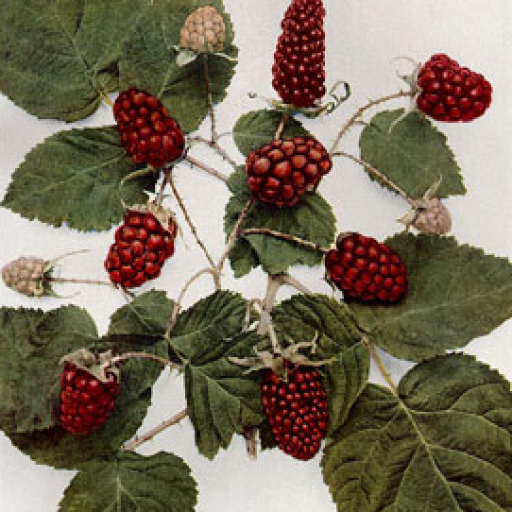
Plant Overview
The Loganberry is a legendary "happy accident" of the horticultural world. Created in 1881 by Judge James Logan, this plant is a natural hybrid between a North American blackberry and a European raspberry. It offers gardeners the best of both worlds: the sturdy vigor of a blackberry and the refined, tart flavor of a raspberry.
🔍 How to Identify
- 🍓 The Fruit: Unlike a round raspberry, Loganberries are elongated and conical. They turn a deep, dusky maroon-red when fully ripe and, unlike raspberries, the core (receptacle) stays inside the fruit when picked.
- 🌿 The Foliage: The leaves are typically dark green with a silvery-white underside, featuring three to five serrated leaflets. They look very similar to raspberry leaves but tend to be slightly larger.
- 🏗️ Growth Habit: This is a trailing plant rather than an upright bush. It produces long, flexible canes that can stretch up to 6–10 feet, requiring a trellis or fence for support.
🏡 In Your Garden
- 🧤 Thorny vs. Thornless: While the original Loganberry is quite prickly, many modern garden varieties are "thornless," making harvesting much more pleasant. If you have the thorny version, thick gloves are a must!
- 🥧 The Flavor Profile: Because they are more acidic than their parent plants, Loganberries are prized by chefs for jams, syrups, and pies. They hold their shape well when cooked and provide a bright, zesty punch.
- ✂️ Pruning Nuance: Loganberries fruit on "floricanes" (canes that grew the previous year). Once a cane has finished fruiting in the summer, it should be cut down to the ground to make room for the new, green "primocanes" that will fruit next year.
⚠️ Safety & Toxicity
- ✅ Status: Entirely non-toxic and safe for human consumption.
- 🐾 Pets & Kids: The berries are a healthy treat for dogs and humans alike. However, if you are growing a thorny variety, the sharp prickles can cause scratches or skin irritation for curious pets or toddlers wandering too close to the canes.
✨ Fun Fact
The Loganberry was created by mistake! Judge Logan was actually trying to cross different varieties of blackberries to create a superior commercial berry. He happened to plant a raspberry bush nearby, and the bees did the rest of the work for him.

Detailed Care Instructions
To grow Rubus loganobaccus (loganberry) plants, follow these steps:
- Climate: Loganberries prefer a cool climate, ideally with a mild summer and cool winter. They thrive in USDA hardiness zones 5-9.
- Soil: Loganberries grow best in well-draining soil that is rich in organic matter. The pH level should be slightly acidic, around 5.5 to 6.5.
- Site selection: Choose a site that receives full sun for at least 6-8 hours per day. Loganberries can tolerate partial shade but produce better fruit in full sun.
- Planting: Plant loganberry canes in early spring when the soil is workable. Dig a hole that is large enough to accommodate the roots of the plant. Place the plant in the hole, ensuring that the crown (where the stems meet the roots) is level with the soil surface. Fill the hole with soil and tamp it down gently.
- Support: Loganberries are a trailing plant and require support to prevent the canes from sprawling on the ground. Install a sturdy trellis or fence system to provide support. Attach the canes to the structure as they grow.
- Watering: Keep the soil consistently moist but not waterlogged. Loganberries have shallow roots, so regular watering is important, especially during dry spells.
- Fertilizing: Apply a balanced, slow-release fertilizer in early spring and again in early summer. Follow the instructions on the fertilizer packaging for proper application rates.
- Pruning: Prune loganberry plants annually to encourage new growth and maximize fruit production. In early spring, remove dead or damaged canes and cut back the remaining canes to about 6 feet (1.8 meters) in length. Also, thin out overcrowded canes to improve airflow.
- Mulching: Apply a layer of organic mulch, such as straw or wood chips, around the base of the plants. This helps to conserve moisture, suppress weeds, and regulate soil temperature.
- Harvesting: Loganberries are typically ready for harvesting in early to mid-summer. Pick the fruits as soon as they turn deep red and become juicy. Gently pull them from the plant, as ripe loganberries are delicate.
By following these steps, you can successfully grow Rubus loganobaccus plants and enjoy the delicious loganberries they produce.

Place in a bright room that is sun drenched almost all day. Or directly in a south-facing window.

To provide adequate hydration to the Rubus Loganobaccus plant, it is essential to follow these guidelines:
1. Ensure that the soil in the planting area is consistently moist but not overly saturated. Avoid letting the soil dry out completely between watering sessions.
2. When watering the Rubus Loganobaccus plant, use a gentle stream or a watering can with a narrow spout to direct the water towards the base of the plant. This allows for deep penetration of water into the soil and encourages the roots to grow.
3. Pay attention to the weather conditions and adjust the watering schedule accordingly. During hot and dry periods, the plant may require more frequent watering to prevent dehydration.
4. It is recommended to water the plant in the morning or late afternoon to minimize evaporation and allow the foliage to dry before evening. This helps prevent the onset of diseases and fungal infections.
5. The frequency of watering will depend on various factors, including the plant's age, location, and the type of soil. As a general rule, a Rubus Loganobaccus plant typically requires watering every 5 to 7 days during the growing season. However, always perform a moisture check by sticking your finger around 2 inches into the soil before watering. If it feels dry at that depth, it's time to water.
6. Use a layer of organic mulch, such as wood chips or straw, around the base of the plant. This helps to retain moisture in the soil, reduce weed growth, and regulate temperature fluctuations.
7. Monitor the plant for signs of overwatering, such as yellowing leaves, root rot, or wilting foliage. If you notice these symptoms, reduce the frequency of watering and ensure proper drainage to prevent waterlogged conditions.
Remember that while adequate watering is crucial for the Rubus Loganobaccus plant's health, it is equally important to strike a balance and avoid excessive moisture, as it can lead to root rot and other issues.
To fertilize the Rubus Loganobaccus plant, follow these instructions:
- Start fertilizing in the early spring when new growth begins to appear.
- Choose a balanced, slow-release fertilizer specifically formulated for fruit-bearing plants.
- Dilute the fertilizer according to the manufacturer's instructions or use a granular form for easy application.
- Apply the fertilizer evenly around the base of the plant, avoiding direct contact with the stems.
- Use a rake or garden fork to gently work the fertilizer into the topsoil, ensuring proper absorption.
- Water the plant thoroughly after fertilizing to help nutrients reach the roots.
- Repeat the fertilization process every 4-6 weeks throughout the growing season.
- Avoid over-fertilization, as it can result in excessive foliage growth at the expense of fruit production.
- Monitor the plant's growth and adjust the fertilizer application as needed.
- Discontinue fertilizing in late summer to allow the plant to harden off and prepare for the dormant season.
For Rubus Loganobaccus plant, it is recommended to use a well-draining, loamy soil with a slightly acidic to neutral pH level. The soil should be rich in organic matter and have good water holding capacity to ensure optimal growth and development of the plant. It is also important to avoid soils that are heavy or compacted, as they can restrict root growth and drainage. Additionally, incorporating some coarse sand or perlite into the soil mixture can improve its drainage capabilities. Overall, providing a nutrient-rich and well-draining soil environment is essential for the successful cultivation of Rubus Loganobaccus plant.
Propagating Rubus Loganobaccus involves a process known as vegetative propagation, which does not involve the use of seeds. Instead, you can propagate this plant through cuttings or by layering. Here's how:
- Cuttings Method:
- Start by selecting a healthy and disease-free mother plant from which you will take cuttings.
- Prepare a clean, sharp pruning shear or knife to make the cuttings.
- Choose a stem that is at least 6 inches long and has healthy leaves.
- Make a clean cut just below a node, which is where the leaf is attached to the stem.
- Remove any leaves from the lower half of the cutting.
- Dip the cut end of the cutting in a rooting hormone powder or gel to promote rooting (optional).
- Prepare a well-draining potting mix or a mix of perlite and peat moss.
- Make a hole in the potting mix and insert the cutting, ensuring that at least 2-3 nodes are buried in the soil.
- Water the cutting gently to settle the soil around the stem.
- Place the cutting in a warm and well-lit area with indirect sunlight.
- Mist the cutting regularly to maintain humidity, but avoid overwatering.
- After a few weeks, you will notice new growth indicating successful rooting.
- Once the roots have developed, transplant the cutting into a larger pot or into the desired planting location.
- Start by selecting a healthy and disease-free mother plant from which you will take cuttings.
- Layering Method:
- Identify a low-growing, flexible stem that is touching the ground or can be bent towards the ground.
- Prepare the area where you want to propagate the plant by removing any grass or weeds.
- Make a small cut or shallow wound on the stem's underside where it touches the ground.
- Dust the wound with rooting hormone powder (optional).
- Dig a small trench in the prepared area where the wounded section of the stem will be buried.
- Gently bend the stem into the trench, ensuring the wounded section remains in contact with the soil.
- Use small stakes or stones to anchor the stem in place if necessary.
- Cover the stem with soil, leaving a small portion of the tip above the ground.
- Water the layered stem gently to settle the soil around it.
- Maintain regular watering to ensure the soil remains moist, but not waterlogged.
- After a few weeks, roots will form from the wounded section of the stem, anchoring it to the ground.
- Once the layered stem has developed a strong root system, you can sever it from the mother plant and transplant it to its permanent location.
Propagation of Rubus Loganobaccus through either method requires patience, care, and suitable environmental conditions. By following the steps mentioned above, you can successfully propagate this plant and enjoy its unique characteristics in your garden or landscape.
- Identify a low-growing, flexible stem that is touching the ground or can be bent towards the ground.
Common pests of the loganberry include Aphids. Make a habit of checking your loganberry frequently for pests so that any infestations can be caught and managed early.








