Plant Overview
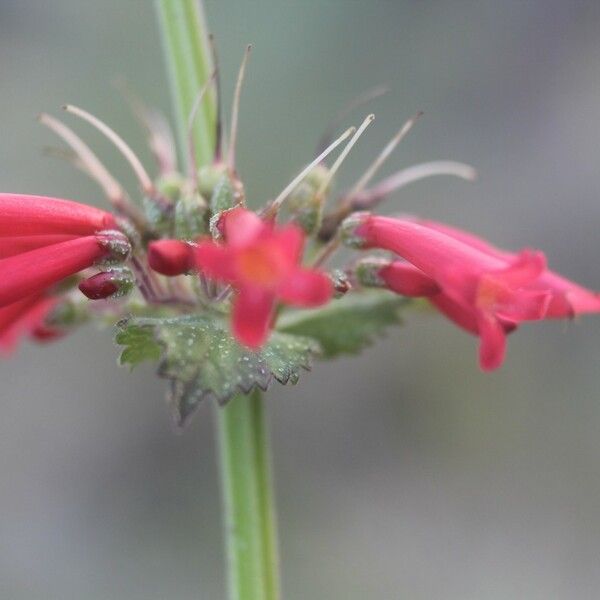
Often called the Leafy Firecracker, Russelia sarmentosa is the more robust, broad-leaved cousin of the common weeping firecracker fern. Native to the sun-drenched landscapes of Mexico and Central America, it acts as a living flare in the garden, sending out bursts of scarlet tubular flowers that look like miniature sticks of dynamite. It is a favorite for those wanting to add a tropical, "wild" flare to their landscape without the finicky nature of more delicate exotics.
🔍 How to Identify
- 🍃 Leaf Structure: Unlike its thin, needle-like relatives, this species sports lush, ovate green leaves with slightly serrated edges that grow in opposite pairs along its square-shaped stems.
- 🔥 Tubular Blooms: The flowers are vivid red or deep orange tubes, hanging in dense clusters (cymes) that can appear almost year-round in frost-free climates.
- 🌿 Growth Habit: It forms a rounded, bushy mound reaching about 3 to 6 feet in height. While its stems are more upright than the "weeping" varieties, they still arch gracefully under the weight of their blooms.
🏡 In Your Garden
- ☀️ Sun Seeker: This plant thrives on heat and light. It needs plenty of sunshine to produce its signature "explosive" blooming display; in too much shade, it becomes leggy and the flowers will be sparse.
- 🦋 The Pollinator Café: If you want a backyard full of life, this is your plant. The tubular shape and bright color of the flowers are perfectly evolved to attract hummingbirds and butterflies, who can easily reach the nectar hidden inside.
- 🪴 Drainage is Key: While it enjoys consistent moisture, it hates "wet feet." It is best planted in well-drained soil or in raised beds to prevent root rot during rainy seasons.
⚠️ Safety & Toxicity
- ✅ Safe Status: Russelia sarmentosa is generally considered non-toxic to humans and common household pets like cats and dogs.
- 🧤 General Caution: As with any garden plant, the sap can occasionally cause mild skin irritation for those with very sensitive skin. It is always a good practice to wear gloves when performing heavy pruning.
✨ Fun Fact
The genus was named by the famous scientist Linnaeus to honor Alexander Russell, an 18th-century Scottish physician and naturalist who wrote the first comprehensive natural history of Aleppo, Syria!

Detailed Care Instructions
To grow Russelia sarmentosa, commonly known as Firecracker plant or Coral fountain, follow these steps:
- Select a suitable planting location: Russelia sarmentosa thrives in full sun to partial shade. Choose a location that receives at least 6 hours of direct sunlight each day. Ensure the soil is well-draining to prevent waterlogged roots.
- Prepare the soil: Russelia sarmentosa prefers slightly acidic to neutral soil pH (around 6.0-7.0). Amend the soil with organic matter like compost or well-rotted manure to improve drainage and nutrient content.
- Plant the seedlings or cuttings: Russelia sarmentosa is normally propagated through stem cuttings or seeds. For stem cuttings, take a 3-4 inch stem cutting from a healthy plant and remove any lower leaves. Dip the cut end in rooting hormone and place it in a pot filled with moist, well-draining soil. Keep the soil consistently moist until new growth appears.
- Watering: Water the plant regularly but avoid overwatering. Russelia sarmentosa prefers slightly moist soil, so water when the top 1-2 inches of soil dries out. Once established, it is moderately drought-tolerant.
- Fertilizing: Feed the plant with a balanced, slow-release fertilizer in the spring and midsummer. Follow the package instructions for the appropriate dosage. Avoid overfertilizing, as it can lead to leggy growth and reduced flowering.
- Pruning: Russelia sarmentosa benefits from regular pruning to maintain its shape and promote bushier growth. Prune back any dead, damaged, or overgrown stems in late winter or early spring before new growth emerges.
- Pests and diseases: Firecracker plant is relatively pest and disease-resistant. However, keep an eye out for common garden pests like aphids, mealybugs, or whiteflies. Treat any infestations with appropriate organic or chemical pest control products.
- Provide support: Russelia sarmentosa has long, arching stems that benefit from support. Use stakes or trellises to provide support when necessary.
- Mulching: Apply a layer of organic mulch around the base of the plant to retain moisture, suppress weed growth, and regulate soil temperature.
- Winter care: In areas with frost or freezing temperatures, Russelia sarmentosa may be frost-sensitive. Protect the plant from extreme cold by covering it with frost cloth or moving potted plants indoors during winter.
By following these steps, you can successfully grow Russelia sarmentosa and enjoy its beautiful cascading, red tubular flowers.

Place in a bright room that is sun drenched almost all day. Or directly in a south-facing window.

To properly water this plant, you should first ensure that the soil is dry to the touch before watering. When you water, it's important to water deeply so that all of the roots are reached. This can be done by slowly pouring water over the soil until it begins to run out of the drainage holes in the bottom of the pot. After watering, make sure to allow the soil to drain completely before placing the pot back in its desired location. This plant prefers well-draining soil and may suffer if watered too frequently or if left in standing water.
To fertilize this particular plant, use a balanced fertilizer with equal amounts of nitrogen, phosphorus, and potassium. The fertilizer should be water-soluble and diluted according to the manufacturer's instructions. Apply the fertilizer every two weeks during the growing season, but reduce the frequency to once a month during winter or when the plant is dormant. Do not over-fertilize as it can burn the plant's roots and cause damage. Water the plant before and after fertilizing to prevent fertilizer burn.
Russelia Sarmentosa prefers a well-draining soil that is rich in organic matter and slightly acidic to neutral pH. It is best to use a soil mix that includes perlite or vermiculite to ensure good drainage. The soil should be kept evenly moist, but not waterlogged, as overwatering can lead to root rot. Adding a slow-release fertilizer to the soil once a year can also help promote healthy growth. It is important to avoid using heavy or compacted soils with this plant, as they can negatively affect its growth and health.
Russelia Sarmentosa plant can be propagated through stem cuttings. To do this, take a healthy stem from the plant that is about 4-6 inches long, and make a clean cutting at a 45-degree angle. Remove any leaves from the lower half of the stem.
Dip the cut end of the stem in rooting hormone powder and insert it into a pot filled with moist potting soil. Firmly press the soil around the stem to provide support.
Cover the pot with a plastic bag to create a humid environment, and place it in a bright area without direct sunlight. Keep the soil moist but not drenched. After several weeks, new growth should appear from the stem.
Once the new growth is established, remove the plastic cover and move the pot to a bright location with indirect sunlight. Gradually acclimate the plant to its new environment by increasing its exposure to sunlight over time.
As the new plant grows, it can be transplanted to a larger container or outside in the garden in well-draining soil.








