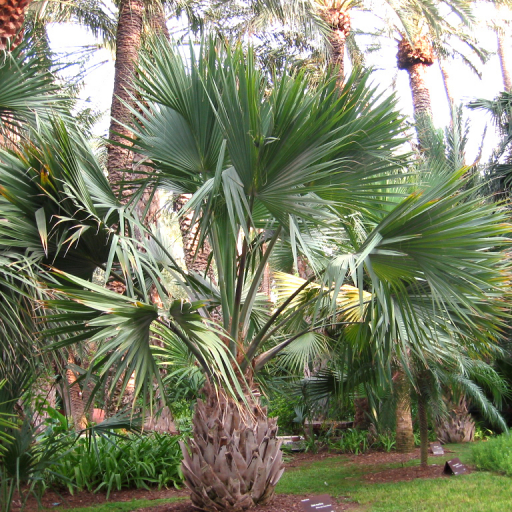
Plant Overview
Known as the "Old Palm" or "Palma Cana," the Sabal maritima is a majestic Caribbean native that brings an air of ancient tropical grandeur to any landscape. Found naturally in Cuba and Jamaica, this palm is often confused with its cousins but stands out due to its massive, robust trunk and stiff, crown-like canopy. It is a slow-growing survivor, often seen standing tall in coastal savannas where other trees might succumb to the salty breeze.
🔍 How to Identify
- 🌴 The Trunk: Unlike slender palms, this species develops a very thick, gray, and sturdy trunk that can reach up to 50 feet. In younger specimens, the trunk is often "booted" with old leaf bases, while older trees become smooth.
- 🍃 The Fronds: It features "costapalmate" leaves—a hybrid shape that looks like a giant fan with a distinct midrib curved down the center. The leaves are a deep, waxy green and can be remarkably large.
- 🍇 The Fruit: In late summer, it produces long, drooping clusters of small, pear-shaped black fruits (drupes) that are a favorite among local Caribbean bird populations.
🏡 In Your Garden
- 🏝️ Coastal Warrior: This palm is incredibly salt-tolerant, making it a perfect choice for beachfront properties where salt spray would wither more sensitive plants. It thrives in limestone-rich or sandy soils that mimic its island home.
- ⚓ The Deep Anchor: One of the most important things to know is that Sabal maritima develops a very deep, sensitive taproot. Because of this, it is notoriously difficult to transplant once established. Choose its "forever home" in your garden carefully, as moving it later often results in the palm failing.
- ☀️ Patience is Key: It is a slow grower. While it won't provide immediate shade, its longevity means it will likely outlive the gardener who plants it, becoming a permanent architectural fixture of the landscape.
⚠️ Safety & Toxicity
- ✅ Pet & Human Safe: The Sabal maritima is generally considered non-toxic to dogs, cats, and humans. It is a "friendly" palm in terms of chemistry.
- ✂️ Physical Hazards: The primary safety concern is physical. The edges of the fan fronds and the "teeth" on the leaf stems can be quite sharp and may cause scratches or skin irritation during pruning. Always wear gloves when handling fallen fronds.
✨ Fun Fact
In its native Caribbean islands, the Sabal maritima is known as the "Bull Thatch." For centuries, its exceptionally durable and water-resistant leaves have been the gold standard for traditional "thatching"—the art of weaving roofs for tropical huts that can withstand heavy tropical downpours.

Detailed Care Instructions
Growing Sabal maritima, commonly known as the Thatch Palm, requires understanding its natural habitat and mimicking those conditions as closely as possible. Here are some steps to help you successfully grow a Sabal maritima plant:
1. Climate Requirements
Sabal maritima is native to the Caribbean, where it thrives in warm and humid climates. It is not frost-tolerant, so it is best suited for USDA hardiness zones 10-11.
2. Soil Requirements
- Soil Type: This palm prefers well-drained, sandy soils but is quite adaptable and can tolerate a range of soil types including loamy or even rocky soils.
- pH: It can grow in a variety of pH levels but prefers slightly acidic to neutral soils (pH 6.0-7.0).
3. Sunlight
- Light Exposure: Full sun is ideal for optimal growth. The plant can tolerate partial shade but may not grow as vigorously.
4. Watering
- Water Needs: While Sabal maritima is somewhat drought-tolerant once established, keeping the soil consistently moist (but not waterlogged) will promote better growth, especially when the plant is young.
- Watering Schedule: Water regularly during the first few growing seasons to help establish a deep, extensive root system. Reduce frequency once the plant is mature.
5. Planting
- Seed Preparation: If starting from seed, soak the seeds in warm water for 24-48 hours to soften the hard seed coat, which aids germination.
- Planting Depth: Plant seeds just below the surface of the soil (about 1 inch deep).
- Transplanting: If transplanting from a container, dig a hole that is twice the diameter of the root ball and as deep. Place the plant in the hole and backfill with soil, firming it gently. Water thoroughly after planting.
6. Mulching and Fertilizing
- Mulch: Apply a layer of organic mulch around the base of the plant to help retain moisture and provide nutrients as it decomposes.
- Fertilizer: Use a balanced, slow-release palm fertilizer. Follow the manufacturer's directions for application rates and schedules. Generally, fertilize twice a year - once in early spring and once in late summer.
7. Maintenance
- Pruning: Minimal pruning is required. Remove dead or damaged fronds to maintain plant health and appearance.
- Pests and Diseases: Sabal maritima is relatively pest-free but occasionally check for common palm pests like scale, spider mites, or palm weevils and treat accordingly.
8. Propagation
- By Seed: The most common method of propagation is by planting seeds.
- By Division: It is less common to propagate by division as this palm does not typically produce offshoots or suckers.
9. Patience
- Growth Rate: Sabal maritima has a slow to moderate growth rate. It may take several years for the palm to reach a noticeable size, so patience is key.
By following these guidelines, you can create an environment that supports the growth and health of Sabal maritima. Remember that successful gardening also requires regular monitoring and adjustments based on the plant's performance and changing conditions.
To water this plant, first ensure that the soil is partially dry before watering. Overwatering can cause root rot, so it is important to not let the soil become too saturated. When watering, water thoroughly and deeply, making sure that the entire root ball is moistened. Allow any excess water to drain out of the pot or container. Watering frequency will vary depending on the climate and season, but typically this plant does well with consistent, moderate watering. Avoid letting the soil become bone-dry between watering sessions.
To properly fertilize your Sabal maritima, follow these guidelines:
Fertilizer Type
- Use a balanced, slow-release granular fertilizer. Look for one with an N-P-K ratio, such as 10-10-10 or 20-20-20. Add micronutrients if possible.
Timing
- Fertilize in the early spring and again in mid-summer. Avoid late-season fertilization to prevent stimulating new growth that could be damaged by cold weather.
Application
- Preparation: Ensure the soil is moist before applying fertilizer. Water the plant a day prior if necessary.
- Measure: Follow the instructions on the fertilizer package to measure the correct amount based on the plant's size and age.
- Spread: Evenly distribute the fertilizer around the base of the plant, staying about 6-12 inches away from the trunk to avoid root burn.
- Incorporate: Lightly rake the fertilizer into the top layer of soil. This helps nutrients reach the root zone more efficiently.
- Watering: Water thoroughly after applying the fertilizer to help dissolve it and wash it into the soil.
Additional Tips
- Avoid over-fertilizing as it can lead to nutrient imbalances and potential harm to the plant.
- Monitor the plant’s health and adjust future applications if necessary.
- Always follow the specific instructions provided by the fertilizer manufacturer for best results.
By following these steps, you'll provide your plant with the necessary nutrients to thrive.
The Sabal Maritima plant requires well-draining, nutrient-rich soil. A combination of sandy and loamy soils is ideal for this plant. The soil pH should be slightly acidic to neutral, with a range of 5.5 to 7 on the pH scale. It is recommended to amend the soil with organic matter, such as compost or manure, to promote healthy root growth. The plant prefers moist, but not waterlogged, soil and does not tolerate drought well. Therefore, regular watering is necessary, especially during hot and dry weather. It is also important to monitor the soil for any signs of nutrient deficiency and adjust the soil accordingly. Overall, choosing the right soil for the Sabal Maritima plant is essential for its growth and health.
To propagate Sabal maritima, you can follow these steps, focusing particularly on seed propagation, which is commonly used for this genus:
Seed Collection:
- Identify Mature Fruit: The seeds should be collected from mature fruits. The fruit typically turns dark brown to black when it is ready for harvesting.
- Cleaning the Seeds: Remove the fleshy outer layer of the fruit by soaking it in water to soften the pulp. Once softened, the pulp can be gently scrubbed off to reveal the seed inside.
Seed Preparation:
- Scarification: Although not always necessary, lightly scarifying the seeds by rubbing them with sandpaper can help water penetrate and facilitate faster germination.
- Soaking: Soak the seeds in water for about 24-48 hours to help soften the hard seed coat and speed up the germination process.
Germination:
- Soil Preparation: Prepare a well-draining potting mix. A mixture of 50% potting soil and 50% sand or perlite works well.
- Planting Depth: Plant the seeds about 1-inch deep in the soil mixture.
- Containers: Use small pots or seed trays with good drainage to start the seeds. Ensure the containers have drainage holes to prevent waterlogging.
- Watering: Keep the soil consistently moist but not waterlogged. Humidity and consistent moisture levels are crucial for successful germination.
Environmental Conditions:
- Light: Place the pots in a location with bright, indirect sunlight. Avoid direct, harsh sunlight, which can dry out the soil too quickly.
- Temperature: Maintain a warm environment with temperatures between 75-85°F (24-29°C). Higher temperatures within this range can promote faster germination.
Transplanting Seedlings:
- Germination Time: Germination may take several weeks to a few months. Be patient and maintain consistent care.
- Seedling Care: Once the seedlings emerge, continue to provide ample light and keep the soil moist.
- Transplanting: When the seedlings have developed a few sets of true leaves and are large enough to handle, they can be transplanted to larger containers or directly into the ground in a suitable, well-draining location.
Long-term Care:
- Soil: Transplant into soil that is sandy or loamy and well-draining. Amending your planting site with organic matter can help improve soil structure.
- Watering: Once established, these plants are relatively drought-tolerant but will benefit from regular watering, particularly during dry periods.
- Protection: Protect young plants from strong winds and harsh conditions until they are well established.
Tips:
- Patience is key. Seed germination can be slow, and initial growth is often gradual.
- Ensure the planting site or pot is large enough to accommodate the mature size of the plant.
- Regularly check for pests and diseases and treat them promptly.
By following these detailed steps, you can successfully propagate Sabal maritima from seeds and nurture it into a mature plant.








