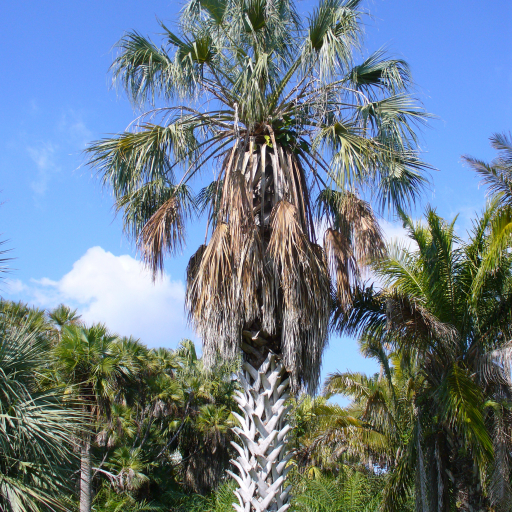
Plant Overview
Often called the Sonoran Blue Palmetto, this striking palm is a desert aristocrat. Hailing from the rugged canyons of Sonora, Mexico, it is famous for its ethereal, silvery-blue foliage that seems to glow under the harsh sun. Unlike many of its moisture-loving tropical cousins, this palm is built for the heat, making it a rugged yet elegant centerpiece for xeric (water-wise) landscapes.
🔍 How to Identify
- 🩵 Silvery Fronds: The most defining feature is the color; the leaves are a distinct metallic blue-grey or silver, especially on younger specimens.
- 🖐️ Costapalmate Leaves: These are "fan-shaped" but with a twist—the midrib extends into the leaf, causing it to arch gracefully and look slightly folded.
- 🐘 Massive Trunk: As it matures, it develops a thick, sturdy trunk that is grey and relatively smooth, though it may retain some old leaf bases near the top.
🏡 In Your Garden
- ☀️ The Blue Factor: To maintain that signature silver-blue hue, this palm needs full, intense sun. In the shade, the leaves may turn a duller green as the protective waxy coating thins.
- 🏜️ Deep Roots: Like many desert dwellers, it develops a deep taproot early on. It is notoriously difficult to transplant once established, so choose its "forever home" in your garden carefully.
- 💧 Establishment Phase: While extremely drought-tolerant once mature, it appreciates regular deep watering during its first few years to help it build the strength needed to survive desert conditions.
⚠️ Safety & Toxicity
- ✅ Safe for Pets: The Sabal uresana is generally considered non-toxic to dogs, cats, and horses.
- 🌵 Physical Hazards: While it doesn't have "thorns" like a cactus, the leaf stems (petioles) are very stiff and the leaf edges can be sharp. Wear sturdy gloves when pruning dead fronds to avoid "paper cuts" from the foliage.
✨ Fun Fact
The stunning blue color isn't just for show—it is actually a thick layer of epicuticular wax. This wax acts like a high-SPF sunscreen, reflecting intense UV rays and sealing in moisture to help the palm survive the blistering heat of the Mexican desert.

Detailed Care Instructions
To grow Sabal uresana, also known as Sonoran palmetto or Sinaloa palmetto, follow these guidelines:
- Climate: Sabal uresana is native to desert regions of northwestern Mexico, such as the Sonoran Desert. It thrives in hot, dry climates. Ensure that your climate matches these conditions before attempting to grow this plant.
- Soil: The plant prefers well-draining soil with sandy or loamy composition. Make sure the soil is not too clayey and does not retain excessive moisture, as this can lead to root rot.
- Sunlight: Sabal uresana requires full sun exposure for at least 6-8 hours a day. Choose a location in your garden that receives ample sunlight.
- Planting: Dig a hole twice as wide and deep as the plant's root ball. Place the plant carefully into the hole and backfill with soil, gently firming it around the roots. Water thoroughly after planting.
- Watering: While Sabal uresana is drought-tolerant, watering is crucial during the establishment period. Provide regular deep watering, allowing the soil to dry out slightly between watering sessions. Once the plant is established, it can handle long dry periods but will benefit from occasional watering during prolonged droughts.
- Mulching: Apply a layer of organic mulch, such as wood chips or compost, around the base of the plant to help retain soil moisture, regulate temperature, and suppress weed growth.
- Fertilizer: Sabal uresana does not typically require heavy fertilization. However, you can apply a balanced slow-release fertilizer in early spring to provide some nutrients to the plant.
- Pruning: Prune any dead or damaged leaves as needed. Avoid excessive pruning, as this plant naturally develops a bushy appearance and requires its leaves for photosynthesis.
- Protection: During cold winters or frost episodes, protect the plant with frost cloth or blankets to prevent damage.
Remember, growing Sabal uresana successfully depends on mimicking its natural habitat. Always consider your local climate and conditions to provide the best care for this plant.
Sabal Uresana is a type of plant that requires regular watering in order to survive. It is important to water this plant deeply in order to ensure that the roots are receiving enough moisture. When watering, it is best to do so at the base of the plant, directly into the soil. Avoid getting the leaves and stems of the plant wet, as this can lead to disease and other issues. The frequency of watering will depend on a variety of factors, such as the climate, the type of soil the plant is in, and the amount of sunlight it receives. In general, it is best to water Sabal Uresana once a week or whenever the soil feels dry to the touch. Overwatering can lead to root rot, so be sure to allow the soil to dry out slightly between waterings.
First, choose a slow-release, balanced fertilizer with a N-P-K ratio of 15-15-15 or 20-20-20. Apply the fertilizer once every three to four months during the growing season. Sprinkle the granules around the base of the plant, avoiding contact with the leaves or stem. Water thoroughly after fertilizing to ensure absorption of the nutrients into the soil. Finally, monitor the plant's growth and adjust the fertilization schedule as needed.
The recommended soil for this plant is one that is well-draining and nutrient-rich. It should have a pH level that falls within the slightly acidic to slightly alkaline range (6.0 to 7.5). The soil should be a mixture of organic matter such as compost, peat moss, or well-rotted manure, and an inorganic component such as sand, perlite, or vermiculite to improve aeration and drainage. It is also recommended to add a slow-release fertilizer to the soil at the time of planting. When choosing soil for this plant, it is important to avoid soils that are heavy, compacted, or prone to waterlogging, as well as those that are too alkaline or too acidic.
Sabal Uresana is a type of plant that can be propagated through several methods. Here are some ways that you can propagate this plant:
- Seeds: Sabal Uresana produces seeds in the fall. After the seeds are harvested, they can be cleaned, soaked for 24 hours, and then planted in a seed tray or pot. The seeds need to be kept moist at all times and should germinate in about three to four weeks.
- Division: Sabal Uresana can be propagated through division. This is done by removing a portion of the plant with roots and planting it in a new pot or in the ground. This method is best done during the spring or fall.
- Cuttings: Sabal Uresana can also be propagated through cuttings. Take a cutting from an established plant and remove the lower leaves. Plant the cutting in a pot with well-draining soil and water it regularly. The cutting should root within a month.
Regardless of the propagation method you choose, make sure to keep the plant in moist soil and in a warm, protected area until it is established.








