Plant Overview
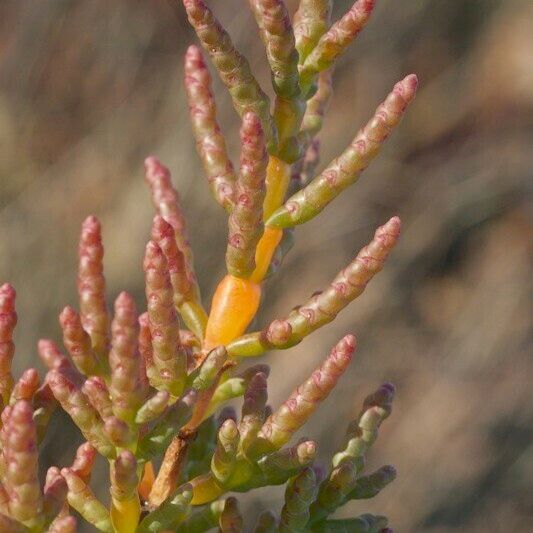
Often called "Sea Asparagus" or "Glasswort," Salicornia disarticulata is a fascinating survivor of the coastal salt marshes. While it looks like a collection of tiny, succulent sausages stacked on top of one another, it is actually a highly specialized flowering plant. It is famously known as "Glasswort" because its mineral-rich ashes were once a crucial ingredient in the historical production of high-quality glass.
🔍 How to Identify
- 🌵 Segmented Stems: The plant consists of fleshy, leafless, bright green cylinders that look like miniature, translucent beads joined together.
- 📍 Disarticulating Spikes: The name "disarticulata" refers to its unique habit where the flowering spikes break apart easily at the joints when the plant reaches maturity.
- 🎨 Seasonal Color: While it spends the summer in vibrant shades of lime green, the entire plant often blushes into deep yellows or burnt reds as autumn approaches.
🌊 Habitat & Ecology
- 🧂 Salt Specialist: This is a "halophyte," meaning it thrives in environments that would kill most other plants. It is typically found in the upper reaches of salt marshes where it is occasionally submerged by the tide.
- 🦀 Coastal Guardian: In its natural habitat, it acts as a pioneer species, helping to trap silt and stabilize muddy shorelines, which provides a nursery for small crabs and coastal insects.
⚠️ Safety & Toxicity
- 🍽️ Status: Edible and considered a gourmet delicacy. It has a salty, crisp texture similar to young asparagus and is often served with seafood.
- 🐶 Pet Note: While the plant itself is not poisonous, its extremely high salt concentration can be dangerous for cats and dogs if consumed in large quantities, leading to salt toxicity.
- ☣️ Foraging Caution: Because Glasswort grows in coastal runoff areas, it can accumulate heavy metals or pollutants from the water. Only consume specimens harvested from clean, unpolluted shorelines.
✨ Fun Fact
In the 16th century, Glasswort was burned in large heaps to produce "soda ash." This ash was then melted with silica (sand) to create the first truly clear glass windows in Europe—hence the name "Glass-wort" (Glass-plant).

Detailed Care Instructions








