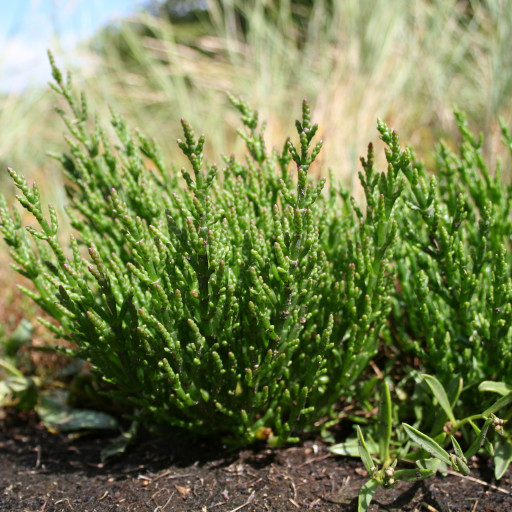
Plant Overview
Known by the charming nicknames "Sea Beans," "Marsh Samphire," or "Crow’s Foot," the Salicornia europaea is a coastal survivor that looks like a miniature, spineless cactus. For centuries, it was a vital resource for glassmakers who burned it to extract soda ash, giving it the enduring name "Glasswort." Today, it is more famous as a gourmet "sea vegetable," prized by chefs for its naturally salty, crunchy snap.
🔍 How to Identify
- 🌵 The Stems: It features distinctive, fleshy, jointed stems that look like tiny interconnected sausages or green coral.
- 🍃 Hidden Leaves: You won’t see typical broad leaves; instead, they are reduced to tiny, inconspicuous scales at each joint, giving the plant a smooth, succulent appearance.
- 🎨 Color Transitions: While it spends the summer a vibrant, translucent green, the entire plant often flushes a dramatic crimson or deep purple as autumn approaches.
🏡 In Your Garden & Nature
- 🌊 The Salt Lover: This is a "halophyte," meaning it thrives in salty conditions that would kill most other plants. If you try to grow it at home, it requires very sandy, well-draining soil and literally needs to be "watered" with a saline solution occasionally to mimic the tide.
- 🦀 Coastal Protector: In the wild, it acts as a pioneer species. It stabilizes mudflats and salt marshes, trapping sediment and building up land so that other less-hardy plants can eventually take root.
⚠️ Safety & Toxicity
- 🥗 Status: Edible and highly nutritious for humans, often compared to salty asparagus.
- 🧪 Environmental Warning: Because it is a bio-accumulator, you should never forage it from areas near industrial runoff or polluted harbors. It can soak up heavy metals from the water, making those specific wild patches unsafe to eat.
- 🐾 Pets: It is generally non-toxic to pets, though the high salt content can cause stomach upset if a dog or cat consumes a large amount.
✨ Fun Fact
In the 18th century, the ash from burned Glasswort was so essential for making high-quality glass and soap that it was a major item of trade; glassmakers would specifically set up shop near coastal marshes just to be close to their "green gold" supply.

Detailed Care Instructions
| Humidity | Normal |
| Difficulty | Medium |
| Hardiness Zones | Min 8A |
To grow Salicornia Europaea, also known as sea asparagus or marsh samphire, you will need to follow these steps:
- Choose a suitable location: Salicornia Europaea is a halophyte, meaning it thrives in salty environments. It can be grown in coastal areas or in areas with high salt content in the soil. Ensure the location receives full sun exposure.
- Prepare the soil: Salicornia Europaea prefers well-drained soil that is rich in organic matter. If your soil is heavy clay or doesn't drain well, you can improve it by adding compost or sand to enhance drainage.
- Obtain seeds or seedlings: Salicornia Europaea can be grown from seeds or purchased as seedlings from a nursery. If starting from seeds, you can sow them directly into the soil or start them indoors before transplanting.
- Planting: If planting seeds directly, scatter them on the soil surface or press lightly into the soil. Cover them lightly with a thin layer of soil or sand. If using seedlings, dig small holes and gently place them in the holes at the appropriate spacing, usually about 30-45 cm (12-18 inches) apart.
- Watering: Salicornia Europaea is tolerant of saltwater, so regular watering is not necessary. However, if you live in an area with low rainfall or have dry conditions, you may need to supplement with occasional watering to keep the soil moist.
- Saltwater irrigation: Salicornia Europaea thrives in salty conditions, so it benefits from occasional saltwater irrigation. If you live near the coast, you can collect seawater and use it to water the plants occasionally. Avoid over-watering or water logging as it can lead to root rot.
- Weed control: Keep the area around the Salicornia Europaea plants free from weeds, as they can choke the growth. Regular weeding or the use of organic mulch can help in weed control.
- Harvesting: Salicornia Europaea can be harvested when the plants reach a suitable size, usually around 20-30 cm (8-12 inches) tall. Cut the stems or pinch off the tender young shoots. Harvesting encourages branching and new growth.
By following these steps, you can successfully grow Salicornia Europaea and enjoy its unique, salty flavor in your culinary endeavors.

Place in a bright room that is sun drenched almost all day. Or directly in a south-facing window.

Watering this plant species entails providing it with a sufficient amount of moisture regularly, but not excessively. The soil should be kept evenly moist, never allowing it to dry out completely or remain waterlogged. Watering the plant deeply once a week during the active growing period is recommended, while reducing watering during the dormant period. It should be noted that this plant is tolerant of high salinity levels, so the irrigation water does not need to be fresh. Therefore, using saline water or seawater for irrigation may be suitable for this plant species. Additionally, it is important to avoid watering the foliage as this may cause waterlogging and promote the growth of fungal diseases.
To fertilize this plant, apply a slow-release fertilizer once every two months during the growing season, which typically occurs from spring to early fall. Apply the fertilizer sparingly to avoid burning the plant. Be sure to water the plant well after fertilizing.
Salicornia Europaea is a type of halophyte plant that is adapted to grow in saline soils, meaning soils with high levels of salt. Therefore, it is important to use a soil that is suitable for its needs. The ideal soil for Salicornia Europaea is one that is well-drained, sandy, and contains high levels of organic matter. This type of soil allows for proper root development and helps to prevent waterlogging, which can be detrimental to the plant's growth. It is also recommended to use a soil that has a neutral to slightly alkaline pH, as Salicornia Europaea does not typically grow well in highly acidic soils. Additionally, the soil should be enriched with the proper nutrients, such as nitrogen, phosphorus, and potassium, in order to promote healthy growth and development. Overall, the key to successful cultivation of Salicornia Europaea is to provide it with the proper soil conditions that are specifically tailored to its unique needs as a halophyte plant.
Propagation of a certain plant can be done by collecting its mature seeds and sowing them in well-drained soil. The seeds require consistent moisture and sunlight to germinate and can take up to several weeks to sprout. Alternatively, stem cuttings can also be used for propagation. The stem should be cut from a healthy and mature plant, and then dipped in rooting hormone powder. The stem cutting should be planted in soil and kept in a moist environment until it forms roots and begins to grow. Both methods require a suitable growing environment such as a greenhouse, nursery, or outdoor garden with ample sunlight and water.








