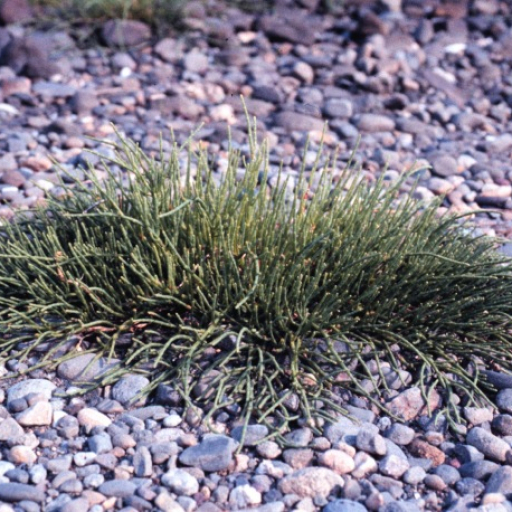
Plant Overview
Known as the "Pickleweed" or "Virginia Glasswort," Salicornia virginica is a succulent marvel that thrives where most plants wither: the salty, soggy edges of the sea. These curious, crunchy stalks have been a coastal delicacy for centuries, often appearing on gourmet menus today as "Sea Beans." Historically, they were a vital resource for early settlers, serving as both a source of nutrition and a key ingredient in industrial glassmaking.
🔍 How to Identify
- 🌵 The Stem: Look for fleshy, jointed segments that look like tiny, translucent green sausages or asparagus tips stacked on top of each other.
- 🍃 Hidden Leaves: The leaves are so incredibly small they appear as tiny scales at each joint, giving the plant a "leafless" and smooth appearance.
- 🎨 Seasonal Color: While vibrant green during the growing season, the plant undergoes a dramatic transformation in the fall, blushing into a deep crimson or ruby red.
🏡 In Your Garden
- 🌊 The Salt Factor: This is a "halophyte," meaning it is a salt-lover. If you are trying to grow it away from the coast, it actually requires saline soil to thrive and will struggle in standard potting mixes that lack minerals.
- 💧 Wet Feet: Unlike desert succulents that demand drainage, Pickleweed loves to be soaked. It naturally grows in salt marshes and estuaries, making it a perfect candidate for a coastal rain garden or a specialized "bog" container.
⚠️ Safety & Toxicity
- 🍴 Status: Edible and highly nutritious for humans. It has a naturally salty, "oceanic" crunch that mimics a fresh pickle or snap pea.
- 🐾 Pets & Kids: It is non-toxic. However, because the plant bio-accumulates salt, it should not be fed in large quantities to pets with kidney issues.
- 🧼 Harvesting Tip: If foraging or gardening, always wash the stalks thoroughly to remove the fine silt and sand that often clings to the segments.
✨ Fun Fact
The name "Glasswort" comes from the 16th century, when the plant was harvested in massive quantities and burned. Its ashes produced "soda ash," a critical ingredient used by glassblowers to lower the melting point of silica, helping create the world's first clear glass windows.

Detailed Care Instructions
To grow Salicornia Virginica plants, also known as pickleweed, you can follow these steps:
- Obtain Salicornia Virginica seeds or seedlings: You can find seeds or seedlings online or at a local nursery that specializes in native plants or aquatic plants.
- Choose a suitable location: Salicornia Virginica is a salt-tolerant plant that thrives in coastal areas and salt marshes. If you are not located near the coast, you can still grow it in a well-drained soil mix with added sea salt or salty water.
- Prepare the soil: Salicornia Virginica prefers sandy or loamy soil. If the soil is heavy or clay-like, incorporate organic matter such as compost or sand to improve drainage.
- Sow the seeds or plant the seedlings: If using seeds, sow them directly into the soil. They require light for germination, so do not cover them with soil. If using seedlings, gently transplant them into the prepared soil, ensuring that they are planted at the same depth as they were in their original container.
- Watering: Salicornia Virginica prefers moist soils but can tolerate seawater flooding. Water regularly to keep the soil moist, but avoid overwatering as it may lead to root rot.
- Provide sufficient sunlight: Salicornia Virginica thrives in full sun. Ensure that the plants receive at least 6-8 hours of direct sunlight each day.
- Control weeds: Keep the area around the plants free from weeds to prevent competition for nutrients and space.
- Harvesting: Salicornia Virginica can be harvested once it reaches a reasonable size, usually 2-3 months after sowing or planting. Harvest by cutting the stems close to the ground. The stems can be used fresh in salads, pickled, or cooked.
- Winter care: Salicornia Virginica is an annual plant that typically dies back in colder climates. In milder climates, it may survive as a perennial. If you live in a colder region, you can collect seeds from mature plants before they die and store them for the next growing season.
Remember to follow any specific instructions that come with the seeds or seedlings you acquire, as different cultivars may have slightly different care requirements.
Salicornia virginica is a halophytic plant that grows in saline environments, such as marshes, estuaries, and sandy beaches. As a result, its water requirements are unique and cannot be met through traditional watering practices.
To water Salicornia virginica, one must be mindful of its salt intake. The plant naturally absorbs salts from its environment, which can affect the quality of its growth if not controlled. Therefore, it is recommended to use saltwater to irrigate Salicornia virginica.
This can be achieved by collecting seawater and mixing it with freshwater to achieve the desired salinity. The recommended salinity level should be similar to the natural habitat of Salicornia virginica, which is around 10-20 ppt (parts per thousand).
Once the water is prepared, it should be distributed evenly to the base of the plant to avoid splashing saltwater onto the leaves. The plant's growth cycle, how often it needs to be watered, and the amount of water required will depend on external factors such as environmental temperature, humidity, and soil composition.
In conclusion, Salicornia virginica is a unique plant that requires a specific type of watering. Using saltwater to irrigate Salicornia virginica will benefit its growth, but the quality of the water must be monitored to prevent overexposure to salts.
- Begin fertilizing Salicornia Virginica once it has established roots and started to grow.
- Use a balanced fertilizer with equal amounts of nitrogen, phosphorus, and potassium.
- Apply the fertilizer sparingly, following the manufacturer's instructions for the appropriate amount per plant.
- Water the plant after fertilizing to help the nutrients absorb properly.
- Monitor the plant for signs of over-fertilization, such as yellowing or browning of the leaves, and adjust the fertilizer accordingly.
Salicornia Virginica is a type of halophyte plant that grows well in soil with high salt content. As a result, it is best to use soil that has a high saline concentration. Such soils can be found in marshy areas near the coast, estuaries, and other areas with high levels of salt. In addition, the soil should be well-draining and able to retain moisture, as the plant requires a lot of water to grow. It is important to avoid using soil that contains too much sand, as this can cause the plant to dry out and die. Ideally, the soil should also be enriched with organic matter and nutrients to promote healthy growth and ensure that the plant has access to all the necessary nutrients required for survival. When planting Salicornia Virginica, it is important to ensure that the roots are properly established in the soil and that the plant is watered regularly to ensure that it stays healthy and robust.
Salicornia Virginica plant can be propagated by taking stem cuttings from mature plants. Here are the steps for propagation:
- Choose a healthy mature plant that has strong stems and leaves.
- Using a sharp and clean pair of scissors or pruning shears, cut a stem from the plant that is about 3-4 inches long. Make sure that the stem has at least two sets of leaves.
- Remove the leaves from the lower half of the stem, leaving only two sets of leaves at the top.
- Dip the cut end of the stem into rooting hormone powder to encourage root growth.
- Fill a small pot with a well-draining potting soil and make a hole in the center.
- Place the stem cutting into the hole and gently press the soil around the stem.
- Water the plant thoroughly and place it in a warm and bright location, but not in direct sunlight.
- Keep the soil moist but not too wet and monitor the plant for signs of growth.
- Once the new plant has established roots and started to grow, it can be transplanted into a larger pot or into the ground if desired.
Remember to give the new plant plenty of care and attention until it is fully established and thriving.








