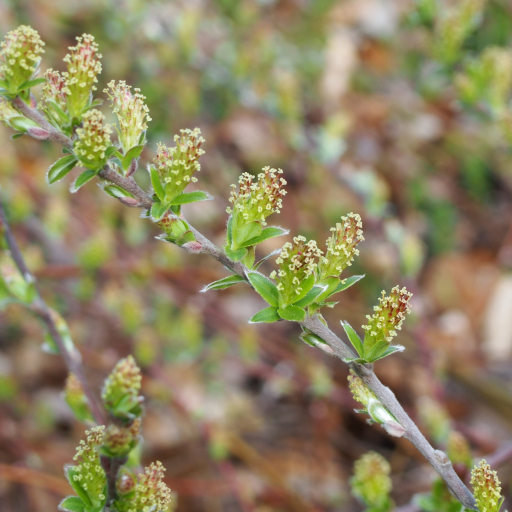
Plant Overview
Known as the "Mountain Mat-Maker," Salix alpina is a tiny titan of the high altitudes. Unlike the weeping giants we see in lowland parks, this willow stays pinned to the earth to survive the brutal winds of the European Alps and Pyrenees. It is a favorite for alpine enthusiasts and rock gardeners who want to capture the rugged beauty of a mountain summit in a miniature form.
🔍 How to Identify
- 🏔️ Prostrate Growth: It forms a dense, creeping carpet that rarely rises more than 2 to 4 inches off the ground, essentially acting as a woody groundcover.
- 🍃 Glossy Foliage: The leaves are small, oval, and surprisingly shiny. They have a leathery texture that helps the plant retain moisture against high-altitude UV rays.
- 🐑 Upright Catkins: In late spring, it produces fuzzy, silvery-yellow catkins that stand vertically like tiny, soft candles against the green mat.
🏡 In Your Garden
- 🪨 The Rock Star: This plant thrives in "scree" conditions—think gravel, crushed stone, and high drainage. It is perfect for tucking into crevices between large stones where its roots can stay cool and moist.
- ❄️ Climate Sensitivity: While it is incredibly cold-hardy, it struggles in hot, humid climates. It prefers "moving" water (well-drained but consistent) rather than standing in heavy, wet clay.
⚠️ Safety & Toxicity
- 🐾 Safe Status: Salix alpina is generally considered non-toxic to humans, cats, and dogs.
- 💊 Salicin Content: Like all members of the willow family, the bark contains salicin (the natural precursor to aspirin). While it isn't "poisonous," chewing on the woody stems in large quantities could cause a mild stomach upset in curious pets.
✨ Fun Fact
Despite being a "tree" in a biological sense (it has a woody trunk and branches), an Salix alpina specimen that is 50 years old might still be less than 3 inches tall! It is a master of "extreme dwarfism," proving that you don't need height to be a survivor.

Detailed Care Instructions

Place in a bright room that is sun drenched almost all day. Or directly in a south-facing window.

When the top few inches of soil dry out, water your plants. If the top few inches of soil are still moist, do not water your plant. Wait a few days, then poke your finger into the soil to see if anything has changed. Overwatering poses a disease risk, such as the development of fungal diseases in the roots. These plants have adaptations in there leaves that allow them to survive in low water supply.








